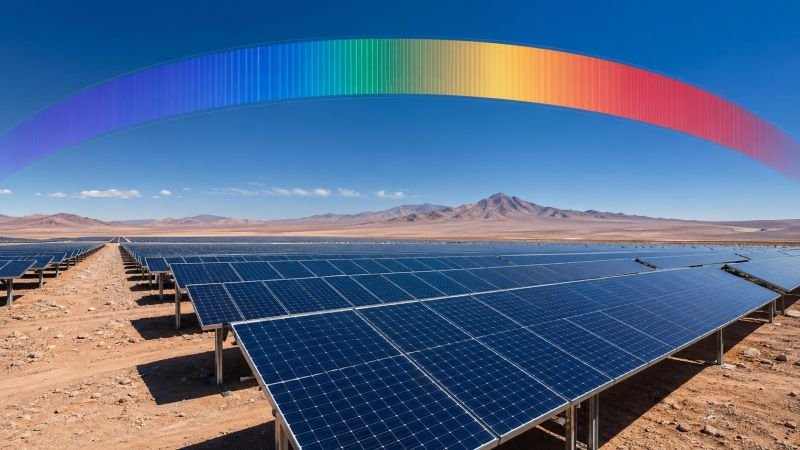





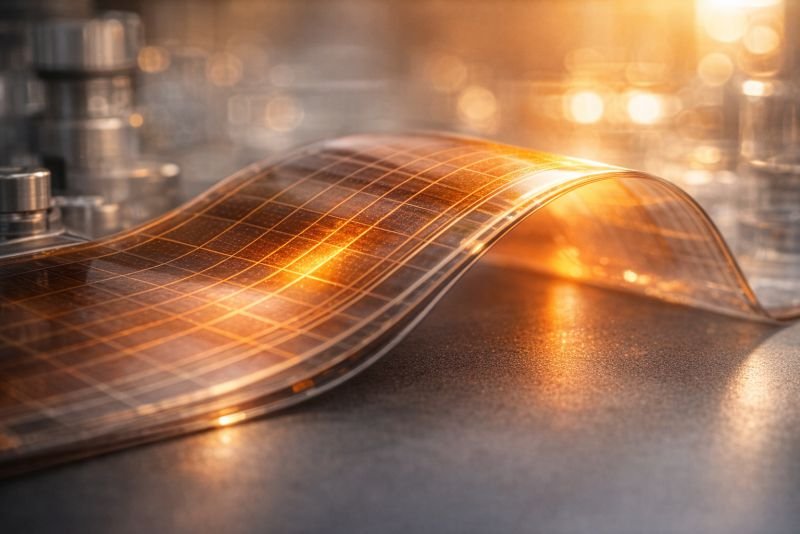
There is a glass building in Freiburg, Germany where the windows generate electricity. Not through silicon panels bolted to the roof, but through the glass itself, coated in a thin organic layer that absorbs light and produces current. The coating is slightly tinted. It lets diffuse light through. And it is, in most of the ways that matter, a solar cell made from carbon compounds rather than refined silicon wafers. Most people walk past it without registering what they are looking at.
The short version: Organic photovoltaics use carbon-based molecules, sometimes including polymers similar to plastics, to convert sunlight into electrical current. The process works through a different mechanism than silicon solar cells, relying on molecular excitons rather than free electrons. Current efficiency in the best laboratory cells reaches 19 percent, lower than silicon’s 22 to 25 percent, but organic cells can be printed onto flexible substrates at very low cost, integrated into windows, fabrics, and curved surfaces, and manufactured without the energy-intensive purification process that silicon requires.
The question the building in Freiburg raises is not whether this technology works. It clearly does. The real question is why, given how much organic photovoltaics can do that silicon cannot, the technology has spent forty years being described as “promising.”
The answer is in the physics.
Table of Contents
How Organic Photovoltaics Absorb Light Differently
Silicon solar cells and organic solar cells both absorb photons. What happens after absorption is completely different, and that difference shapes every engineering challenge in the field.
In a conventional silicon cell, a photon striking the semiconductor immediately liberates a free electron. The electron moves through the material and into the circuit without needing a partner. The process is direct. A photon arrives, a charge departs.
Organic photovoltaics do not work this way. When a photon strikes an organic semiconductor, it creates a bound electron-hole pair called an exciton. The electron and hole are attracted to each other by electrostatic force and travel together as a unit. They do not spontaneously separate. For the cell to produce current, something must pull them apart before they recombine and release the absorbed energy as heat or light rather than electricity.
This distinction matters enormously. In silicon, the dielectric constant of the material is high enough that the electron-hole attraction is weak, and thermal energy at room temperature is sufficient to separate them. In organic materials, the dielectric constant is much lower, around 3 to 4 compared to silicon’s 11.7. The exciton binding energy in organic semiconductors is typically 0.3 to 1.0 electronvolts. Thermal energy at room temperature provides only about 0.025 electronvolts. The exciton is not going to separate on its own.
This is the central physical constraint of organic photovoltaics. Every architectural decision in cell design is a response to it.
The Donor-Acceptor Junction: Where Excitons Split
The solution to the exciton problem is an interface. If two organic materials with different electron affinities are placed in contact, a junction forms between them where the energy difference is large enough to pull the exciton apart. One material is called the donor, the other the acceptor.
When an exciton reaches this junction, the energy difference drives the electron into the acceptor material and leaves the hole behind in the donor. The two charges are now separated and can move independently toward their respective electrodes.
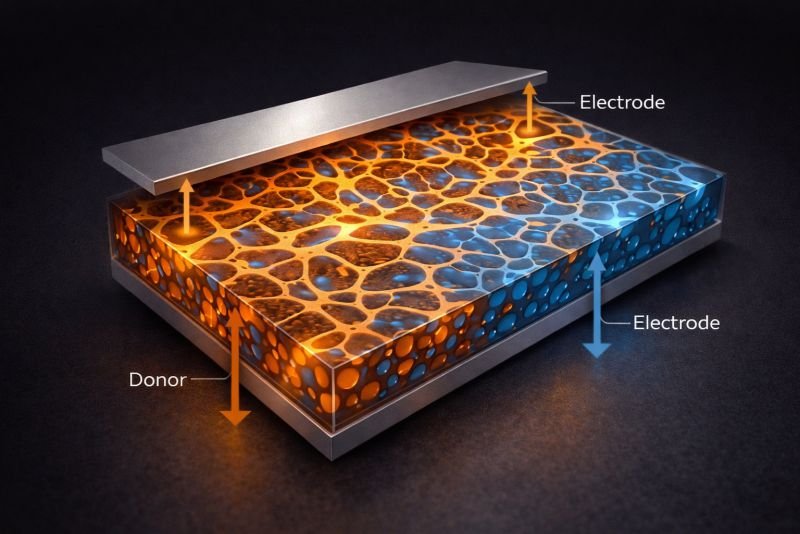
The critical number here is the exciton diffusion length. In most organic semiconductors, excitons can travel only 5 to 20 nanometres before they recombine. If the donor-acceptor junction is further away than that, the exciton dies before reaching it and produces no current. This means the active layer of an organic cell cannot simply be a thick slab of material. The junction must be everywhere, or almost everywhere, within the film.
Early organic cells used a flat bilayer architecture, one layer of donor on top of one layer of acceptor. The junction was a single plane. The result was predictable: most excitons recombined before reaching it, and efficiency was poor. The architecture was physically correct in principle but geometrically wrong in practice.
The solution that transformed the field was the bulk heterojunction, introduced in the 1990s. By blending donor and acceptor materials together into an interpenetrating network, the junction becomes distributed throughout the entire active layer. No exciton is ever more than a few nanometres from an interface. Efficiency improved immediately and substantially.
The Power Conversion Efficiency Formula
How much electricity can an organic cell actually produce from incoming sunlight? The answer comes from the power conversion efficiency, or PCE, which relates the electrical power output of the cell to the solar power incident on it.
The formula is:
PCE = (Jsc x Voc x FF) / Pin
Where Jsc is the short-circuit current density in milliamps per square centimetre, Voc is the open-circuit voltage in volts, FF is the fill factor (a dimensionless number between 0 and 1 describing how square the current-voltage curve is), and Pin is the incident light power density, standardised at 100 milliwatts per square centimetre for AM1.5 sunlight.
Working through a real example: a well-engineered organic cell might achieve a Jsc of 18 mA/cm2, a Voc of 0.85 V, and a fill factor of 0.72. Substituting these values:
PCE = (18 x 0.85 x 0.72) / 100 = 11.0 / 100 = 0.11, or 11 percent.
That number is not a disaster. It is not silicon’s 22 percent either. The gap exists because each of those three parameters faces specific physical constraints in organic materials: the current density is limited by the absorption spectrum of the organic semiconductors, the open-circuit voltage is limited by the energy offset required at the donor-acceptor junction to split excitons, and the fill factor is limited by charge carrier mobility in the organic films. Each constraint is a separate engineering problem. In the best laboratory cells today, combining near-infrared absorbing non-fullerene acceptors with optimised morphology control, PCE reaches 19 percent. That is not so far from silicon.
What Organic Semiconductors Are Actually Made Of
The word “plastic” in the context of organic solar cells is both accurate and misleading. It is accurate because many of the materials are indeed carbon-based polymers, processed from solution. It is misleading because it implies something cheap and simple, when the molecules involved are architecturally sophisticated.
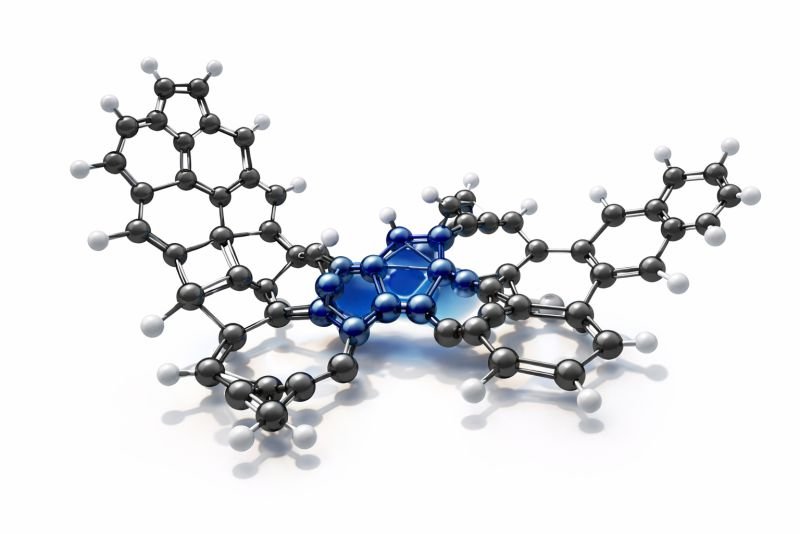
The earliest organic photovoltaic materials were small molecules, things like copper phthalocyanine, which is also the blue pigment in some paints. These absorb light well but have limited solubility and narrow absorption spectra.
Conjugated polymers changed the picture. In these materials, alternating single and double bonds along the polymer backbone create a continuous system of delocalised electrons that can absorb photons and transport charge. The absorption spectrum can be tuned by adjusting the chemical structure of the polymer, pushing it toward red or infrared wavelengths by introducing electron-donating or electron-withdrawing groups at specific positions along the chain.
For decades, the standard acceptor material was a fullerene derivative called PCBM, a modified version of the carbon-60 buckyball. Fullerenes accept electrons easily and have good electron mobility, but they absorb very little visible light and add limited photocurrent to the cell.
The shift that drove efficiency past 15 percent was the development of non-fullerene acceptors, particularly a family of molecules known as ITIC and its descendants. These molecules absorb light strongly, have tunable energy levels, and can be matched precisely to polymer donors to optimise the energy difference at the junction. The result is a cell where both the donor and acceptor contribute meaningfully to light absorption.
| Material Generation | Example | Typical PCE Range | Key Limitation |
|---|---|---|---|
| Early small molecules | Copper phthalocyanine | 1-3% | Narrow absorption, flat bilayer |
| Conjugated polymers + fullerenes | P3HT : PCBM | 3-6% | Fullerene absorbs little light |
| Low-bandgap polymers + fullerenes | PTB7 : PC71BM | 7-10% | Fullerene energy mismatch |
| Non-fullerene acceptors | PM6 : Y6 | 15-19% | Morphology stability |
The progression is not linear luck. Each step solved a specific physical problem that the previous generation had exposed.
Everything here is free. Readers are the reason it stays that way.
I make all of it alone, with no ads. If it is worth a coffee a month to you, that keeps the next one coming.
Keep it alive →Charge Transport and the Morphology Problem
Splitting the exciton at the donor-acceptor junction is only half the job. The separated charges then have to travel to their respective electrodes without recombining. In organic materials, this transport is slow.
Silicon has electron mobility of around 1,400 cm2/V-s. The best organic semiconductors reach 10 to 20 cm2/V-s in ideal conditions, and typical bulk heterojunction films used in real cells operate at 0.01 to 0.1 cm2/V-s. Lower mobility means charges take longer to reach the electrodes, which means more time to encounter a recombination partner.
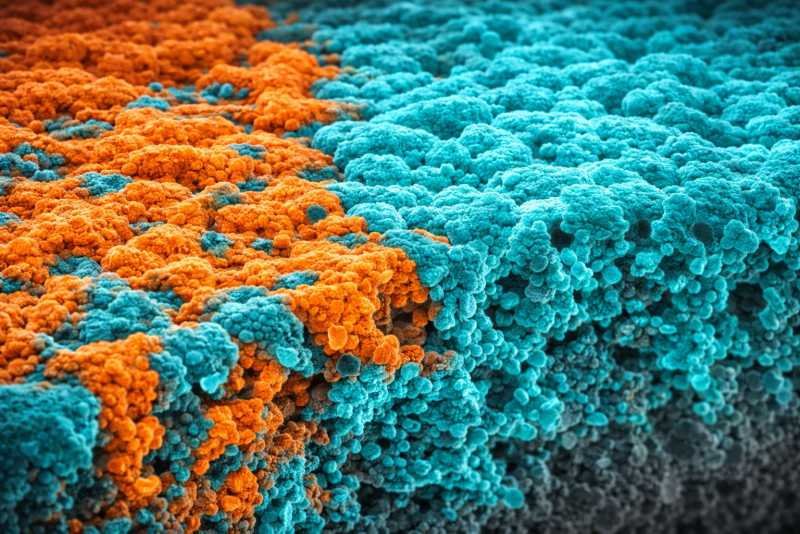
The bulk heterojunction creates an additional trap. For charges to reach the electrodes, the donor and acceptor phases must form continuous pathways from the junction all the way to their respective electrodes. If the morphology of the blend is wrong, donor islands become surrounded by acceptor material, electrons get stranded in donor-rich pockets, and charges die before completing the journey.
Morphology control is where much of the practical engineering in organic photovoltaics actually lives. The processing conditions during film deposition, the choice of solvent, the use of solvent additives, thermal annealing, the molecular weight of the polymers, and the ratio of donor to acceptor all affect the final nanoscale structure of the film. Getting this structure right simultaneously for exciton diffusion, charge separation, and charge transport is a multi-variable optimisation that still relies partly on empirical trial and error.
This is not a fundamental barrier. It is a manufacturing science problem. The physics does not forbid a well-organised bulk heterojunction. The challenge is building it reliably.
Why Organic Cells Degrade and What That Means
There is a conversation happening in every organic photovoltaics laboratory about lifetime. Silicon solar cells are guaranteed for 25 years. Commercial organic solar cells today are typically rated for 5 to 10 years. The gap is real, it matters, and it has a physical explanation.
Organic semiconductors are, by their nature, reactive. The conjugated systems that make them good light absorbers also make them susceptible to oxidation. Oxygen and water molecules diffuse into the organic film and react with the photoactive layer, disrupting the molecular order that enables charge transport and breaking chemical bonds in the polymer backbone. Under illumination, the process accelerates, because absorbed photons can drive photochemical reactions that would not occur in the dark.
The solution is encapsulation. If oxygen and water cannot reach the active layer, the degradation pathways are blocked. Modern encapsulation for organic cells uses multilayer barrier films, alternating organic and inorganic layers, that reduce water vapour transmission rates to below 10-6 grams per square metre per day. That is low enough to extend device lifetimes substantially.
What does stable actually mean for organic photovoltaics? The standard test is called ISOS, a set of protocols that stress cells with heat, humidity, illumination, and dark storage and track how efficiency changes over time. Cells that maintain 80 percent of their initial efficiency after 1,000 hours of illumination at 65 degrees Celsius pass the T80 benchmark. Several non-fullerene acceptor systems now meet or approach this threshold under controlled conditions.
The honest position is that lifetime is the last major remaining barrier. It is not a physics barrier. It is a materials chemistry and packaging problem. It is solvable.
The Manufacturing Advantage Silicon Cannot Match
Silicon solar cell manufacturing is capital-intensive at every stage. Purifying silicon to the 99.9999 percent level required for photovoltaics consumes enormous energy, around 80 to 120 kilowatt-hours per kilogram. Wafer production involves high-temperature crystal growth, precision slicing, and surface treatment. Each step requires specialised equipment and controlled environments.
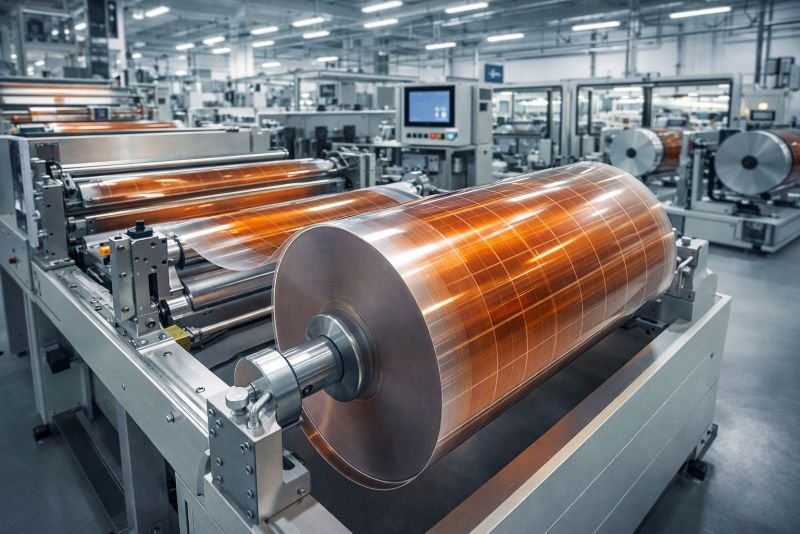
Organic solar cell manufacturing looks different in almost every respect. The active materials are deposited from solution, which means they can be applied through processes similar to commercial printing: roll-to-roll coating, inkjet deposition, slot-die coating. A flexible plastic substrate replaces the rigid silicon wafer. The processing temperatures are low, rarely exceeding 150 degrees Celsius.
The consequence is cost per unit area. Silicon modules are manufactured at around 20 to 30 US cents per watt in the most efficient facilities. Organic photovoltaic manufacturing, at scale, is projected to reach 5 to 15 cents per watt because the materials cost less and the processing energy is lower. The tradeoff is efficiency: you need more area of organic film to generate the same power as a silicon panel.
For applications where area is not constrained, this tradeoff is irrelevant. A building facade has plenty of area. A greenhouse roof has plenty of area. A product packaging film has plenty of area. The question is not whether organic photovoltaics can compete with silicon on a watt-per-panel basis. The question is whether they can occupy applications that silicon cannot physically access.
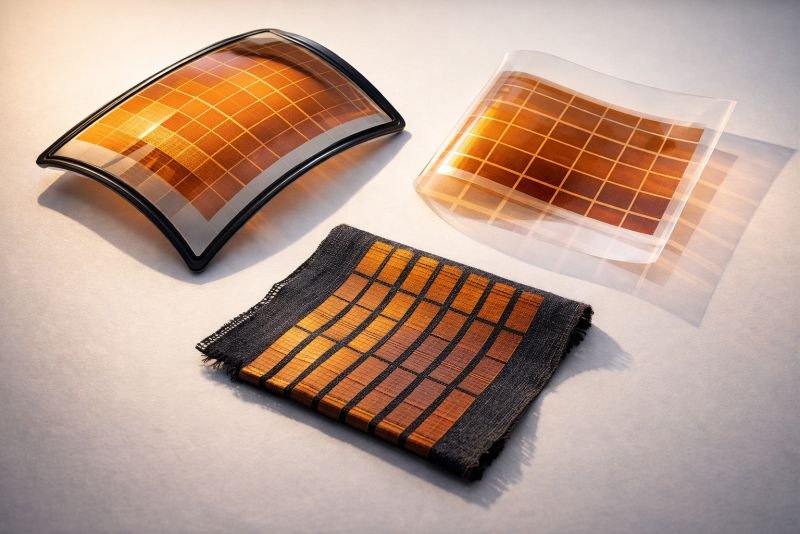
And they can. A silicon panel cannot be printed onto a curved car roof. It cannot be woven into a textile. It cannot be deposited onto a window in a continuous manufacturing process. The value of organic photovoltaics is not in replacing silicon. It is in electrifying surfaces that silicon cannot touch.
Where Organic Photovoltaics Actually Make Sense
Agriculture is one of the more interesting application areas. A semi-transparent organic solar cell can be tuned to absorb specific wavelengths of light, particularly those that plants use less efficiently, while transmitting the wavelengths that drive photosynthesis. A greenhouse roof made from such material would generate electricity while allowing crops to grow normally underneath. Research in this area, sometimes called agrivoltaics, suggests that certain crops grow as well or better under filtered light conditions, particularly in high-solar-irradiance climates where direct sunlight can cause heat stress.

Building-integrated photovoltaics is the more mature application. Organic cells can be deposited onto glass and tuned to transmit a specific fraction of visible light, functioning as a tinted window that simultaneously generates electricity. The power density is modest, a 10 percent efficient cell on a square metre of office window generates roughly 50 to 80 watts under direct sun, but the area available across a modern glass-facade office building is substantial.
Portable and wearable applications are less commercially mature but physically compelling. A solar cell that can be printed onto a backpack or tent fabric and charge a phone or a navigation device directly has genuine utility in contexts where fixed infrastructure does not exist. The key requirements are flexibility, conformability, and resistance to repeated mechanical deformation, all of which organic cells can satisfy in ways silicon cannot.
What organic photovoltaics should probably not try to do is replace ground-mounted silicon arrays. In that context, efficiency matters more than flexibility, lifetime requirements are 25 to 30 years, and the cost advantage of organic processing does not outweigh the efficiency penalty at the scale of a utility solar farm.
What Organic Photovoltaics Science Still Does Not Know
Efficiency has improved faster than understanding. That is an uncomfortable statement, but it accurately describes where the field stands. The bulk heterojunction morphology that produces the best organic solar cells is not yet fully characterised at the molecular level. Researchers can measure the efficiency of a given processing condition. Predicting why a particular solvent additive at a particular concentration produces a better morphology than the alternative is still partly guesswork.
The exciton splitting mechanism at non-fullerene acceptor interfaces has revealed unexpected behaviour. In some high-efficiency systems, charges appear to separate faster than the standard donor-acceptor energy offset model predicts. A competing explanation involves charge transfer states, intermediate bound pairs that sit at the interface between donor and acceptor before separating into free charges. Whether these states are a pathway to free charges or a recombination trap, and what determines which outcome occurs, is an active research question with direct consequences for cell design.
Triplet excitons are another open problem. Singlet excitons, the standard excited state in organic absorbers, are short-lived and mobile. Triplet excitons, formed through intersystem crossing from the singlet state, live much longer but are largely immobile and contribute nothing to photocurrent. In some organic blends, a significant fraction of absorbed photons end up as triplets. Suppressing triplet formation without disrupting the singlet dynamics that drive charge separation is an unsolved materials design challenge.
The degradation mechanisms are better understood than they were a decade ago, but still not completely mapped. Oxygen and water are the primary culprits, but the molecular-level sequence of reactions that converts a working photoactive layer into a degraded one depends on the specific materials involved. A degradation pathway in one polymer system does not necessarily apply to another. Building a predictive model of lifetime from molecular structure alone is not yet possible.
The Surfaces Organic Photovoltaics Can Reach That Silicon Cannot
The scientific principles behind organic photovoltaics, the solution processability of conjugated molecules, the tunability of their absorption spectra, the mechanical flexibility of polymer films, point toward a specific category of application that silicon physically cannot address.
Tandem architectures are one direction. An organic cell absorbing near-infrared light can be stacked on top of a silicon cell absorbing visible light, with each layer harvesting the portion of the solar spectrum the other misses. The organic layer in this configuration does not need to compete with silicon’s efficiency. It needs only to absorb wavelengths that silicon wastes and convert them at any reasonable efficiency. Perovskite-organic tandems are exploring similar territory, using organic cells as the lower sub-cell in a stack tuned to capture the full solar spectrum from ultraviolet to near-infrared.
Semitransparent solar cells for building integration depend on the ability to tune the absorption spectrum of the organic layer to transmit visible light while absorbing the surrounding wavelengths. Silicon cannot do this without compromising its fundamental electronic structure. Organic semiconductors can be designed for specific absorption windows through molecular engineering.
Photodetectors and imaging sensors are an application where organic photovoltaic materials appear in a different context. The same organic semiconductors that absorb light and separate charges in a solar cell can detect light in a medical X-ray detector, a fingerprint reader, or a large-area optical sensor. The flexibility and solution processability that make organic photovoltaics interesting for energy generation make them equally interesting for large-area sensing applications where silicon circuits would be rigid, heavy, and expensive.
The principle that emerges across all of these applications is the same one that makes organic photovoltaics scientifically distinctive: the electronic properties of organic semiconductors are not fixed by the crystal structure of a single material, but tunable through the molecular architecture of the compound. That tunability is the real scientific contribution of the field, and it extends well beyond solar cells.
You read the whole thing.
That is rarer than it should be, and it is the exact kind of attention I built this archive for. I make every piece alone, with no ads and no investor deciding what gets written. If you want the next machine taken apart like this one, you can help me make it.
A coffee a month is enough to keep it free for everyone.
Prefer crypto or a one time gift? Other ways to give →
Technologies Related to This Concept
| Technology | Concept |
|---|---|
| Transparent Solar Fabrics for Window Curtains | Concept: Semi-transparent fabrics that generate electricity while allowing light to pass through, ideal for curtains and blinds. |
| Photovoltaic Window Shades and Blinds | Concept: Window coverings that generate electricity while controlling light and privacy. |
| Solar Fabric Coverings for Greenhouses | Concept: Greenhouse coverings that generate electricity while optimizing light for plant growth. |
| Solar-Generating Textiles: When the Fabric Itself Becomes the Power Source | Concept: Fabrics woven with photovoltaic fibers that generate electricity from sunlight, powering wearable electronics. |
| Photovoltaic Building Facades with Energy Paints | Concept: Skyscrapers coated with solar paints to transform entire facades into energy generators. |