




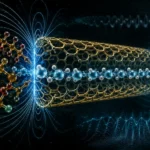


What Is Faraday constant?
The Faraday constant is the electric charge carried by one mole of electrons. It links atomic-scale charge to laboratory and engineering quantities: F = eN_A = 96,485 C mol^-1. Because one electron has a fixed elementary charge, multiplying by Avogadro’s number gives the charge associated with a mole of electron transfer in a chemical reaction.
In real electrochemical systems, the constant converts reaction stoichiometry into current, capacity, and energy. If n moles of electrons move through a cell reaction, the charge is Q = nF, and the maximum electrical work is often written as Delta G = -nFE. In electrochemical energy storage, that relation connects cell voltage with chemical free energy.
The concept matters because it makes batteries, fuel cells, electrolysis, corrosion, and electroplating calculable from the same charge balance. Used in devices include lithium-ion cells, hydrogen electrolyzers, fuel-cell stacks, coulometric sensors, and industrial plating baths. Engineers use it to estimate how much material reacts for a measured current, how much charge a cell can store, and how voltage maps onto chemical driving force.
Example:
During battery discharge, one mole of lithium ions moving with one mole of electrons corresponds to about 96,485 coulombs of charge through the external circuit.
Related Terms:
- Electric Charge
- Avogadro Constant
- Gibbs Free Energy
NoSuchDevice is a free archive of machines that do not exist yet but already have a shadow in physics. I research and write every entry alone, with no ads. Take a look around the archive, or help keep it free.