



What Is Ground Reaction Force?
Ground reaction force is the force a surface exerts back on a body when the body pushes against it, following Newton’s third law. In walking or stepping, this reaction has vertical, horizontal, and time-varying components that depend on body mass, acceleration, contact geometry, and the stiffness of the surface.
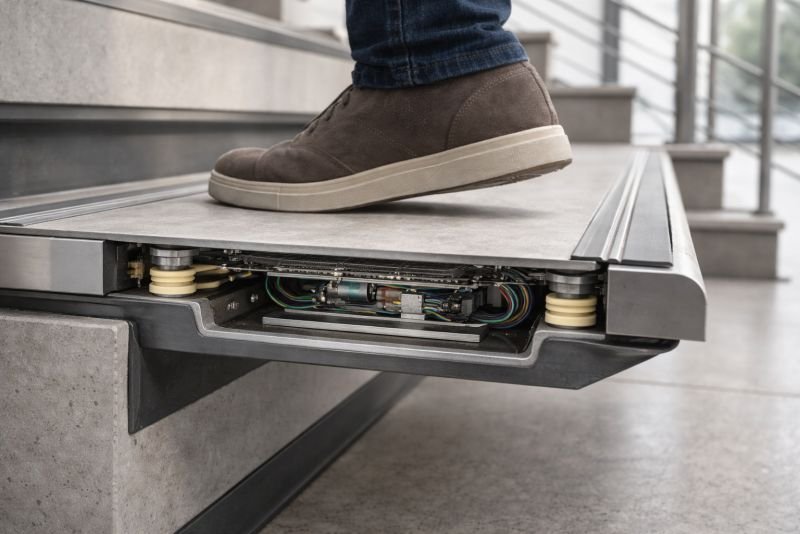
In pedestrian load biomechanics, the force rises quickly during heel strike, shifts as weight transfers across the foot, and falls during push-off. That changing load determines how much a stair tread deflects and how much input reaches an embedded Transducer for electrical conversion.
A compact expression is F = m x a for net force, although measured ground reaction force also includes changing contact dynamics within the gait cycle. It matters because peak force, loading rate, and impulse shape structural design limits, injury analysis, and the energy available to harvesting systems built into floors or stairs.
Used in devices include force plates, instrumented treadmills, and smart insoles. Engineers measure the force in newtons and examine its waveform over time to compare gait patterns, validate models, or size load-bearing components for repeated pedestrian traffic.
Example:
A laboratory force plate records the vertical ground reaction force under a runner to identify how landing technique changes impact loading.
Related Concepts:
- Transducer
- Gait Cycle
- Force Plate
NoSuchDevice is a free archive of machines that do not exist yet but already have a shadow in physics. I research and write every entry alone, with no ads. Take a look around the archive, or help keep it free.