




What Is Transducer?
A transducer is a device that converts energy from one physical form into another by coupling a measurable input to a corresponding electrical, mechanical, optical, or acoustic output. In electromechanical systems, the conversion depends on physical effects such as electromagnetic induction, piezoelectric charge separation, or changes in resistance under strain.
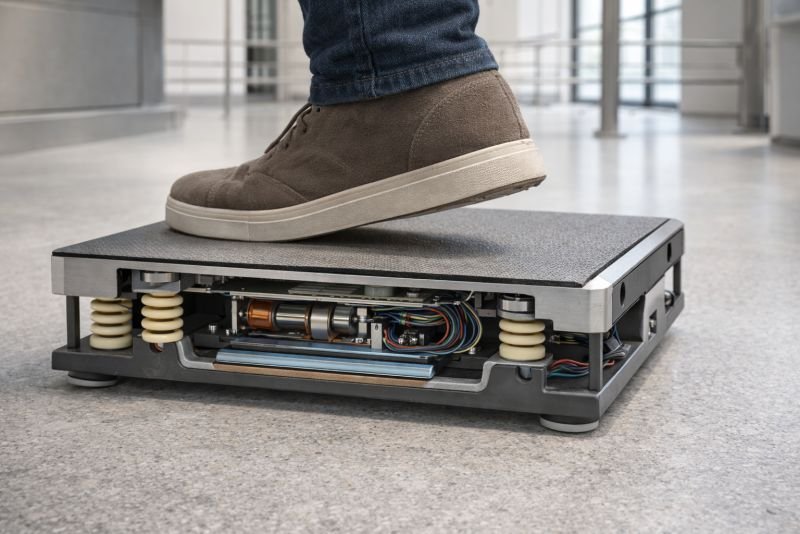
In energy-harvesting staircase engineering, a transducer sits inside the tread and turns small structural deflection from a footfall into usable current or voltage. The incoming load is set by Ground Reaction Force, while the output waveform depends on displacement, loading rate, material properties, and the power-conditioning circuit connected to the device.
A short way to express its role is eta = E_out / E_in, where conversion efficiency compares electrical energy delivered to mechanical energy applied. This matters because the transducer defines how much of each footfall can be recovered, how much is lost as heat, and which device architecture remains practical under repeated loading in public infrastructure.
Used in devices include piezoelectric sensors, dynamic microphones, and electromagnetic generators. Designers choose the transducer type by matching force range, motion amplitude, response speed, durability, and cost to the intended operating conditions rather than by output voltage alone.
Example:
A stair tread that drives a magnet through a coil when a commuter steps down uses a transducer to convert brief mechanical deformation into electricity.
Related Concepts:
- Ground Reaction Force
- Piezoelectricity
- Electromagnetic Induction
NoSuchDevice is a free archive of machines that do not exist yet but already have a shadow in physics. I research and write every entry alone, with no ads. Take a look around the archive, or help keep it free.