



Canary Wharf station in London handles around 100,000 passengers on a busy weekday. Many of them use the staircases – the long inclined runs connecting the underground platforms to street level. Each person descending pushes several hundred newtons of force into a step, holds it for a fraction of a second, transfers their weight forward, and moves on. The step does nothing with any of it. The force disperses into the concrete, a faint vibration travels through the structure, and the energy is gone.
An energy-generating staircase would intercept that moment. Not to power the city. Not to replace the grid. But to take energy that is already being spent and recover some fraction of it before it disappears into heat and sound.
The short version: An energy-generating staircase embeds transducers inside each tread to convert the mechanical force of footfalls into electricity. A single step under a 70 kg person delivers roughly 0.4 joules of mechanical energy per footfall. A mature installation in a busy transit hub could generate 150 to 300 watt-hours per day – enough to power the stairwell’s lighting and sensors indefinitely, without drawing from the building’s grid. The physics is established. The mature device requires solving two to three decades of materials science and mechanical engineering problems, but the path from here to there follows directly from principles that are already understood.
Key Takeaways
- Every footfall on a conventional staircase wastes kinetic energy that has already been spent by the person climbing or descending
- The most productive installation for an energy-generating staircase is descending traffic, not ascending – and the physics explains exactly why
- A home staircase version will never pay back its manufacturing energy in any reasonable timeframe
- The electromagnetic approach and the piezoelectric effect solve the same problem through entirely different physical mechanisms, and combining them recovers more energy than either alone
- At the scale of a major transit network, the energy-generating staircase is the prototype of a larger idea: active infrastructure surfaces that generate the power their own environments need from the traffic that passes through them
Table of Contents
How an Energy-Generating Staircase Would Convert Footfalls to Current
Building a staircase that generates electricity does not require new materials or exotic physics. The underlying mechanisms are well understood. What does not yet exist is a system that integrates them into a durable, load-bearing structure with the reliability expected of permanent building infrastructure – a device that can accumulate tens of millions of footfalls over decades without maintenance access to the electronics sealed inside each tread.
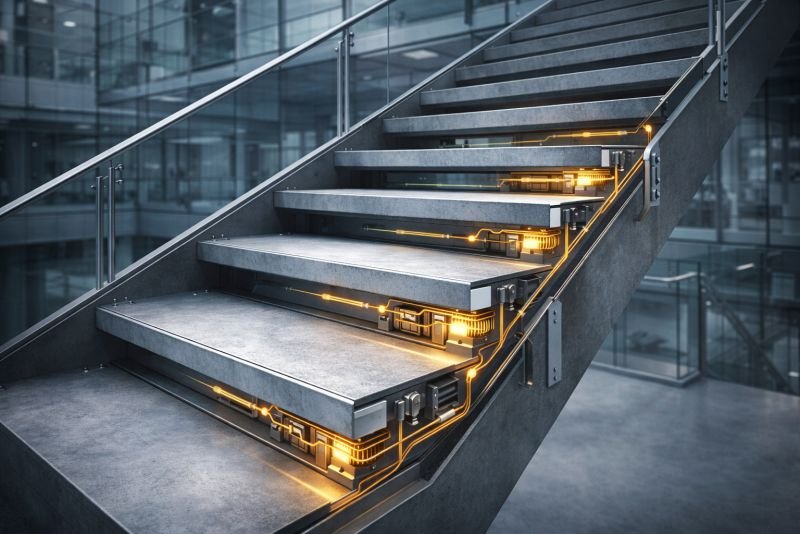
The concept works by replacing or augmenting the structural layer of each step with a transducer – a device that converts mechanical deformation into electrical energy. When a foot lands on the tread, the step deflects slightly under the load. That deflection is the input. The transducer’s job is to turn it into current.
Electromagnetic induction inside the tread
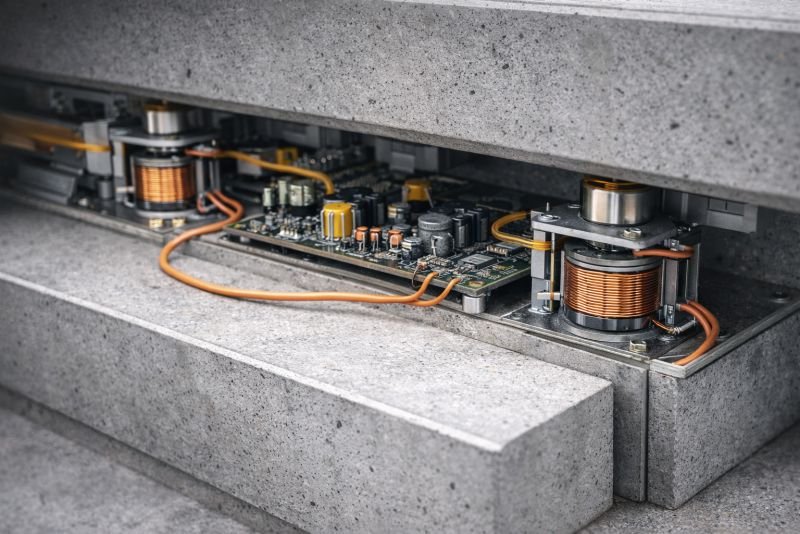
One approach places small electromagnetic generator units inside each step. Each unit contains a magnet and a coil of copper wire. When the step deflects under foot load, a lever or piston mechanism drives the magnet through the coil. Moving a magnetic field through a conductor induces a voltage – this is the same principle behind every power station turbine, scaled down to fit inside a stair tread.
The output from an electromagnetic unit is alternating current, produced in a brief pulse with each footfall. The current is relatively low in voltage but higher in amperage than piezoelectric alternatives, which makes it easier to work with in practical power conditioning circuits. Electromagnetic units also use conventional materials – steel, copper, ferrite – which are cheaper and better understood in long-duration mechanical applications than piezoelectric ceramics.
The piezoelectric layer as a complementary mechanism
A piezoelectric material generates a voltage when mechanically stressed. Press it, and charges separate across the crystal structure, creating a potential difference. Release it, and the charges return. Each footfall produces two voltage spikes – one on impact, one on release.
Piezoelectric materials respond quickly. They capture the sharp initial crack of a heel strike better than an electromagnetic piston, which requires physical movement over a small distance. The lead zirconate titanate ceramics used in today’s research demonstrations convert 25 to 40 percent of applied mechanical energy into electricity. Lab-condition results with optimized electrode geometries have reached 40 percent in controlled tests. The mature energy-generating staircase described here assumes that figure is achieved consistently in field conditions – not a current reality, but a physically grounded target that a mature manufacturing process would approach.
Why a hybrid system recovers more than either alone
What does a footfall actually look like in time? The impact phase – heel strike to full weight transfer – lasts roughly 50 to 80 milliseconds. Peak force arrives quickly, then plateaus as the foot flattens, then decreases as the person’s weight shifts forward onto the ball of the foot. The release phase lasts another 60 to 100 milliseconds.
Piezoelectric layers respond best to the sharp, high-rate-of-change impact phase. Electromagnetic units respond better to sustained load movement. A hybrid system assigns each mechanism to the part of the footfall it handles most efficiently: the piezo layer captures the impact pulse, the electromagnetic stage captures the settling load. Together they recover a larger fraction of the available mechanical energy than either could alone.
The Physics That Makes Energy-Generating Staircases Possible
A footfall is a mechanical event. Mechanics is energy. The question is how much energy, and how much of it can realistically be captured.
When a 70 kg person steps onto a tread, they apply a ground reaction force of roughly 700 to 900 newtons – somewhat more than their body weight due to the dynamics of walking. The step deflects under this load. In a conventional staircase that deflection is purely structural: the step bends imperceptibly and returns. In an energy-generating staircase, that deflection is the working stroke of the transducer.
Calculating the energy available per footfall
The energy stored in a deflected elastic element is given by:
E = ½ × F × d
Where:
- E is the energy in joules
- F is the applied force in newtons
- d is the deflection distance in meters
For an energy-generating staircase step: F = 800 N (a 70 kg person walking), d = 0.001 m (one millimeter of deflection, at the upper limit of what building codes permit for stair tread deflection under live load).
E = ½ × 800 × 0.001 = 0.4 joules per loading cycle
At a system efficiency of 40 percent for a hybrid electromagnetic-piezoelectric transducer, the electrical output per footfall is approximately 0.16 joules. Across both the loading and unloading phase, a well-designed system recovers around 0.2 to 0.3 joules per footfall in practical conditions.
This number sets the ceiling. No improvement in electronics, no better power conditioning circuit, no more sophisticated control system can extract more than the mechanical energy that entered the system. The ceiling is set by the footfall itself – by the weight of the person and the distance the step moves. Both are constrained: building codes limit deflection, and human body mass does not change.
Descending traffic generates more than ascending
Here is a detail that surprises most people encountering this concept for the first time. Going downstairs is more productive for energy generation than going upstairs.
When a person descends, they dissipate potential energy they stored during the climb. Their muscles fire eccentrically – braking the downward motion – and the ground reaction force on each step is higher than during level walking. The step receives a sharper mechanical pulse with a cleaner, faster loading rate. The piezoelectric layer, which is most sensitive to high-rate-of-change loading, responds more effectively.
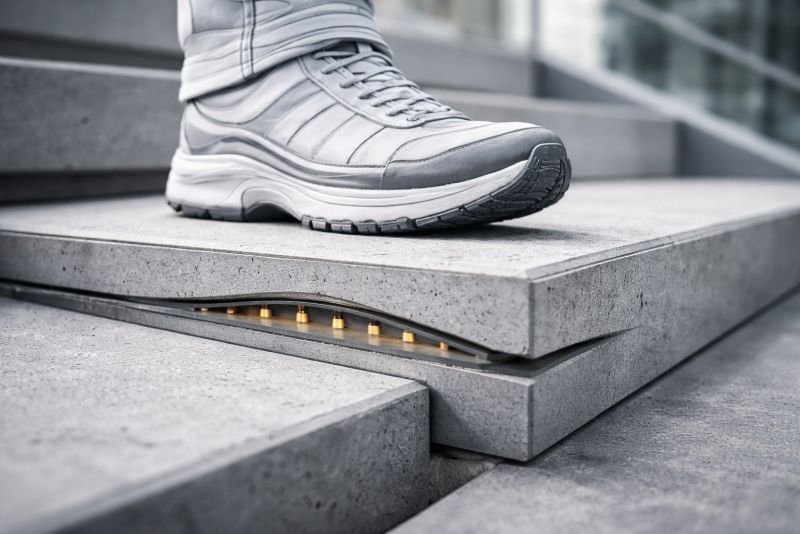
When a person ascends, the story is different. They are the engine. They generate mechanical work with each push-off, and the step is simply a surface they push against. The loading profile is gentler, the impact forces are lower, and less energy is available for recovery. An energy-generating staircase in a location with mostly ascending traffic produces measurably less per footfall than one with mostly descending traffic.
The deflection constraint and what it costs
Building codes in most jurisdictions specify a maximum allowable deflection for stair treads under live load, commonly expressed as 1/360 of the unsupported span. For a 900 mm span – a typical stair width – this gives a maximum permitted deflection of 2.5 mm. Most energy-generating staircase designs aim for 0.5 to 1 mm of working deflection, well within code requirements but at the lower end of what the energy formula would prefer.
Every additional 0.5 mm of deflection increases available energy proportionally. A step that deflects 1 mm instead of 0.5 mm doubles the harvestable energy. The constraint is not structural physics – it is occupant perception. A staircase that feels springy fails as a staircase regardless of how much electricity it produces.
Engineering an Energy-Generating Staircase That Lasts
Understanding the physics is the simpler part. The harder problem is building a system that performs reliably for 20 or 30 years in a real building, with real maintenance constraints and real budgets. Every component that differs from conventional stair construction adds cost, complexity, and a potential failure mode.
The layer stack and what each part does
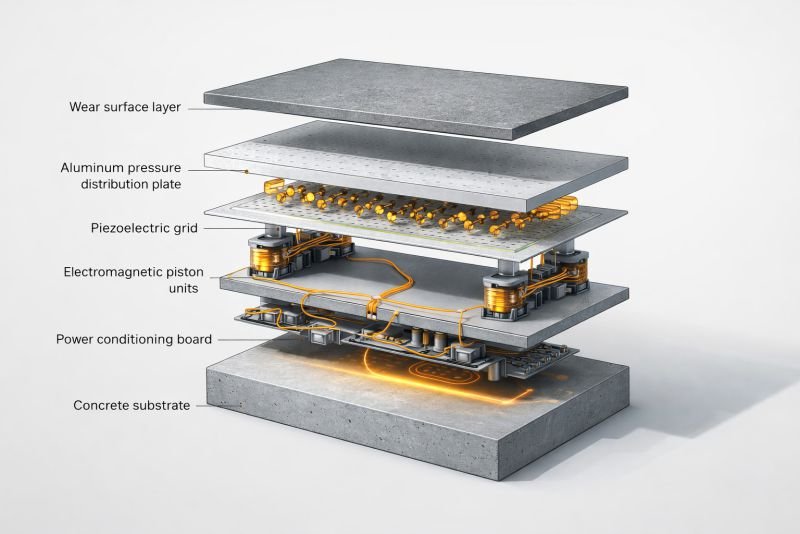
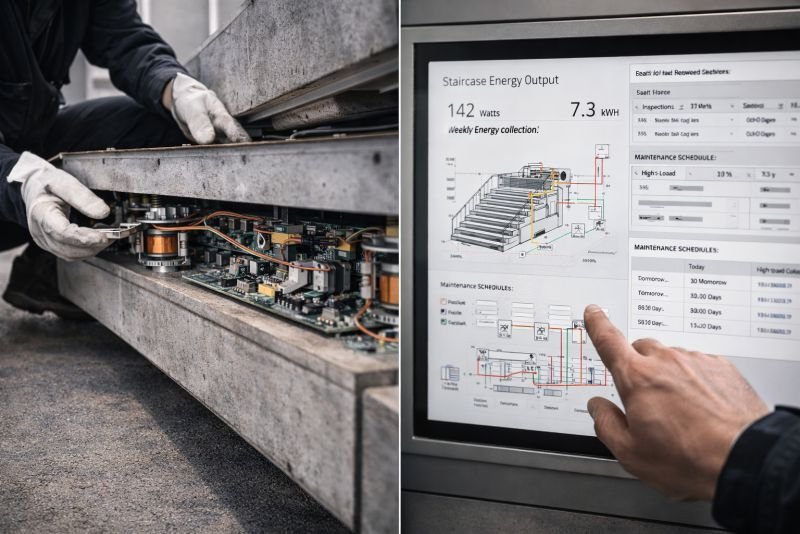
A practical energy-generating staircase step would be built as a composite assembly. Starting from the walking surface: a hardened wear layer, typically the same tile, stone, or composite used in conventional construction. Below that, an aluminum or hardened polymer pressure distribution plate, which spreads the concentrated load from a heel strike across the full area of the transducer layer below. Without this plate, the peak stress under a heel would be orders of magnitude higher than the average load, potentially cracking piezoelectric ceramics on the first day of use.
The transducer layer sits below the distribution plate. In a hybrid design, this is a grid of piezoelectric wafers bonded between conductive electrodes, with electromagnetic piston units positioned at regular intervals between the piezo elements. Below the transducer layer is the structural substrate – the same concrete, steel, or engineered timber used in any other staircase. The transducer assembly is essentially inserted between the structural layer and the finish layer, replacing a portion of the substrate with an active energy-recovery system.
Power conditioning: from raw pulses to usable current
What does the raw electrical output from a footfall actually look like? Each step produces a brief pulse of alternating current – sharp, irregular, and too low in voltage for most loads to use directly. Before the electricity can power anything, it passes through a power conditioning circuit.
For piezoelectric output, this means a rectifier bridge first converts AC to DC. A voltage regulator then stabilizes the output. A buffer capacitor or small rechargeable cell smooths the intermittent supply – because footfalls arrive in bursts during peak hours and stop entirely at night – into a steady voltage rail that connected loads can use. Each of these conversion steps carries an efficiency cost. A piezoelectric transducer at 35 percent mechanical-to-electrical efficiency loses another 15 to 20 percent in conditioning before the electricity reaches a usable form.
Electromagnetic output is easier to condition. The voltage is lower but the current is more regular, and the conditioning chain is shorter. For high-traffic installations where output volume matters, this efficiency advantage compounds across thousands of daily footfalls.
| Transducer type | Mechanical-to-electrical efficiency | Output characteristics | Conditioning complexity | Durability concern |
|---|---|---|---|---|
| Piezoelectric (PZT) | 25-40% | High voltage, low current, AC pulses | Rectifier + regulator + buffer required | Ceramic cracking under off-axis load |
| Electromagnetic | 35-50% | Low voltage, higher current, AC | Simpler rectifier sufficient | Bearing wear at piston surfaces |
| Hybrid (both) | 40-55% combined | Mixed profile, broader capture window | Parallel conditioning chains | Both failure modes present |
Distributed versus centralized conditioning
What is the better architecture – one conditioning circuit per step, or a central unit collecting raw AC from all steps? Each approach trades different risks.
Distributed conditioning means each step manages its own power processing. A failure in one step’s electronics affects only that step. Installation is modular – steps can be added or replaced independently. The cost is higher per unit and maintenance requires access to electronics embedded in every tread.
Centralized conditioning routes raw AC from all steps through a single processing unit mounted in the stringer or under the staircase. Electronics costs are lower, the system is easier to monitor, and a single maintenance point covers the whole staircase. The risk is a single point of failure that takes down the entire installation. Neither architecture has emerged as clearly superior across all use cases – the right choice depends on building type, traffic pattern, and how much the operator values redundancy over installation simplicity.
Everything here is free. Readers are the reason it stays that way.
I make all of it alone, with no ads. If it is worth a coffee a month to you, that keeps the next one coming.
Keep it alive →The Physics Beneath Each Step
An energy-generating staircase draws on three distinct areas of physics. Each one contributes a different layer of the system’s behavior, and understanding all three is necessary to see both what the device can do and what it cannot escape.
Piezoelectricity: charge from crystal deformation
Certain crystalline materials generate an electric charge when mechanically deformed. The effect arises from the internal structure of the crystal: when stress displaces the positive and negative charge centers within the unit cell, a net dipole moment appears across the material. Accumulate enough of these dipoles across a ceramic disk, and the result is a measurable voltage at the electrodes.
The lead zirconate titanate ceramics used in current research demonstrations produce this effect with reasonable efficiency, high repeatability over millions of cycles, and manageable manufacturing cost. A mature energy-generating staircase would likely use these materials in its earliest deployed form, then transition to lead-free alternatives as regulatory pressure increases and competing formulations reach production readiness. Bismuth sodium titanate composites and potassium sodium niobate are the current research directions. Neither yet matches PZT’s efficiency across the full operating temperature range – but that gap is narrowing, and the regulatory pressure to close it is not going away.

Faraday’s law: current from a moving magnetic field
Michael Faraday established in 1831 that a changing magnetic field through a conductor induces a voltage in that conductor. Every electromagnetic generator in existence – from the turbines at a hydroelectric dam to the alternator in a car engine – operates on this principle. The energy-generating staircase scales it down to a piston a few centimeters long moving through a coil wound inside a step.
The induced voltage depends on how fast the magnetic field changes, which in a staircase context means how fast the piston moves. A sharp impact drives the piston faster than a slow settling load. Designing the mechanical linkage to maximize piston velocity during the short window of each footfall is where most of the engineering optimization work in electromagnetic staircase systems concentrates.
Structural mechanics: the deflection window
Every load-bearing element in a building deflects under load. A staircase tread is a short-span beam supported at its ends. When a person stands on it, the tread curves downward slightly at the center. When they step off, it returns. The energy stored in that elastic deformation is the source that both transducer types draw from.
The deflection window is bounded on one side by structural codes and on the other by occupant perception. Engineers designing energy-generating staircases work within a narrow band of acceptable deflection – large enough to produce meaningful energy, small enough that the staircase feels solid underfoot. Composite substrate designs using engineered timber or fiber-reinforced polymer instead of concrete can increase deflection compliance without reducing stiffness, potentially widening this window without compromising structural performance.
Engineering Problems the Mature Device Still Needs to Solve
Several problems separate a working laboratory demonstration from a device a building owner would install and forget about for twenty years. They are not insurmountable. They are also not minor, and pretending otherwise would give this technology a credibility problem it does not need.
Durability under real-world loading conditions
How long does the transducer layer last? A transit station staircase accumulates 10 million footfalls per year. Piezoelectric ceramics in laboratory conditions have demonstrated 100 million cycles before significant efficiency degradation – but laboratory conditions do not include off-axis loading from people who step toward the edge of a tread, thermal cycling from a staircase that transitions between a heated interior and a cold exterior, or moisture infiltration through a compromised wear surface.
Field lifespans for piezoelectric elements in transport applications are typically 30 to 60 percent shorter than laboratory predictions. Electromagnetic units wear at their bearing surfaces and at the mechanical linkage that connects step deflection to piston movement. A system designed for a 20-year building service life with no mid-life transducer replacement does not yet exist. That is the durability challenge, and it is the single largest gap between demonstration and deployment.
Lead content in the most efficient ceramics
The piezoelectric material with the best combination of efficiency, repeatability, and manufacturing maturity contains lead. European RoHS regulations already restrict lead in consumer electronics, and similar restrictions on construction materials are under active discussion in several jurisdictions. A future energy-generating staircase built for the European market will need to perform comparably using lead-free ceramics – and none of the current lead-free alternatives match PZT’s efficiency across the full operating temperature range. Research is active. Production-ready lead-free piezoelectrics that match PZT in staircase applications are a 10 to 15 year materials science horizon, not a current product.
Integration with building power systems
A staircase that generates electricity needs somewhere to send it. For self-powered stairwell lighting, the circuit is simple and closed. For any export to the building’s electrical system, the energy-generating staircase needs to interface with building management systems, comply with electrical grid standards, and in many jurisdictions go through the same interconnection approvals as a rooftop solar installation.
The path of least resistance – and the most coherent first application – is isolated stairwell operation. The staircase generates power, uses it locally, and never touches the building’s main electrical system. Simpler approvals, simpler wiring, simpler value proposition. That closed loop is not a compromise. It is where the device actually makes sense.
From Step to Surface: The Evolutionary Arc of Kinetic Infrastructure
The energy-generating staircase is not a finished product concept waiting for a manufacturing partner. It is the first legible form of something larger: the idea that high-traffic infrastructure surfaces can generate the power their own environments require, from the movement of the people who use them. Understanding where that idea leads requires following the engineering logic across three generations of development, not just the first one.
First generation: the embedded tread
The earliest deployable energy-generating staircases will be direct descendants of today’s laboratory demonstrations. They will use lead zirconate titanate ceramics as the primary transducer material, electromagnetic piston units as the secondary stage, and a hybrid conditioning chain that is probably too complex for easy field maintenance. They will be installed in transit environments – underground stations, airport concourses, stadium approach staircases – where the traffic volumes justify the capital cost and the maintenance infrastructure already exists for analogously complex systems like escalators.
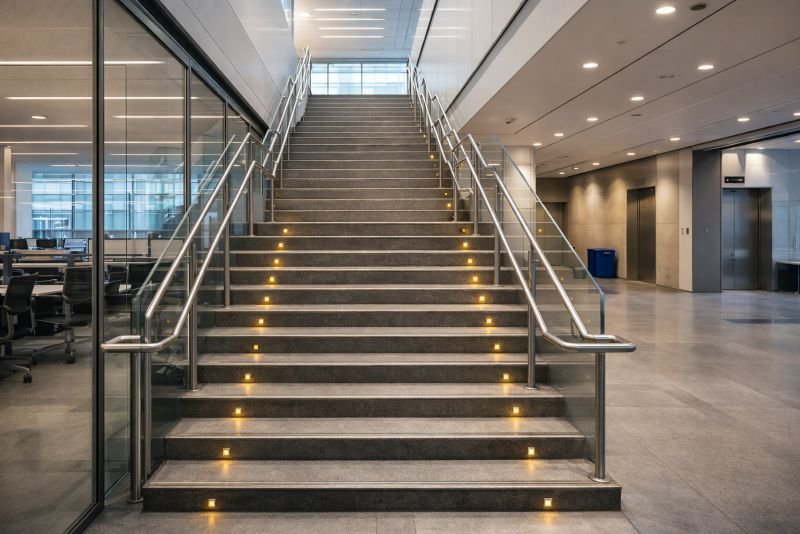
Performance in this generation will fall short of the theoretical ceiling. Efficiency losses in the conditioning chain, off-axis loading that the distribution plate partially compensates but does not fully address, and thermal cycling that stresses ceramic bonds will keep real-world output at the lower end of the design range. A 20-step staircase in a busy metro station will generate 100 to 200 watt-hours per day rather than 300. That is still enough to sustain the stairwell’s lighting, sensors, and emergency signs. The closed-loop stairwell – generating and consuming its own power without connection to the building’s main electrical system – is the first generation’s achievable and honest value proposition.
Mature generation: the self-sufficient stairwell ecosystem
The second generation of the device emerges when two engineering gaps close simultaneously: lead-free piezoelectric ceramics that match PZT efficiency across operating temperatures, and transducer assemblies engineered for 20-year field service without mid-life replacement.
When both conditions are met, the device changes character. It is no longer a demonstration of a principle. It becomes standard infrastructure. New transit construction in dense urban environments routinely specifies energy-generating staircases as part of the base specification, the same way it specifies motion-activated lighting or emergency exit illumination. The stairwell becomes a closed energy ecosystem – every fixture, sensor, air quality monitor, Bluetooth beacon, and emergency sign running on footfall-generated power, with no electrical connection to the building above.
The composite substrate matters here. Engineered timber and fiber-reinforced polymer substrates, rather than concrete, allow slightly more tread deflection within code limits. A step that deflects 1.2 mm instead of 0.8 mm generates 50 percent more harvestable energy per footfall. That gain, compounded across millions of footfalls and dozens of steps, means the difference between a stairwell that barely meets its own lighting load and one that has surplus capacity for additional sensors and emergency communications equipment.
Civilizational-scale form: the active surface
The third generation is not a staircase. It is a class of architecture.
The logic that applies to a staircase tread – high-traffic load-bearing surface, predictable force profile, need for local low-voltage power – applies equally to pedestrian floor surfaces in transit concourses, airport terminals, and dense urban corridors. The staircase is the prototype because the force concentration and geometry are favorable for early engineering development. The mature technology, once the transducer stack is reliable and manufacturable, migrates outward to any surface that sustains high pedestrian traffic.
A major underground transit hub handling 300,000 daily passengers distributes that traffic across staircases, escalator landings, platform surfaces, and concourse floors. Each of those surfaces, instrumented at the transducer layer, becomes a power node. The hub’s low-voltage infrastructure – lighting, ventilation sensors, passenger information displays, access control, communications equipment – runs on kinetic power generated by the passengers themselves. No solar panels. No grid connection for operational loads. The passengers are the power source, spending energy they were already spending, on a surface designed to catch it.
This is not a scenario for the near future. It is the destination that the physics points toward, if the engineering matures enough to follow.
Where the Numbers Justify the Device
The energy output of an energy-generating staircase scales almost directly with traffic. Location selection is the most important design decision – not material choice, not transducer architecture, not electronics. A system installed in the wrong building produces irrelevant quantities of electricity regardless of how well it is engineered.
Transit infrastructure as the primary deployment context
A busy station in a major city can register 15,000 to 30,000 footfalls per day on a single staircase run. At 0.25 joules per footfall of recovered electrical energy, that is 3,750 to 7,500 joules per day per step – roughly 1 to 2 watt-hours. Across a 20-step staircase where each step contributes independently, and accounting for the distribution of traffic across all treads, a full run generates 100 to 300 watt-hours per day.
A single 10-watt LED fixture running continuously for 24 hours consumes 240 watt-hours. The staircase powers its own lighting. Emergency exit signs, occupancy sensors, air quality monitors, and Bluetooth beacons in the stairwell typically draw less than 0.1 watts continuously – small, persistent loads that an energy-generating staircase could sustain indefinitely without connecting to the building’s electrical system at all. That is a clean engineering outcome. It is also the only honest one for this generation of the technology.
Office buildings and commercial spaces
A mid-size office building with 80 staff, four floors, and a culture of taking the stairs represents a different traffic profile. Perhaps 300 to 500 footfalls per day on a given staircase tread. At that level, the daily output from a full staircase run is in the range of 5 to 15 watt-hours. Still useful for powering stairwell LEDs during building hours – the lighting load in a stairwell that only activates on motion is well within reach – but not a source of meaningful contribution to the building’s overall energy budget.
The correct framing for commercial buildings is not electricity bill reduction. The stairwell becomes autonomous. It generates what it consumes. For a building manager, that is a simpler value proposition than projecting returns on energy arbitrage, and it has the advantage of being true.
The home staircase: where the physics simply does not work
A household staircase used 30 to 50 times per day by two or three people generates roughly 0.05 to 0.1 watt-hours per day. A single smartphone charges at around 10 watt-hours. The home staircase would need 100 to 200 days of operation to charge one phone once.
The manufacturing energy embedded in a fully instrumented harvesting step – transducers, distribution plate, power conditioning electronics, modified substrate – sits somewhere between 50 and 200 kilowatt-hours depending on system complexity. At 0.1 watt-hours of daily output, the energy payback period is measured in centuries. No improvement in efficiency changes this. The problem is not engineering – it is physics. Two people walking up and down stairs do not represent a meaningful energy source at any foreseeable transducer efficiency level. That is not a manufacturing problem. It is a traffic problem.
The View From NoSuchDevice
I find this technology more convincing than most in the energy harvesting space, and more limited than its advocates typically admit.
The physics is honest. A conventional staircase wastes energy that has already been spent – spent by the people using it. Recovering some fraction of that waste is not a sleight of hand. The energy is there. The conversion is real. The output numbers follow directly from the weight of the person and the distance the step moves, which means they cannot be inflated by a more enthusiastic engineering team or a more optimistic press release.
What I find harder to accept is the framing that appears in most coverage of this technology. Energy-generating staircases are regularly described as a contribution to building energy needs. They are not, at any deployment scale that is realistic in the next 30 years. A busy office staircase covering its own lighting load is a closed, useful loop. Calling it a contribution to the building’s energy budget is a category error dressed up as ambition.
On the question of where this sits on the NoSuchDevice horizon: the energy-generating staircase is not quite a 100 to 200 year technology. The core physics is already demonstrated. The materials science gaps are real but not exotic – lead-free piezoelectrics, composite structural substrates, long-duration mechanical reliability. These are 15 to 30 year engineering problems, not century-scale ones. What belongs on the longer horizon is the extrapolation: the active urban surface, the kinetic infrastructure grid, the transit hub that generates its own operational power from the people who pass through it. The staircase is the seed of that idea. The seed is worth studying precisely because of what it implies about where the idea leads.
Where I would put development resources: transit infrastructure, without hesitation. Millions of footfalls per day, long maintenance intervals, predictable traffic profiles, and existing operators who understand infrastructure investment with 20-year payback horizons. Metro systems already maintain escalators with complex embedded mechanical systems. An energy-generating staircase is not a fundamentally harder maintenance proposition – and it has the significant advantage of generating power rather than consuming it.
The residential version should be abandoned as a product category. The numbers do not support it and they will not. Two people on a home staircase do not represent a meaningful energy source at any foreseeable efficiency level. Building and selling that expectation does lasting damage to the credibility of the broader concept.
If this technology reaches its potential, it will do so quietly, in the background, in train stations and airports and underground concourses – powering the lights in the stairwells that lead to it, and eventually the sensors, displays, and communications equipment that make those spaces navigable. That is not a dramatic outcome.
It is an honest one.
You read the whole thing.
That is rarer than it should be, and it is the exact kind of attention I built this archive for. I make every piece alone, with no ads and no investor deciding what gets written. If you want the next machine taken apart like this one, you can help me make it.
A coffee a month is enough to keep it free for everyone.
Prefer crypto or a one time gift? Other ways to give →