




What Is Hagen-Poiseuille flow?
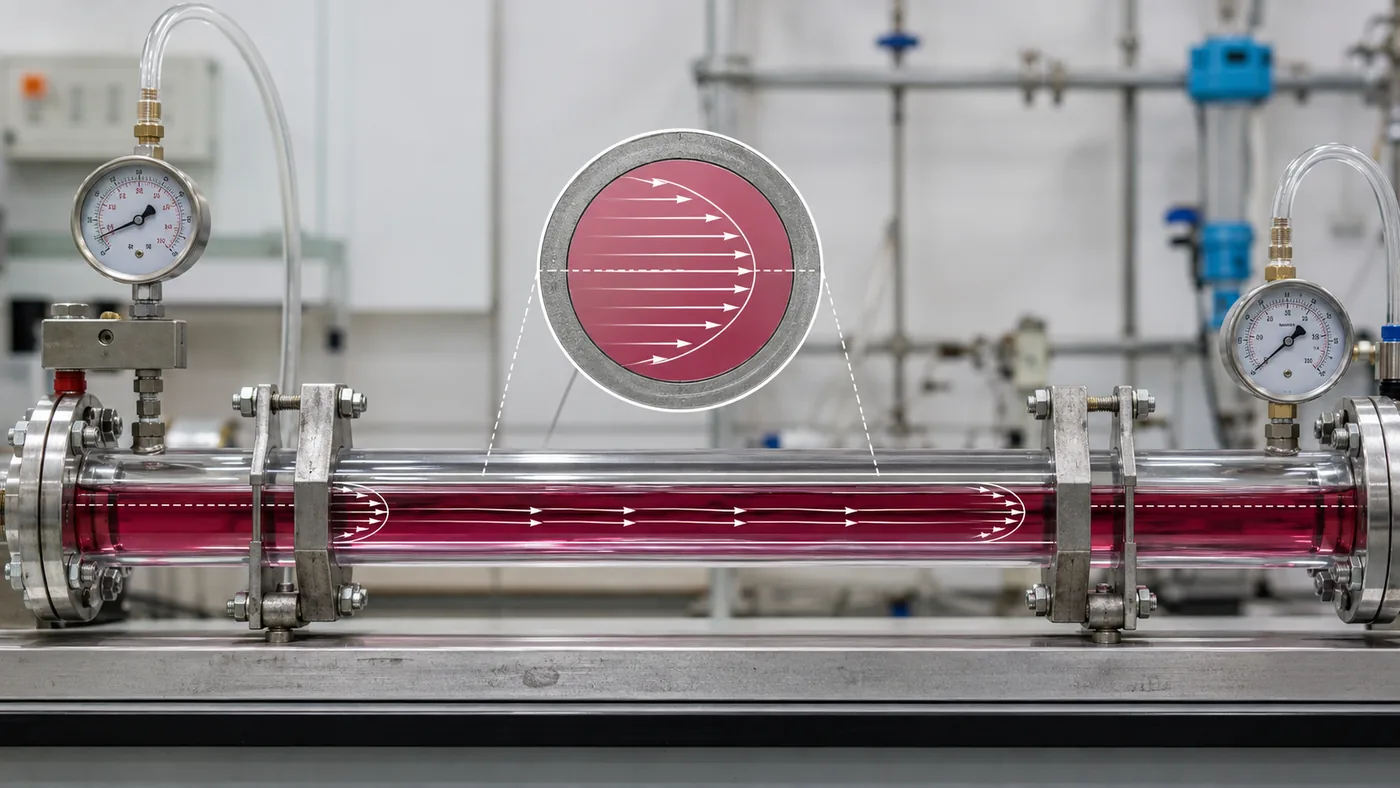
Hagen-Poiseuille flow is the pressure-driven motion of a viscous fluid through a long, narrow cylindrical tube under laminar conditions. It predicts a parabolic velocity profile, with fluid moving fastest at the center and slowest at the wall. The standard relation is Q = pi r^4 Delta P / (8 mu L), where flow rate rises sharply with tube radius and pressure difference, but falls with viscosity and length.
In real systems, the relation works best when the fluid is Newtonian, the tube is smooth and uniform, entrance effects are small, and the Reynolds number remains low. It is widely used as a reference model for capillaries, microfluidic channels, porous media, and membrane pores. In membrane flow engineering, deviations from the classical prediction can reveal wall slip, nanoscale confinement, or nonclassical transport behavior.
The concept matters because it links geometry directly to hydraulic resistance. A small reduction in radius can cause a large drop in flow, which strongly affects pumps, filters, lab-on-chip devices, and biological circulation models.
Used in devices include microfluidic chips, capillary viscometers, dialysis membranes, fuel-cell flow plates, and filtration modules designed around controlled pressure loss.
Example:
In a microfluidic assay, doubling a channel radius can greatly increase liquid throughput without changing the pump pressure.
Related Terms:
- Laminar Flow
- Reynolds Number
- Viscosity
NoSuchDevice is a free archive of machines that do not exist yet but already have a shadow in physics. I research and write every entry alone, with no ads. Take a look around the archive, or help keep it free.