A kilowatt-hour generated at a power plant carries a quiet mortality. Between the turbine and the wall socket, some fraction of it stops being electrical energy and becomes heat – not useful heat, but heat that radiates from underground cables into the soil, from high-voltage lines into the evening air, from transformer housings into the sides of buildings. In a major metropolitan grid, the total across every cable, every transformer, every junction in the distribution network adds up to between 8 and 15 percent of everything generated. The city paid for it. A furnace did work to produce it. Nobody got any use from it.
The quantum energy grid is the device built to make that figure disappear.
It does not achieve this by building better cables or running higher voltages. It achieves it by removing the wire from the energy transfer equation entirely – using quantum entanglement between distributed city nodes to route power without any current flowing through any conductor between source and destination.
The short version: A quantum energy grid transfers electrical power across a city using quantum entanglement between physical routing nodes. Energy is delivered through quantum energy teleportation – power injected at a source node causes an equivalent quantity to become extractable at the destination node, without current flowing between them. Transmission and distribution losses drop from 8-15% to below 1%. For a city consuming 50 terawatt-hours per year, recovering that loss means 4 to 7 terawatt-hours reclaimed annually – enough to power several hundred thousand homes that previously ran on waste.
Key Takeaways
- Classical grids lose approximately 2,200 terawatt-hours per year globally – more electricity than Germany generates in total
- Quantum energy teleportation allows energy to arrive at its destination without physically traveling through the space between source and delivery point
- The grid operates on two parallel layers: a quantum fiber layer that handles the energy work, and a classical fiber layer that directs when and how much
- The mesh of quantum routing nodes has no trunk line to overload – partial failures stay local and the rest of the network routes around them
- A city running this grid acquires a quantum-encrypted communications backbone as a structural corollary, sharing node infrastructure with no additional construction
Table of Contents
The 15% That Never Reaches the Socket
Every conductor resists the flow of electrons through it. That resistance converts some fraction of electrical energy into heat. The relationship is captured in the Joule heating (I² R loss) formula:
P_loss = I² × R_per_km × L
Where P_loss is the power dissipated as heat (watts), I is the current (amperes), R_per_km is the cable’s resistance per kilometer (ohms/km), and L is the total length (km).
For a typical urban distribution cable carrying 500 amperes with a resistance of 0.3 ohms per kilometer over a 10-kilometer run:
P_loss = 500² × 0.3 × 10 = 750,000 watts
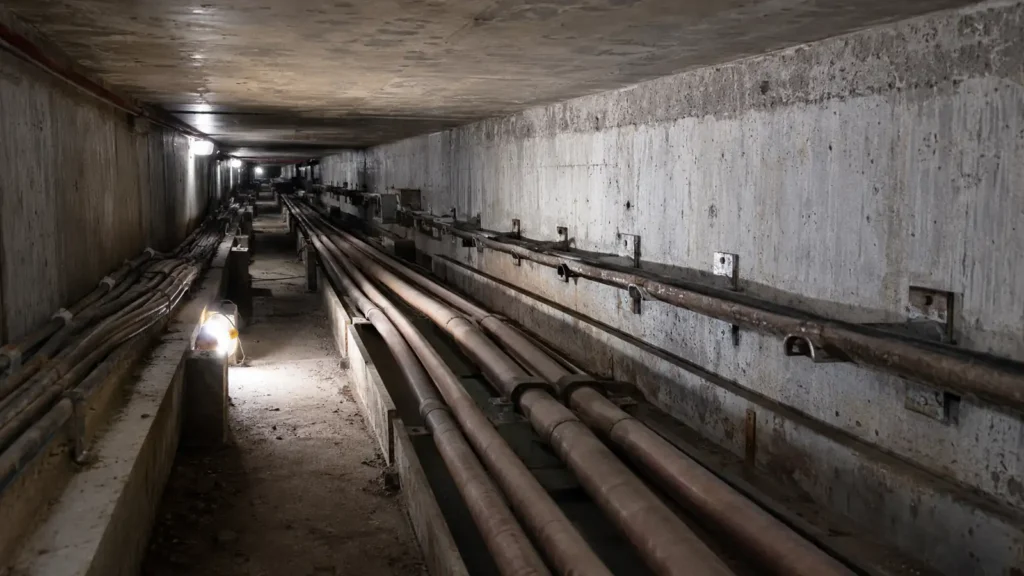
A single distribution circuit moving 10 megawatts of power loses 750 kilowatts of it as heat. 7.5 percent gone before it reaches a building. Multiply that across hundreds of such circuits in a real urban grid, add transformer losses and high-voltage trunk losses, and the 8-to-15 percent figure stops looking like an approximation.
Engineering responses to this problem over the past century have pushed transmission voltages higher – 230 to 765 kilovolts on long-distance trunk lines – because doubling voltage halves current, and since losses scale with the square of current, that cuts waste to a quarter. The improvement is genuine. At urban distribution voltages, where the actual city network operates, the losses remain structural and persistent.
The quantum energy grid approaches the problem at the source. No current through a conductor means no I² × R. The wire is not improved. It is absent.
How a Quantum Energy Grid Could Transfer Power
The grid does not transmit electricity in the classical sense. Nothing moves through a medium between source and destination. What arrives at a destination node is energy that the node extracts from its local quantum environment – an extraction made possible by a quantum connection prepared in advance with the source.
The Entanglement Layer and Quantum Energy Teleportation
The physical mechanism at the core of the device is quantum energy teleportation (QET). Two particles are prepared in an entangled state and distributed – one to the source node, one to the destination. The source node performs a quantum measurement on its particle, injecting energy into the quantum field at that location. A classical signal then travels to the destination node describing which measurement was performed. Armed with that information, the destination node performs a specific operation on its own particle and extracts energy from local quantum vacuum fluctuations.
The energy that appears at the destination did not travel from the source through any medium. The quantum vacuum at the destination becomes accessible to energy extraction only when the entangled state and the classical coordination signal are both present. The source loses energy. The destination gains a matching quantity. Conservation of energy is not violated. The accounting is exact. The wire was simply never part of the mechanism.
At urban distances of one to five kilometers, the classical signal travels in microseconds. For any practical grid operation – which dispatches power on second-to-minute timescales – that latency is invisible.
Quantum Routing Nodes – The Network’s Physical Skeleton
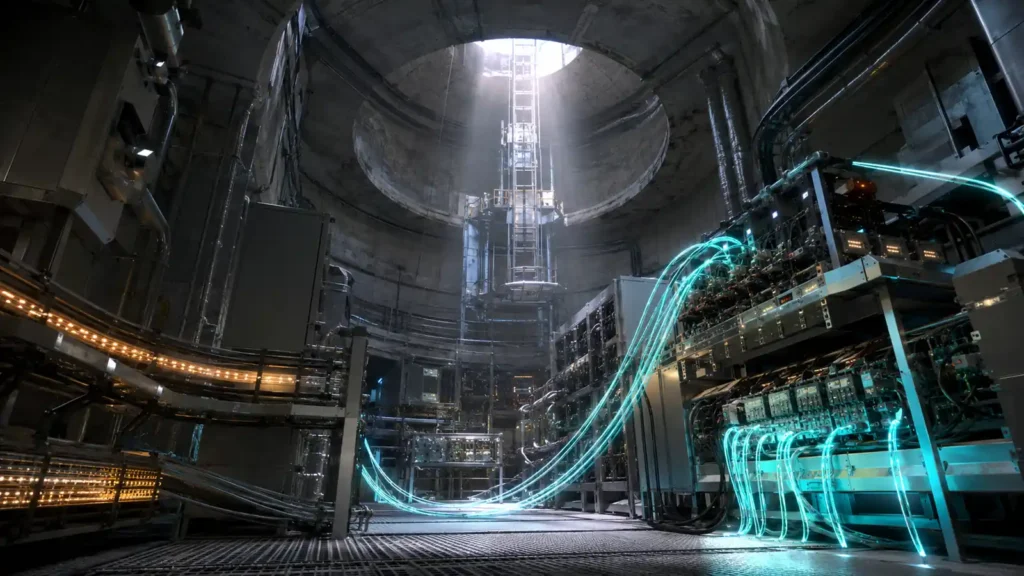
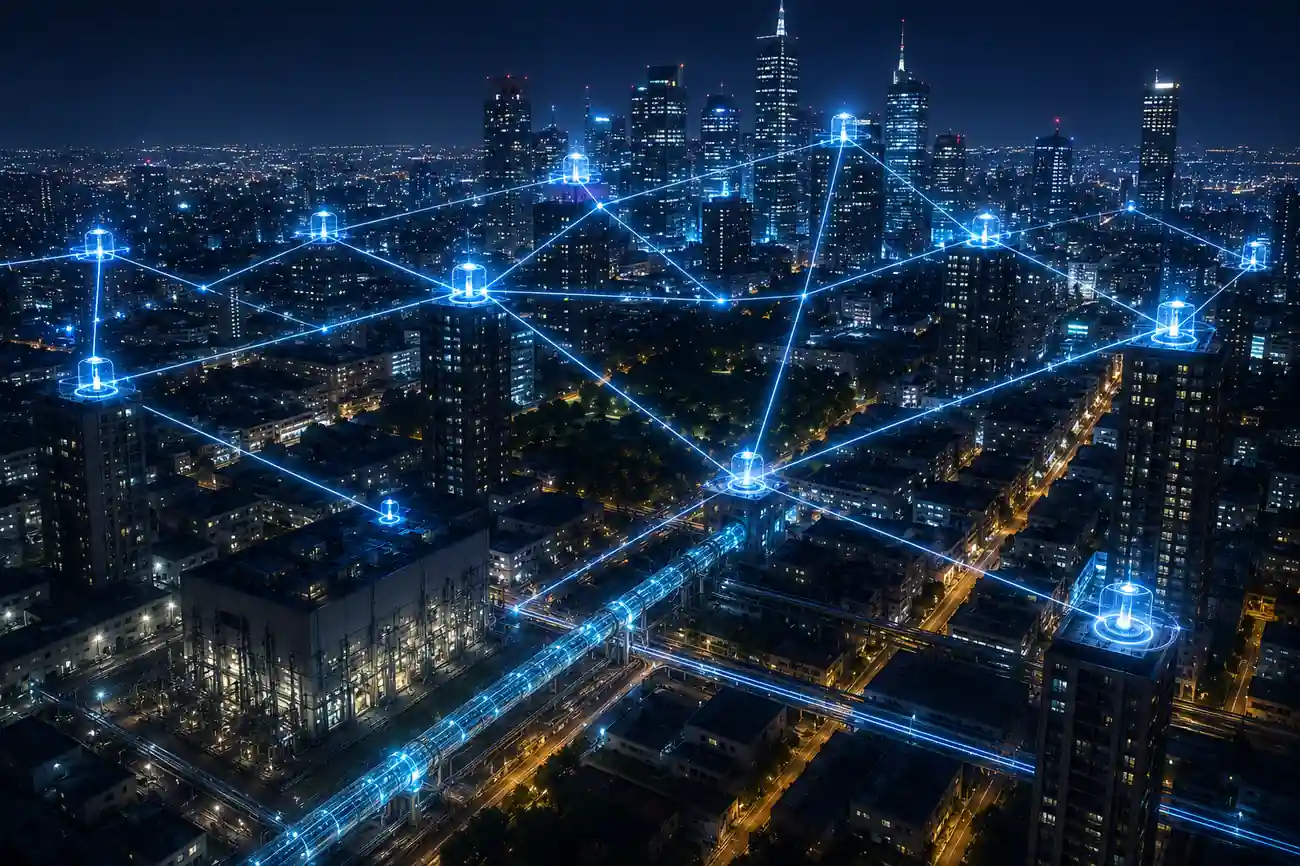
The grid’s physical infrastructure is a mesh of quantum routing nodes distributed across the city. Each node maintains a continuously refreshed inventory of entangled particle pairs, processes incoming and outgoing classical coordination signals, and operates as both an injection and an extraction point for energy. A city-scale deployment places primary nodes at one-to-two kilometer intervals, with secondary micro-nodes every few hundred meters in high-density districts.
The topology is a mesh, not a tree. There is no single trunk line carrying power to branches. Every node can reach every other node through multiple independent paths. When a node fails, its routing function distributes across adjacent nodes. The grid has no architectural single point of failure built into it.
The No-Communication Theorem and the Hybrid Architecture
Quantum entanglement carries a constraint that physics enforces without exception. The no-communication theorem states that entanglement alone cannot transmit information – or energy – faster than light. Any device claiming otherwise would require rewriting special relativity.
The quantum energy grid does not contradict it. The destination node cannot extract energy from its vacuum state until the classical coordination signal arrives from the source. That signal travels at the speed of light through a conventional fiber channel. The classical channel is not a workaround for the theorem – it is a structural component of the mechanism. Without it, the destination node cannot know which operation to perform, and the vacuum energy remains inaccessible.
Classical Signal, Quantum Delivery
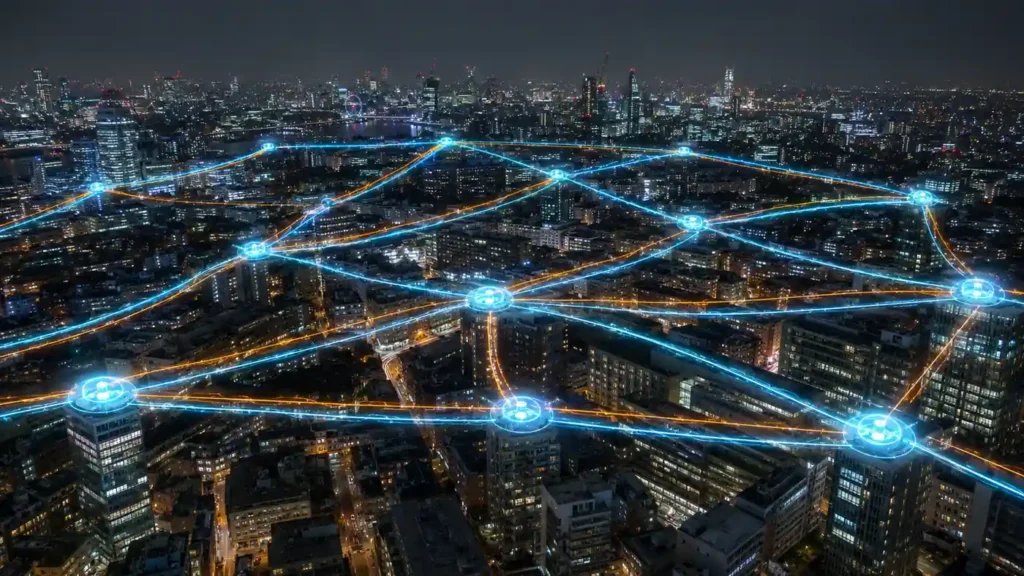
The hybrid architecture runs two parallel layers across every link in the grid simultaneously. A quantum fiber network generates, distributes, and maintains the entangled pairs between nodes – continuously, not on demand. A classical fiber network carries the coordination signals: when a transfer is initiated, what quantity is involved, and which measurement was performed at the source.
The quantum layer does the physical work that would otherwise require a copper cable. The classical layer is the control system. An interruption in the classical layer suspends transfers on that link. An interruption in the quantum layer degrades entanglement quality on that link. Both are recoverable through the mesh’s alternate paths. The constraint that appears to limit the system is also what makes the energy extraction controllable and precise.
What Zero Transmission Loss Means in Numbers
Tokyo’s metropolitan grid serves approximately 13 million households and consumes around 290 terawatt-hours annually. At a conservative distribution loss figure of 9 percent, 26 terawatt-hours disappear into cable heat every year. That number is roughly Singapore’s total annual electricity consumption. At Japan’s residential consumption rate of 4,500 kilowatt-hours per household, those 26 terawatt-hours – recovered by a quantum energy grid operating at under 1 percent loss – cover 5.7 million homes.
The global picture is less comfortable to sit with. World electricity production runs at approximately 28,000 terawatt-hours per year. Average transmission and distribution losses of 8 percent mean 2,240 terawatt-hours generated and wasted annually. At a weighted average carbon intensity of 475 grams of CO2 per kilowatt-hour, those losses represent approximately 1.06 billion tonnes of CO2 emitted every year to produce power that heated the ground.
| Parameter | Classical Grid | Quantum Energy Grid |
|---|---|---|
| Transmission and distribution losses | 8-15% | Under 1% |
| Urban distribution losses | 4-8% additional | Eliminated |
| Routing flexibility | Fixed cable infrastructure | Dynamic, node-to-node |
| Response to load spike | Seconds to minutes | Microseconds |
| Physical cable vulnerability | Extensive | No transmission cables |
| Third-party interception risk | Monitorable on trunk lines | Detectable by quantum mechanics |
Recovering 26 terawatt-hours that Tokyo’s grid currently loses as heat every year is the kind of number this archive was built to take seriously.
I make all of it alone, with no ads. If it is worth a coffee a month to you, that keeps the next one coming.
Keep it alive →Scaling From a Single Block to a Full Metropolitan Grid
A quantum channel between two nodes is a proof of mechanism. A city-wide mesh is an engineering problem of a different order, and the central challenge is maintaining entanglement integrity across the distances an urban grid requires.
Quantum entanglement is not robust under environmental interference. Vibrations, electromagnetic noise, and thermal fluctuations gradually disrupt the correlated state. High-quality quantum fiber maintains coherence reliably over short distances – across an urban area of tens of kilometers without active management, the entanglement degrades faster than it can be put to work.
Quantum Repeaters and the Distance Problem
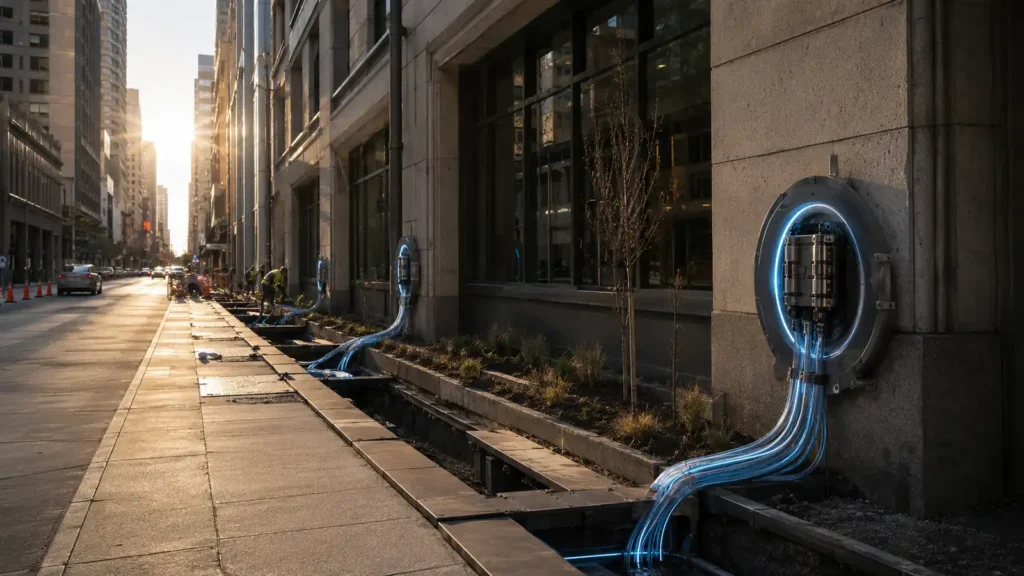
Quantum repeaters solve this by dividing a long-distance link into shorter verified segments. Each repeater creates fresh entangled pairs over its segment, confirms the state quality, and uses an entanglement swapping operation to extend the correlation to the next node in the chain. The result is a sequence of reliable short-range links functioning as a single long-range connection.
For the quantum energy grid, repeaters are not supplementary components. They are load-bearing infrastructure. City-scale deployment places repeater-equipped nodes at 50-to-100 meter intervals in high-density cores and every 500 meters in lower-density districts. The entanglement stock at each node needs continuous replenishment, which means the quantum fiber links operate always – not only when a power transfer is requested.
The mesh topology makes scaling economically favorable. A 10-node network has 45 possible direct links. A 100-node network has 4,950. Each additional node added to the mesh increases connectivity at a rate that outpaces the cost of the addition. The per-node cost of expanding coverage drops as the network matures. Building the first city block is the expensive part.
Which Cities Need This Grid First
Not every city has the same relationship with this device. The argument for early deployment scales with two factors: how aged the existing infrastructure is, and how much energy-critical load the city concentrates in small geographic areas.
Mumbai, Cairo, Karachi, and large sections of the US Northeast operate distribution infrastructure built primarily between the 1950s and 1980s. These grids face replacement cycles regardless of whether a quantum alternative exists. For these cities, the practical decision is not quantum grid versus a functioning classical grid – it is quantum grid versus another generation of copper cable burial in aging conduits.
At the application level, the first-deployment contexts are well-defined. Hospitals run life-critical systems where power interruption carries direct human consequences, and where a distributed mesh with no single point of cable failure provides immediate value beyond the efficiency argument. Data centers, which consume 1 to 2 percent of global electricity and operate at near-continuous maximum load, face carbon accounting pressures that make zero-loss routing materially significant. Urban rail systems concentrate enormous energy demand in linear corridors that map naturally onto a node-to-node mesh architecture – a metro network’s power demand profile is almost purpose-designed for quantum energy routing.
When Nodes Fail and the Network Keeps Running
Classical transmission grids have a failure mode that grid operators spend considerable effort managing. When a high-voltage line goes down, its load redistributes to adjacent lines. If those lines were already near capacity, the added load pushes them over. The 2003 Northeast blackout – which left 55 million people without power – originated with a software bug and a few overloaded lines in Ohio. The cascade was the grid’s own architecture working against it. Remove a trunk segment and the branches downstream lose their path.
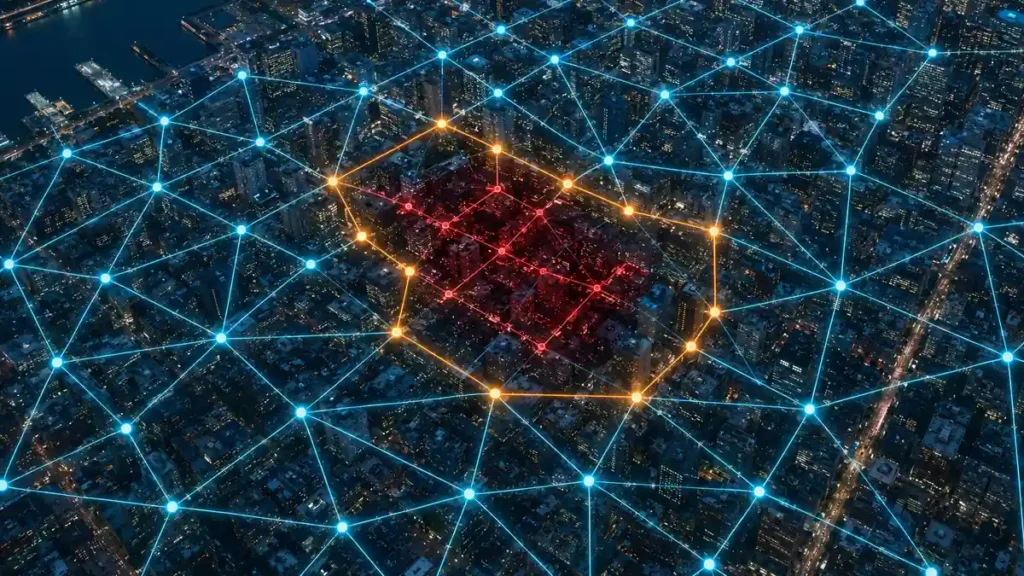
The quantum energy grid’s mesh topology has no trunk segments. When a node fails, the routing function distributes across adjacent nodes. The entanglement links connected to the failed node degrade, but the remaining mesh continues operating, routing energy requests through alternate paths. The failure is local. No physical mechanism propagates a sector failure into a city-wide event, because the city-wide grid is not a network with a center – it is a mesh with many centers simultaneously.
A major physical disaster that destroys a large area of nodes would reduce capacity in that area proportionally. A grid cannot route energy to nodes that no longer exist. But the failure boundary stays at the boundary of the physical damage. Beyond it, the city runs normally.
The Quantum City and What It Already Carries
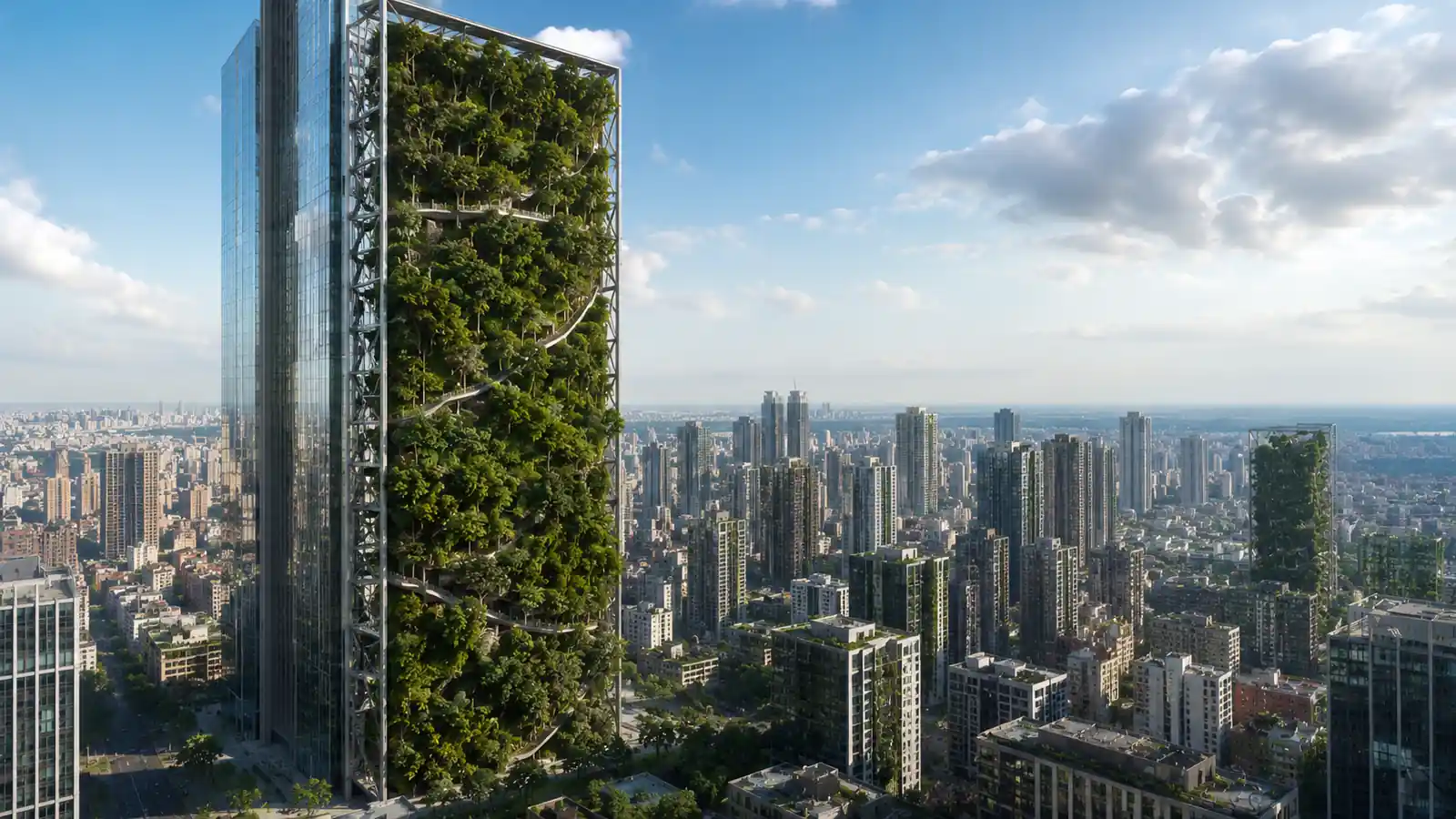
The quantum energy grid does not arrive alone. It shares node infrastructure with two other urban systems on converging technical trajectories: quantum communication networks, which use identical entanglement fiber for ultra-secure data transmission, and quantum sensor networks, which use entangled states for precision monitoring of structural integrity, air quality, and grid load conditions.
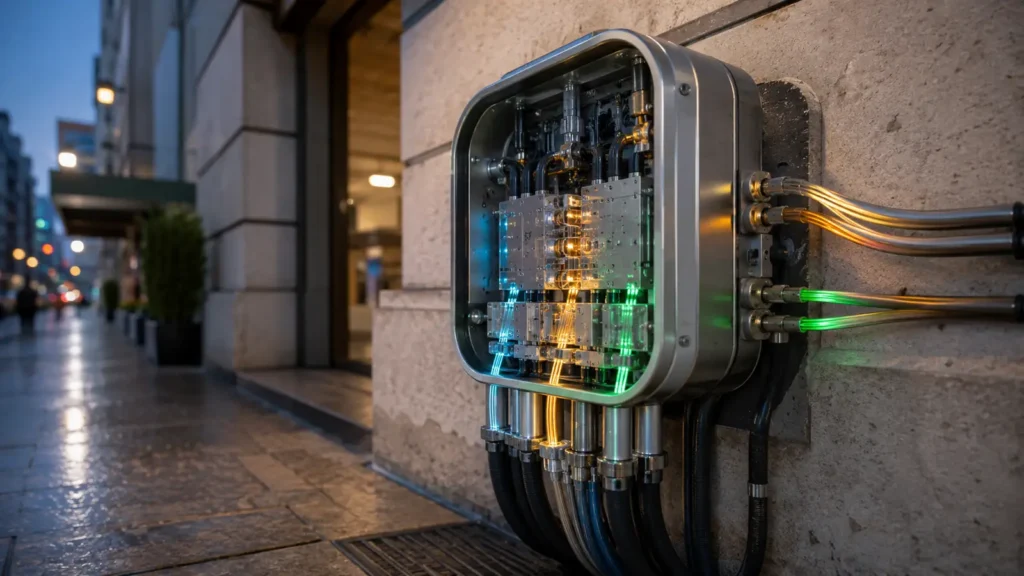
A city that builds the energy grid builds the physical backbone of a quantum communications network at near-zero marginal cost. The security characteristic follows from the same quantum mechanics that powers the energy transfer: any attempt to intercept or observe an entangled state without authorization disturbs that state in a way the network detects. The grid is not encrypted as an added feature – privacy is a structural property of quantum mechanics.
Artificial intelligence sits at the operational layer of the entire system. Managing thousands of entanglement pair allocations across a dynamic city load in real time, predicting demand spikes before they develop, and coordinating the entanglement refresh cycle so no node depletes its inventory during peak hours – no human operator functions at that speed or across that combinatorial complexity. The AI layer is a required operating component, not an optimization add-on.
The CO2 picture compresses neatly at the end. A city of 5 million recovering 9 percent of its electricity consumption from quantum transmission efficiency – 12 to 15 terawatt-hours per year – eliminates between 5.7 and 7.1 million tonnes of CO2 annually at the global average carbon intensity. Across the 33 cities with populations above 5 million, that figure becomes a number the planet notices.
The evolutionary arc of the device runs from a proof-of-concept quantum channel between two buildings, to a district-scale mesh covering a hospital campus, to a borough-scale deployment, to a full metropolitan grid. At each stage the mesh adds nodes, paths, and resilience. What starts as an energy efficiency project becomes, at city scale, a different category of urban infrastructure – one that handles power, communications, and sensing through a shared physical layer that classical copper grids cannot replicate at any voltage.
The View From NoSuchDevice
I find quantum technology writing frustrating for a specific reason: the word “quantum” functions as a full stop. Something is described as quantum, the audience treats the mechanism as inherently mysterious, and the actual physics never gets examined. The quantum energy grid is a test case for whether that pattern is necessary or just habitual.
The underlying mechanism – quantum energy teleportation – is real physics with a paper trail going back to 2008 and nothing physically preventing it from operating at larger scales. The no-communication theorem, which quantum-hype pieces routinely misunderstand, is not a barrier to this device. The classical coordination signal the theorem makes mandatory is exactly the control mechanism the grid needs to direct energy to specific nodes on demand. The constraint and the solution are the same thing. When that happens in a physics argument, it is worth paying attention to.
What interests me most about this device is not the efficiency figure, as large as 2,240 terawatt-hours of recovered global losses would be. It is the topology shift. A mesh that fails gracefully, cannot be intercepted without self-revealing, and shares infrastructure with a communications backbone is a structurally different kind of urban infrastructure from anything a copper-based grid can become. You cannot retrofit this capability onto the existing network. The architecture has to change.
The cities that make the strongest first candidates are not the ones with the newest infrastructure. They are the ones holding aging copper together with planning workarounds for twenty years while their populations and digital loads continue growing. For them, the question is not whether to replace the grid. The question is what to replace it with, and whether the next generation of cable burial is the last sensible version of that answer.
You read the whole thing.
That is rarer than it should be. A grid that delivers power to its destination without any of it traveling through the space in between is the kind of machine this archive was built to take apart. I make every piece alone, with no ads and no investor deciding what gets written. If you want the next machine taken apart like this one, you can help me make it.
A coffee a month is enough to keep it free for everyone.
Prefer crypto or a one time gift? Other ways to give →