






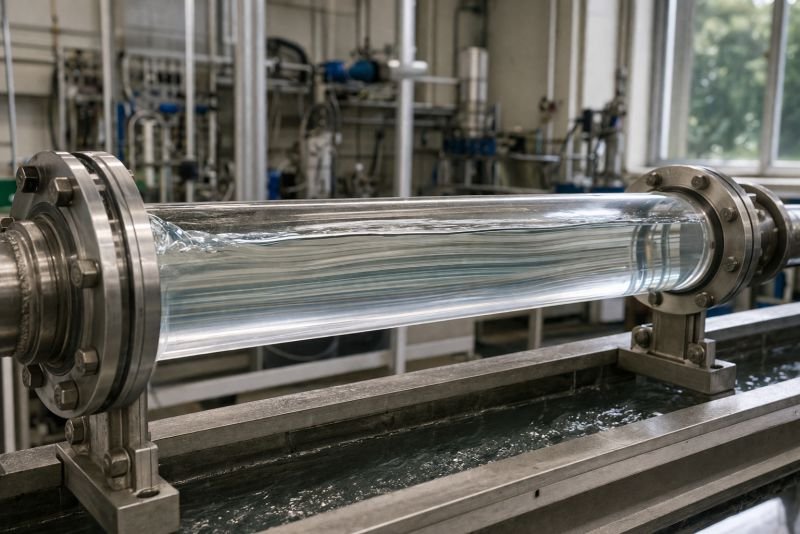
What Is Laminar flow?
Laminar flow is a fluid regime in which water moves in orderly layers, with minimal cross-mixing between adjacent streamlines. Velocity changes smoothly from the wall toward the center of the passage, and viscous forces dominate the motion. In circular pipes it is commonly associated with Reynolds number below about 2300, though real transitions depend on roughness, disturbances, and inlet conditions.
Large hydro plants rarely operate in fully laminar conditions because their passages are wide and their velocities are high. Even so, the concept remains useful as a baseline for understanding how friction develops before a flow becomes Turbulence. In a small test loop or narrow Penstock segment, laminar behavior produces predictable shear and comparatively low mixing.
The concept matters because it provides the reference case from which engineers judge transition, pressure loss, and model validity. In pipe-flow analysis for hydropower, knowing whether a region is laminar or not affects which friction correlations, sensor interpretations, and scale-model assumptions can be trusted when estimating efficiency and operating margins. It also clarifies when simple analytical predictions remain useful before complex eddy behavior takes over.
Example:
A laboratory water loop with low velocity and a smooth narrow tube can maintain laminar flow for careful calibration work.
Related Concepts:
- Viscous Shear
- Flow Transition
- Velocity Profile
NoSuchDevice is a free archive of machines that do not exist yet but already have a shadow in physics. I research and write every entry alone, with no ads. Take a look around the archive, or help keep it free.