




What Is Helium-3?
Helium-3 is a light, stable isotope of helium whose nucleus contains two protons and one neutron. It differs from common helium-4 by having one fewer neutron, which changes its nuclear mass, spin behavior, and reaction pathways. A notable fusion relation is D + He-3 -> He-4 + p + energy, producing a high-energy proton rather than a neutron-dominated output.
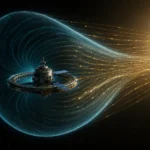
In real materials and plasmas, helium-3 is rare compared with helium-4, so its value depends on separation, storage, and source availability. It can appear in natural gas deposits, lunar regolith implanted by solar particles, and the solar wind. Because it is chemically helium, enrichment relies on physical isotope separation rather than ordinary chemistry.
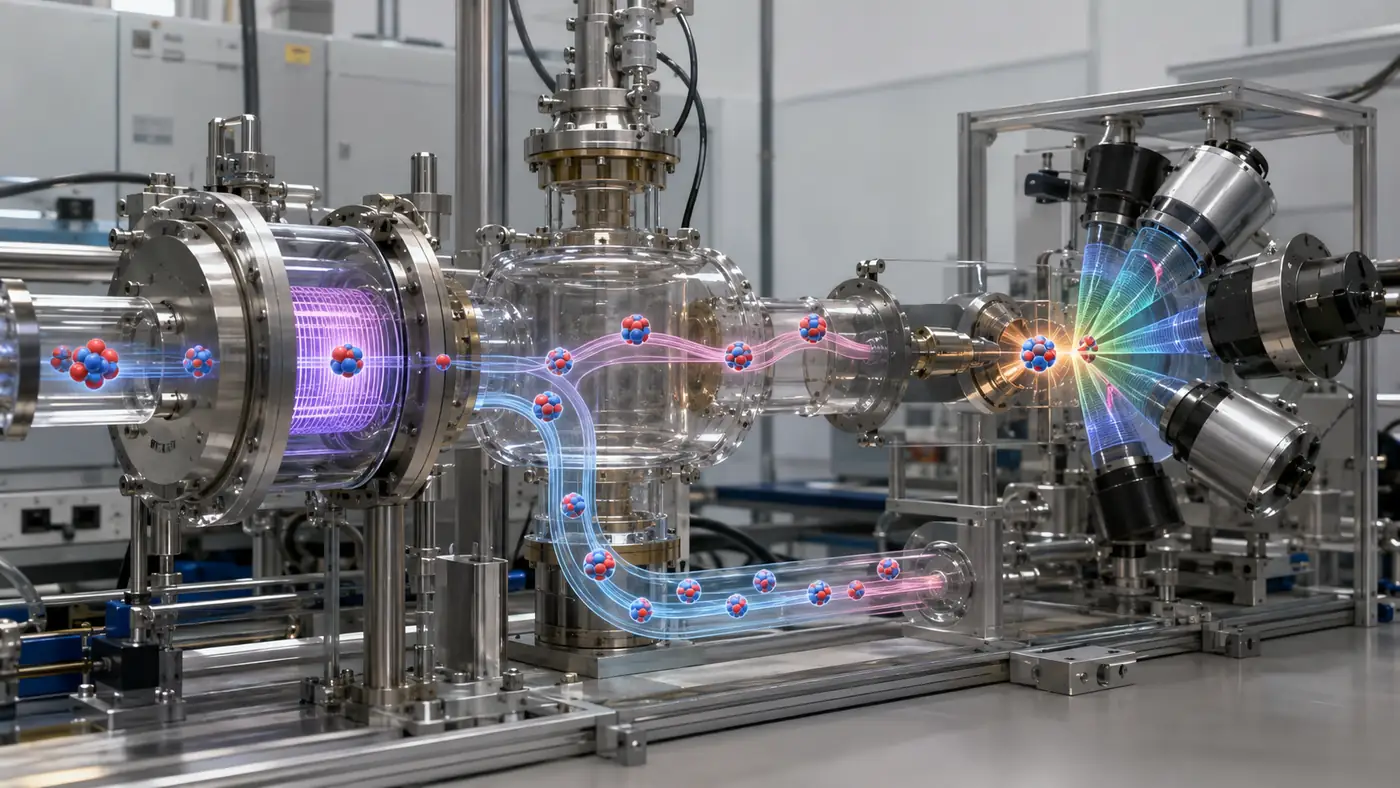
The concept matters because helium-3 is useful in cryogenics, neutron detection, magnetic resonance research, and proposed advanced fusion systems. In fusion fuel resource analysis, its scarcity determines whether collection and enrichment infrastructure is plausible. Used in devices include dilution refrigerators, neutron detectors, polarized gas targets, fusion test systems, and isotope separation equipment.
Researchers measure helium-3 abundance with mass spectrometry and isotope-ratio instruments that distinguish nuclei with nearly identical chemistry but different masses.
Example:
A neutron detector can use helium-3 gas because neutron absorption produces charged particles that are easier to measure electronically.
Related Terms:
- Solar Wind
- Particle Flux
- Isotope Separation
NoSuchDevice is a free archive of machines that do not exist yet but already have a shadow in physics. I research and write every entry alone, with no ads. Take a look around the archive, or help keep it free.