



What Is Solar wind?
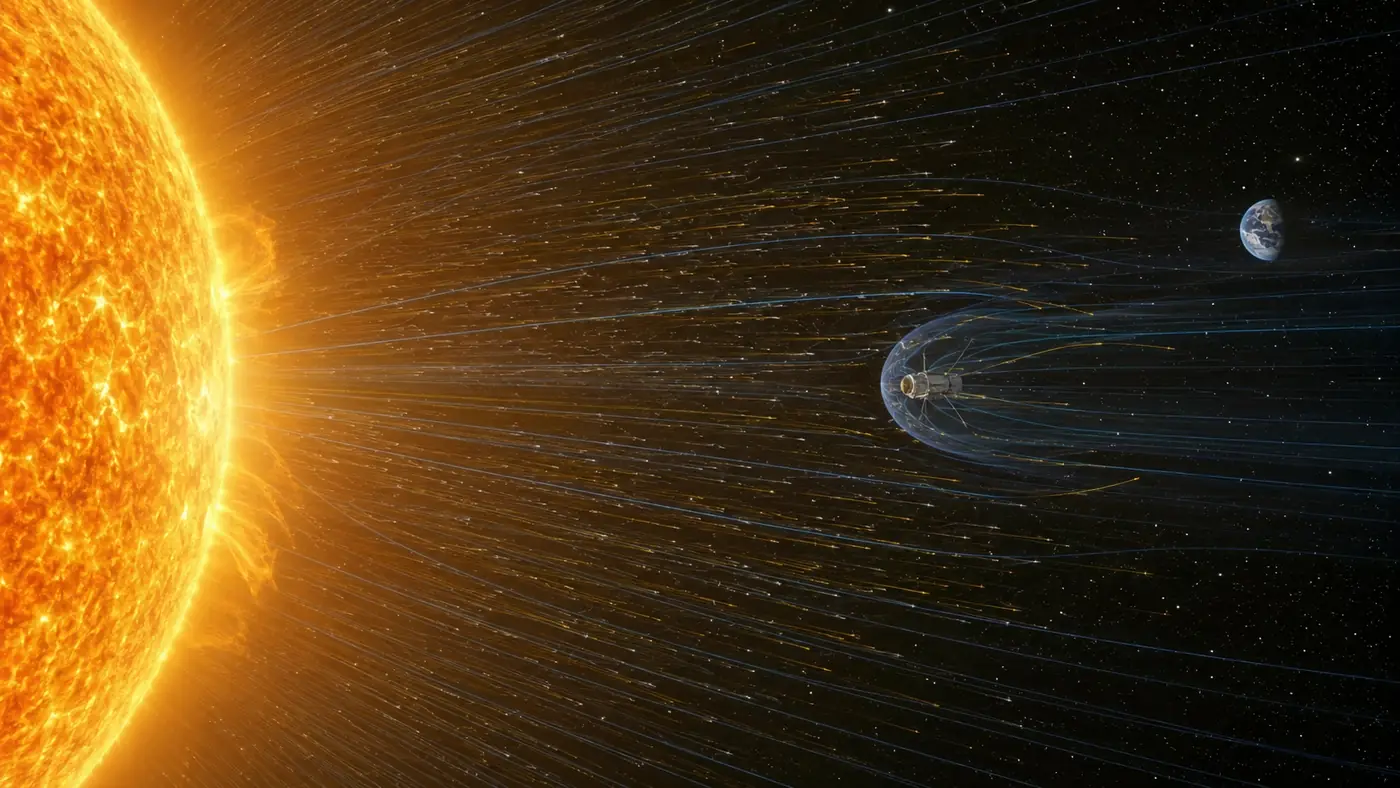
Solar wind is the continuous flow of ionized gas released from the Sun’s outer atmosphere into interplanetary space. It is a plasma made mostly of protons and electrons, with smaller amounts of helium nuclei and heavier ions. A useful relation is Phi = n v, where particle flux depends on number density and bulk flow speed.
In real space environments, solar wind speed, density, temperature, and magnetic structure vary with solar activity, heliographic latitude, and distance from the Sun. Fast streams, slow streams, shocks, and magnetic sector boundaries all change how the plasma interacts with planets, spacecraft, and artificial magnetic fields. At planetary scales, it can compress magnetospheres or feed auroral currents.
The concept matters because solar wind is the background plasma medium of the inner heliosphere. In heliospheric plasma collection, it supplies both charged particles and kinetic energy that can be redirected by electromagnetic fields. Used in devices include plasma analyzers, magnetometers, electrostatic particle detectors, solar-wind monitors, and spacecraft charging sensors.
Scientists measure it with particle counters, Faraday cups, ion spectrometers, and magnetometers that track velocity distributions, composition, and magnetic field direction over time.
Example:
A spacecraft near Earth can detect a faster solar wind stream before geomagnetic activity increases at the planet.
Related Terms:
NoSuchDevice is a free archive of machines that do not exist yet but already have a shadow in physics. I research and write every entry alone, with no ads. Take a look around the archive, or help keep it free.