



What Is Particle flux?
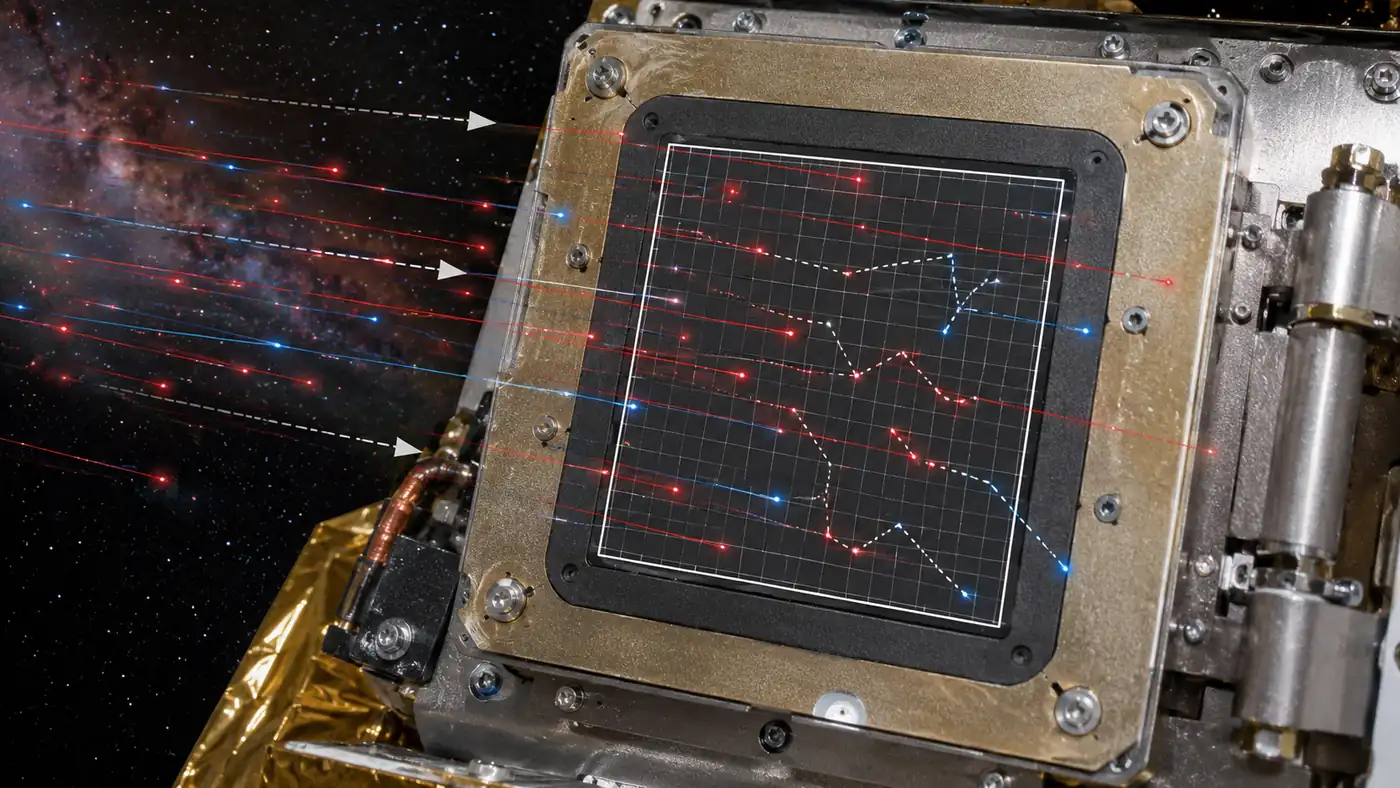
Particle flux is the number of particles crossing a unit area in a unit time. It describes how intense a stream of atoms, ions, electrons, neutrons, or photons is at a surface or detector. For a uniform beam moving perpendicular to an area, Phi = N / (A t), and in a flowing gas or plasma it is often approximated as Phi = n v.
In real systems, particle flux depends on direction, energy distribution, density, speed, and how the detector is oriented relative to the incoming stream. A surface may receive different fluxes for different particle species, so instruments often separate ions from electrons or sort particles by energy. Shielding, magnetic fields, and scattering can also reshape the measured flux.
The concept matters because it turns particle motion into an engineering quantity for radiation exposure, plasma collection, surface processing, and astrophysical measurement. In space plasma instrumentation, particle flux determines how many charged particles a collector or sensor can intercept. Used in devices include Faraday cups, ion counters, radiation dosimeters, particle accelerators, and plasma processing chambers.
Measurements usually report flux by particle type and energy range, because the same count rate can imply very different power, dose, or material effects.
Example:
A radiation monitor on a spacecraft can register a higher proton particle flux during a solar storm.
Related Terms:
- Solar Wind
- Coronal Mass Ejection
- Number Density
NoSuchDevice is a free archive of machines that do not exist yet but already have a shadow in physics. I research and write every entry alone, with no ads. Take a look around the archive, or help keep it free.