





What Is L1 Lagrange point?
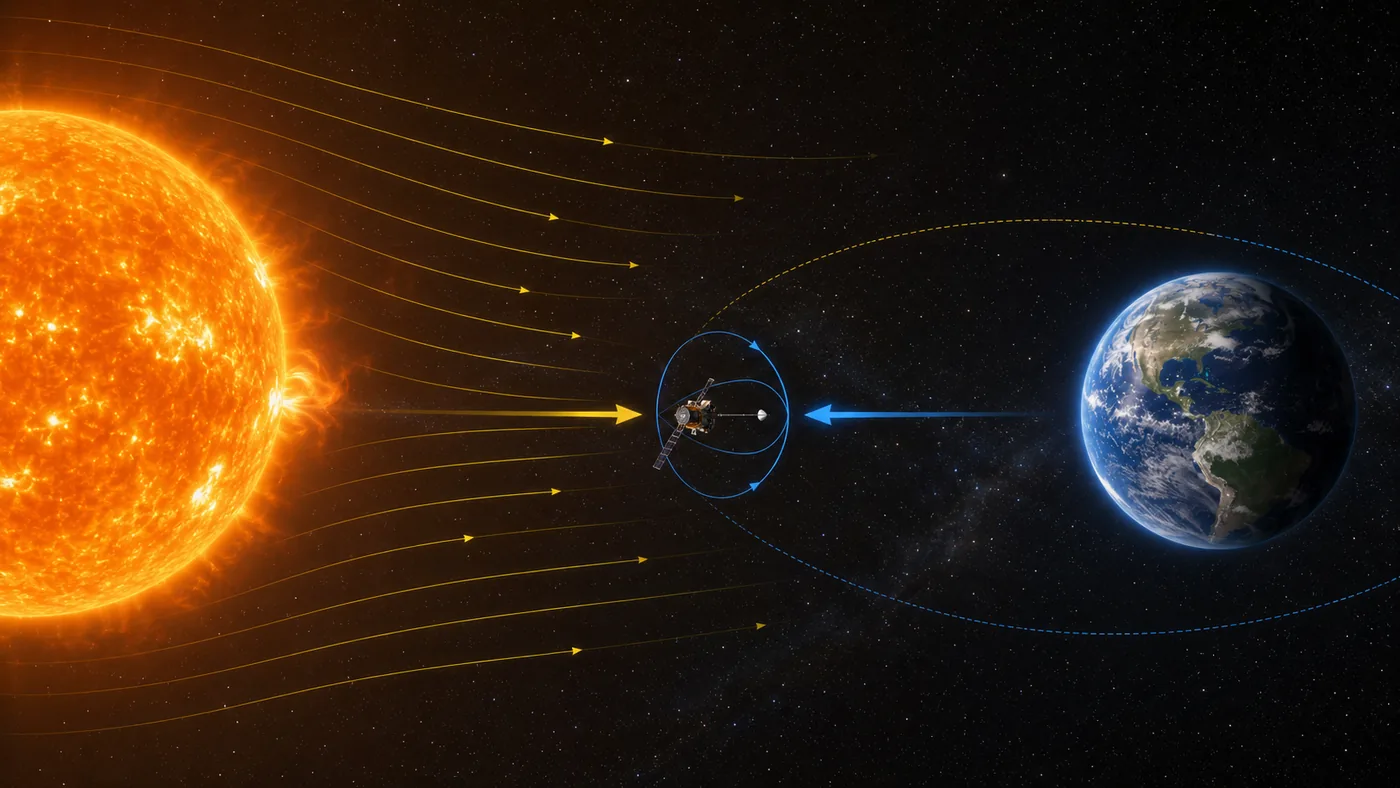
L1 Lagrange point is the first collinear balance region between two orbiting bodies, located between the smaller body and the larger one. At this location, gravity and orbital motion combine so a spacecraft can remain near the line connecting the two bodies with modest station-keeping. For the Sun-Earth system, the distance from Earth is approximated by r = R(M_E / 3M_S)^(1/3).
In real mission design, L1 is not a fixed parking spot but a region where spacecraft use halo or Lissajous orbits around the mathematical point. Small corrections are still required because perturbations from other bodies, radiation pressure, and orbit geometry gradually move the spacecraft away. The point offers continuous sunlight and an unobstructed view toward the Sun.
The concept matters because L1 is useful for solar observation, space weather warning, and upstream sampling of interplanetary plasma before it reaches Earth. In deep-space logistics, it can host infrastructure outside much of Earth’s magnetospheric shielding. Used in devices include solar observatories, plasma monitors, magnetometers, relay spacecraft, and propellant depot concepts.
Mission planners evaluate L1 operations with gravitational models, station-keeping budgets, communication geometry, thermal conditions, and access trajectories from Earth or lunar space.
Example:
A solar monitoring spacecraft near Sun-Earth L1 can sample incoming plasma before the same disturbance reaches Earth’s magnetosphere.
Related Terms:
- Solar Wind
- Particle Flux
- Orbital Mechanics
NoSuchDevice is a free archive of machines that do not exist yet but already have a shadow in physics. I research and write every entry alone, with no ads. Take a look around the archive, or help keep it free.