




What Is Magnetic dipole field?
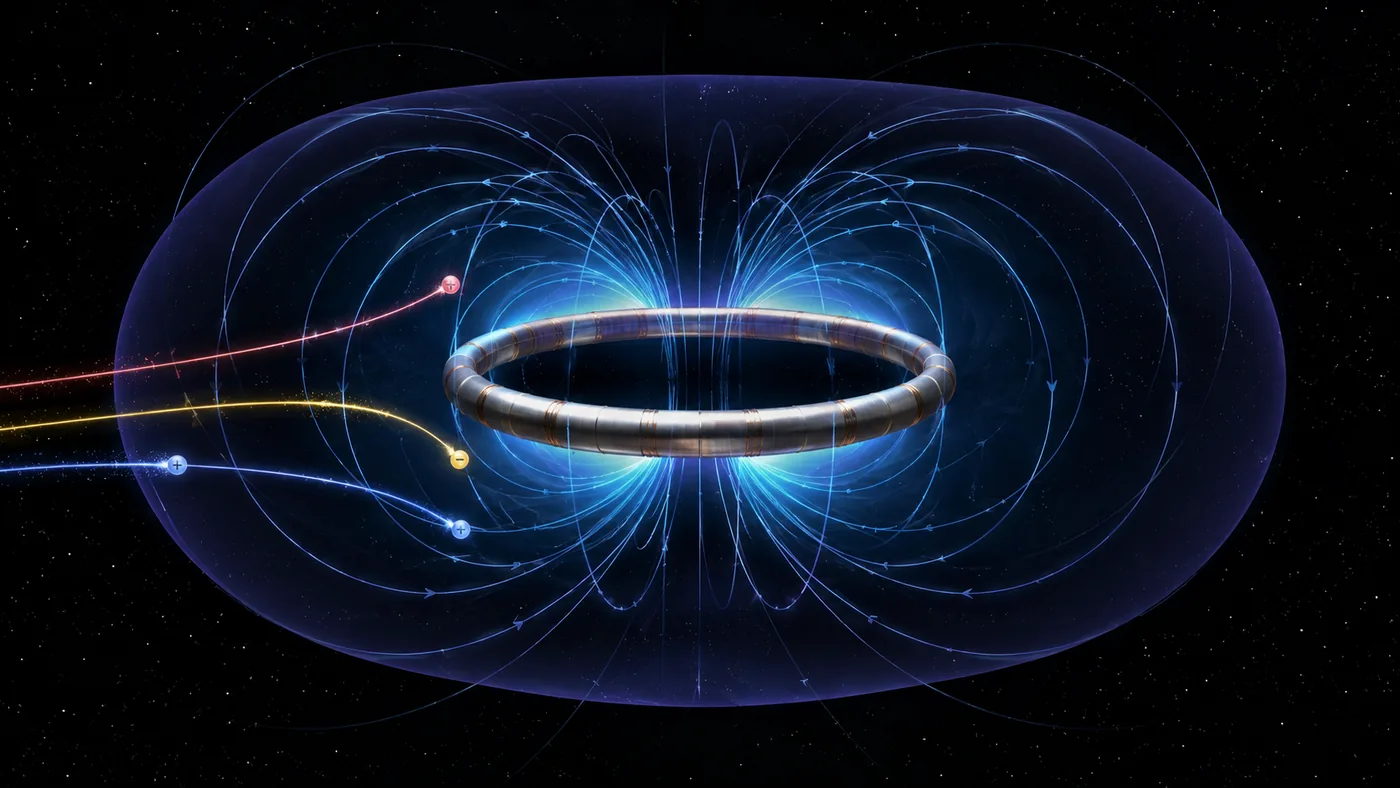
A magnetic dipole field is the magnetic field pattern produced by a small current loop, bar magnet, or magnetized body with north and south poles. Far from the source, many magnetic systems behave like dipoles even when their internal structure is complex. Along the dipole axis, the field strength scales approximately as B proportional to m / r^3, where m is magnetic moment.
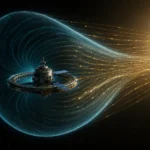
In real systems, dipole fields curve outward from one pole and return toward the other, forming closed field lines. Their strength falls rapidly with distance, so nearby geometry, coil shape, surrounding plasma, and external fields can distort the ideal pattern. Charged particles encountering the field may spiral, mirror, or be diverted depending on speed and pitch angle.
The concept matters because dipole fields are the first approximation for planets, coils, magnets, and magnetic shields. In magnetic plasma interaction, a dipole-like field can enlarge the effective area that deflects incoming charged particles. Used in devices include magnetometers, magnetic bearings, plasma traps, spacecraft attitude systems, and superconducting coil assemblies.
Field mapping usually combines sensor measurements with numerical models, because practical dipoles include higher-order distortions, structural limits, and time-varying currents.
Example:
Earth’s magnetosphere is often modeled first as a tilted magnetic dipole field before solar wind distortion is added.
Related Terms:
- Lorentz Force
- Solar Wind
- Magnetic Moment
NoSuchDevice is a free archive of machines that do not exist yet but already have a shadow in physics. I research and write every entry alone, with no ads. Take a look around the archive, or help keep it free.