



What Is Lorentz force?
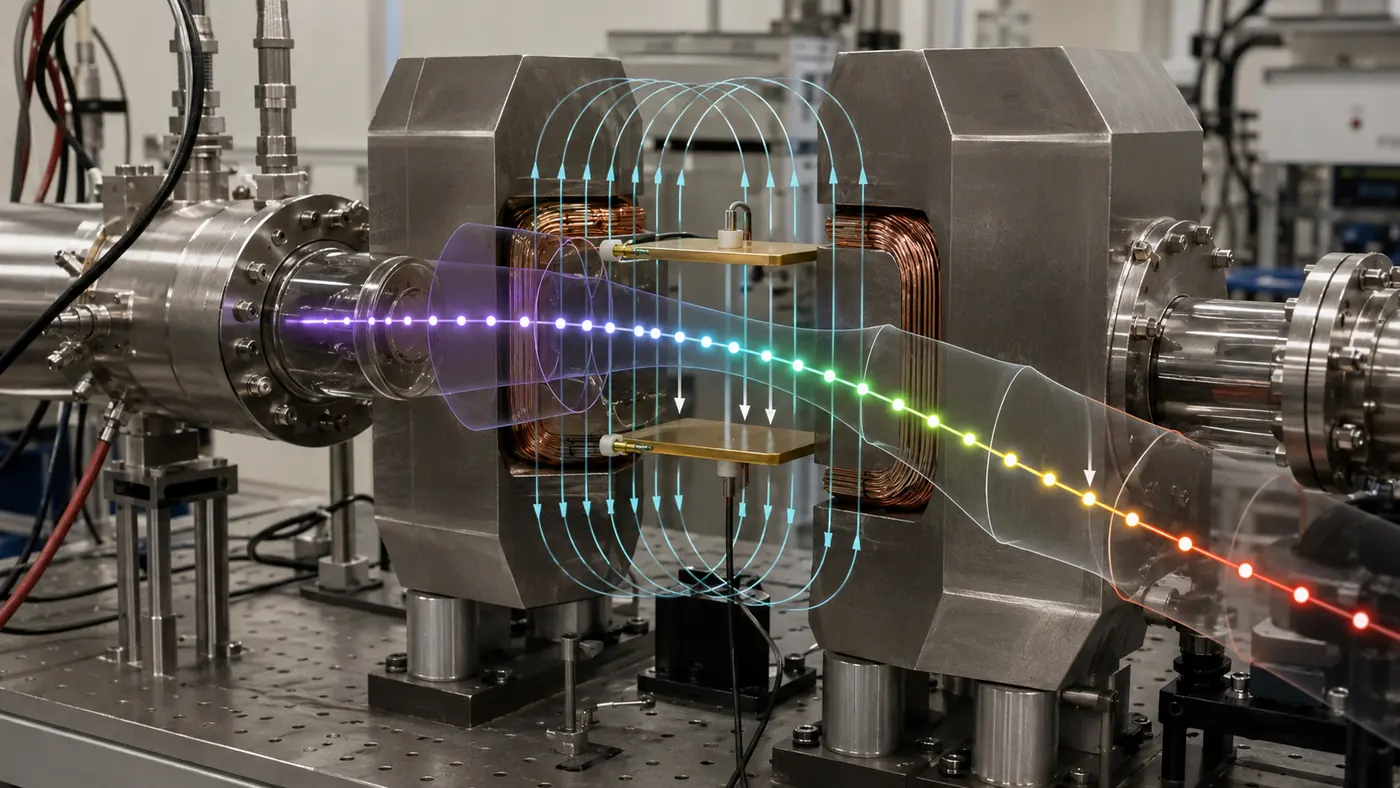
Lorentz force is the force acting on a charged particle because of electric and magnetic fields. It combines acceleration from an electric field with sideways deflection from motion through a magnetic field. The standard relation is F = q(E + v x B), where q is charge, v is particle velocity, E is electric field, and B is magnetic field.
In real systems, the magnetic part bends particle paths without directly changing their speed, while the electric part can add or remove kinetic energy. The resulting motion may be circular, helical, trapped, or guided along field lines depending on field geometry and particle energy. In plasmas, many individual Lorentz forces combine into currents, waves, drifts, and large-scale field interactions.
The concept matters because it explains how electromagnetic fields steer charged matter in instruments, machines, and space environments. In charged-particle control, Lorentz force determines whether incoming ions are deflected, focused, or captured. Used in devices include mass spectrometers, cyclotrons, Hall thrusters, magnetic confinement systems, and plasma probes.
Engineers estimate it from particle charge, velocity, and local field maps, then test trajectories with detectors or simulations that include collisions and field gradients.
Example:
An ion entering a magnetic field at an angle can spiral along the field direction instead of moving in a straight line.
Related Terms:
NoSuchDevice is a free archive of machines that do not exist yet but already have a shadow in physics. I research and write every entry alone, with no ads. Take a look around the archive, or help keep it free.