


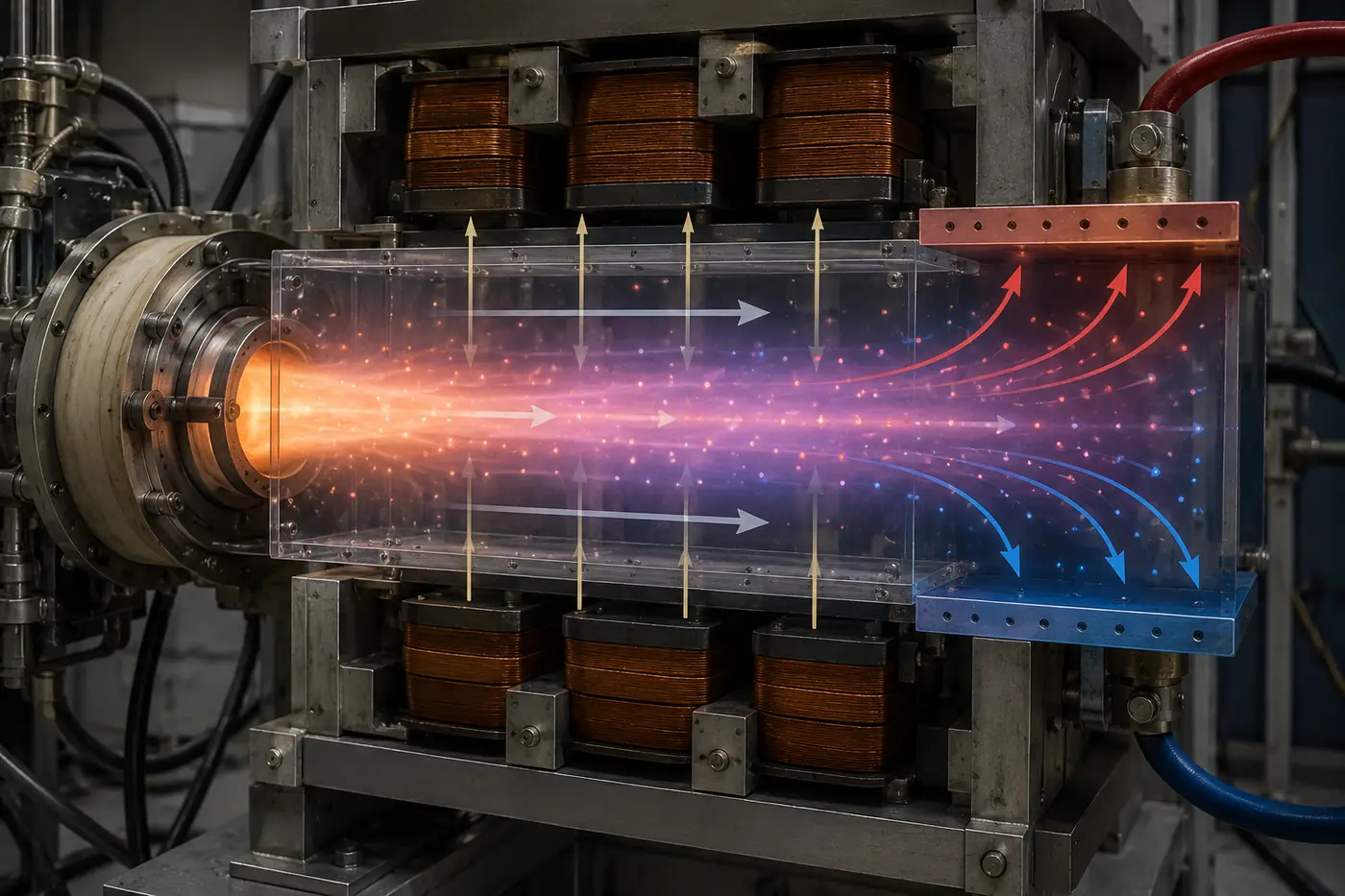
What Is Magnetohydrodynamic generation?
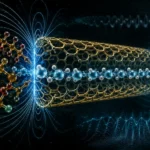
Magnetohydrodynamic generation is the direct production of electricity from a moving electrically conducting fluid passing through a magnetic field. The fluid may be plasma, ionized gas, or liquid metal. Charge carriers separate across the flow, creating voltage without a rotating turbine. A simple relation is E = v x B for the induced electric field.
In real systems, output depends on fluid conductivity, flow speed, magnetic-field strength, electrode design, and losses from turbulence or recombination. High temperatures or ionization are often needed to make the fluid conductive enough. Used in devices include MHD generator channels, plasma power experiments, liquid-metal converters, and advanced space energy systems.
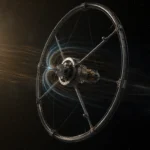
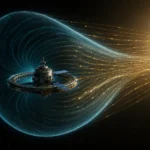
The concept matters because it can convert kinetic or thermal energy into electrical power with few moving parts. In space plasma power conversion, MHD generation offers a way to extract electricity from charged flow redirected through a magnetic channel. It also appears in research on fusion blankets, hypersonic flows, and high-temperature power cycles.
Engineers assess MHD systems by measuring open-circuit voltage, current density, plasma conductivity, electrode erosion, and magnetic-field uniformity. Practical designs must manage heat and material degradation.
Example:
A hot ionized gas stream moving through a transverse magnetic field can develop a voltage between electrode walls.
Related Terms:
NoSuchDevice is a free archive of machines that do not exist yet but already have a shadow in physics. I research and write every entry alone, with no ads. Take a look around the archive, or help keep it free.