






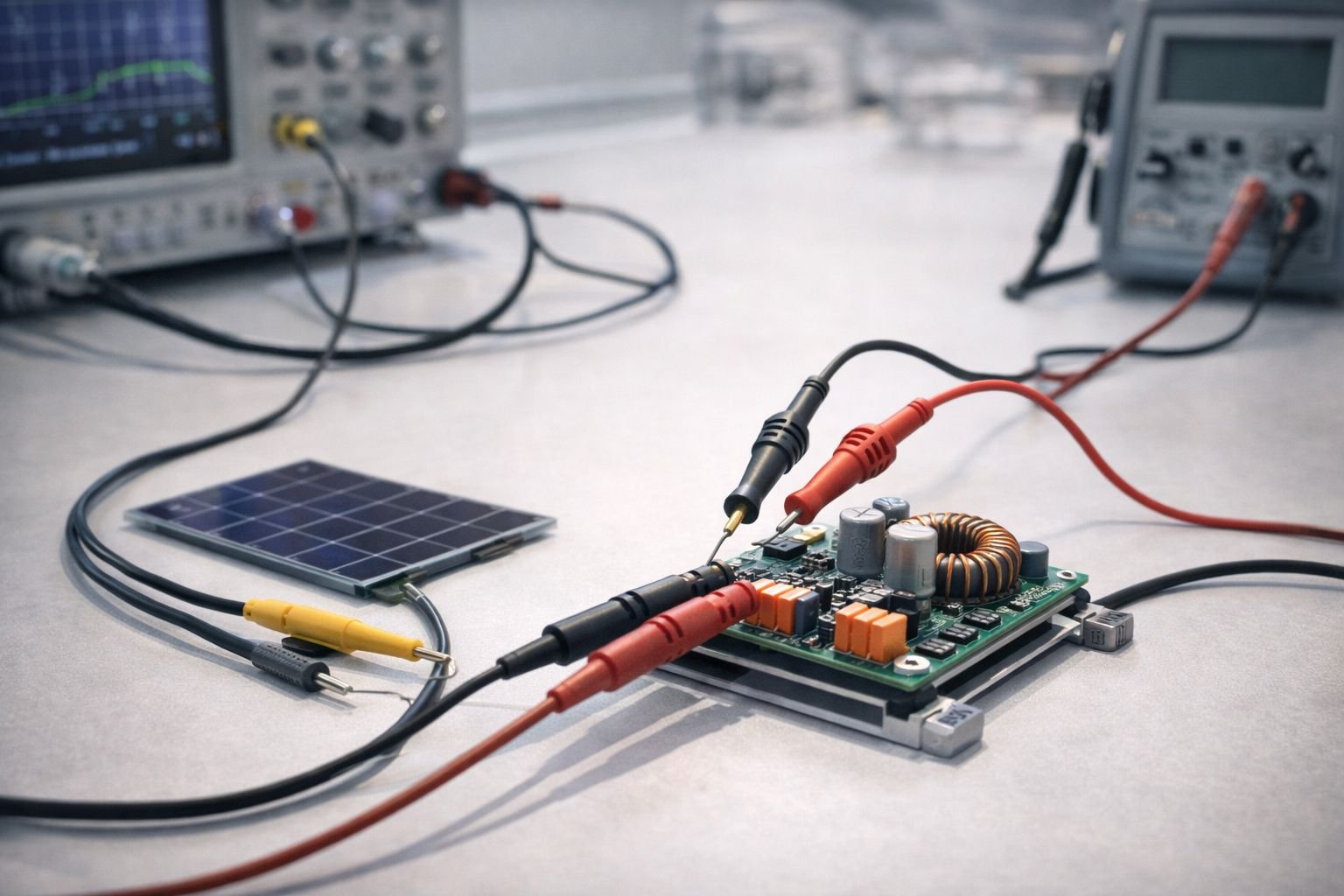
What Is Maximum Power Point Tracking (MPPT)?
Maximum power point tracking is a control method that keeps an energy-harvesting source operating at the voltage and current where its electrical output is highest. Because solar cells and other generators have nonlinear current-voltage curves, the point of maximum power shifts with light level, temperature, load conditions, and internal resistance.
In distributed textile power conversion, MPPT becomes especially useful because different yarn bundles can see different illumination at the same moment. Local conversion electronics can adjust each section independently instead of forcing the whole garment to run at one compromise operating point that wastes available energy.
A defining condition at the optimum is dP/dV = 0, with power given by P = V x I. Why it matters is that even a good photovoltaic or thermal harvester can lose a large share of its output if the external circuit holds it away from its real maximum-power operating point.
Used in devices include solar chargers, battery-management modules, and thermoelectric harvesting systems. Common implementations use perturb-and-observe or incremental-conductance control because the tracker must react to changing conditions quickly without consuming too much of the power it is trying to recover.
Example:
A portable charger can produce more usable energy during partial shading when its controller continuously retunes the input operating point.
Related Terms:
NoSuchDevice is a free archive of machines that do not exist yet but already have a shadow in physics. I research and write every entry alone, with no ads. Take a look around the archive, or help keep it free.