






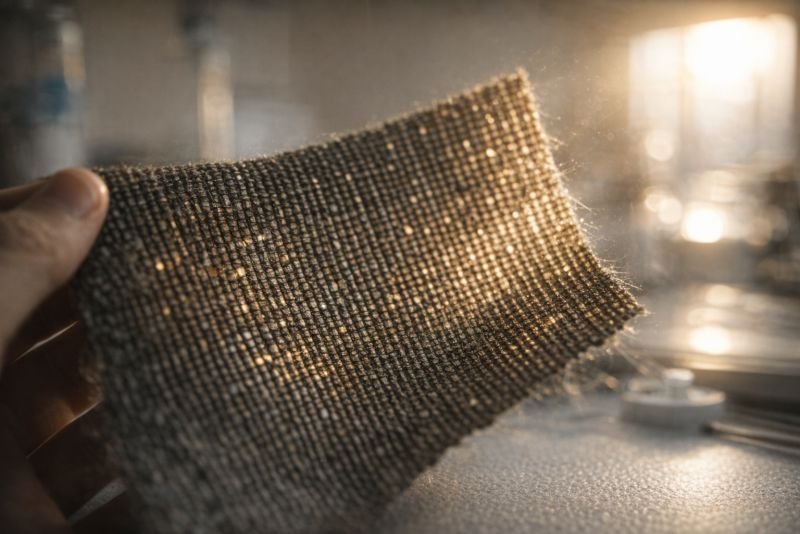
A person walking through a city on a clear June afternoon has roughly 1,700 square centimeters of fabric facing the sky. The jacket, the shoulders, the sleeves – all of it sitting under direct sunlight, absorbing photons and converting them to heat. Nobody designed that surface to do anything with the energy. For most of textile history, the materials that could catch it did not bend, and the materials that bent could not catch it.
That constraint is dissolving.
The short version: Photovoltaic fibers woven directly into fabric could generate 2-4 watts from a typical jacket under direct sunlight – enough to trickle-charge a phone or power a GPS unit continuously. The real barriers are not the fiber itself but the electrical architecture inside the textile and the encapsulation chemistry that keeps it working after contact with moisture and mechanical stress. A mature solar garment assumes those problems are solved. The physics already permits it.
Key Takeaways
- A standard jacket in direct sun has enough surface area to generate 2-4W continuously – modest but genuinely useful for low-draw devices
- The human body is a moving, tilting, shadow-casting object, which cuts theoretical efficiency by 40-60% compared to a fixed panel
- Organic photovoltaic fibers bend without fracturing; inorganic alternatives are more efficient but significantly more brittle
- The hardest engineering problem is not the fiber – it is wiring thousands of microsources inside a fabric without adding rigidity or bulk
- Solar textiles make clear sense in three scenarios: military field operations, urban active commuting, and body-heat-plus-solar hybrid harvesting
Table of Contents
A Surface That Has Been Wasting Energy for Decades
A standard rooftop solar installation occupies 15-20 square meters and generates 3-5 kW under good conditions. The math behind that number – watts per square meter of exposed surface – applies to any surface under the same light. A human body walking through a city at noon is, in photovoltaic terms, a small mobile platform carrying roughly 0.17 square meters of sun-facing area depending on posture and garment coverage. Nobody has ever tried to use it seriously, because the surfaces were the wrong material.
The Gap Between What the Body Carries and What It Uses
Wearable electronics have a power problem. A GPS unit draws 30-100 mW. A small radio transmitter needs 500 mW to 2 W. Modern fitness sensors pull less than 10 mW each. None of these numbers are large in absolute terms, but all of them require either a battery or a continuous energy input, and batteries in field conditions are a logistical constraint that has caused real operational failures. The body walks through daylight carrying a surface that intercepts solar radiation continuously. Connecting those two facts has been the obvious idea for four decades. The obstacle was never the concept.
Why Fabric and Photovoltaics Have Always Been a Bad Match
A silicon solar cell is a rigid ceramic-like structure optimized for one job: sitting flat, staying clean, and not moving. Fabric is optimized for exactly none of those things. Bending a conventional PV cell past a radius of a few centimeters introduces microfractures in the semiconductor layer. Repeated flexion – like an elbow joint completing ten thousand cycles in a workday – destroys the electrical contacts. The first generation of “solar fabric” prototypes were essentially flexible panels sewn onto textile carriers, not photovoltaic fibers woven into the structure itself. They worked until the wearer sat down.
The device described here is different. It assumes photovoltaic material woven at the fiber level – individual threads that generate current – not panels attached to fabric. That distinction matters more than it sounds.
How Photovoltaic Fibers Would Actually Work
Getting photovoltaic function into a weavable thread requires rethinking what a solar cell is geometrically. A flat panel works by exposing a broad semiconductor junction to light. A fiber has to do the same thing in three dimensions, wrapped around a core that is flexible enough to survive a loom and a human body in motion.
From Silicon Wafer to Weavable Thread
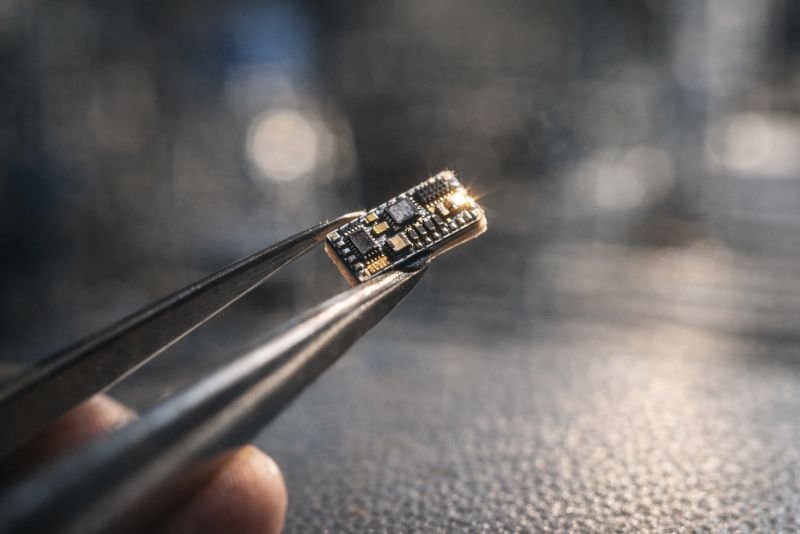
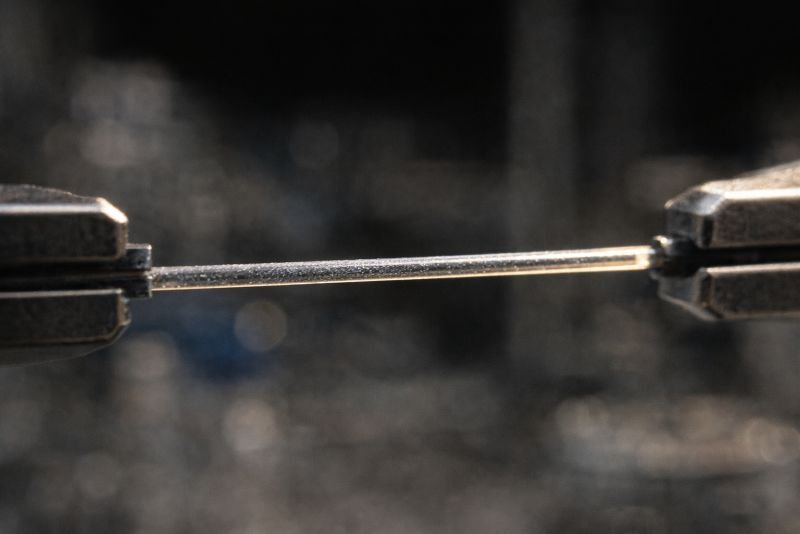
The basic architecture of a photovoltaic fiber involves a conductive core – typically a thin metal wire or carbon fiber – coated with a photoactive semiconductor layer, then wrapped in a transparent conductive outer shell. Light enters through the outer layer, generates electron-hole pairs in the semiconductor, and the charge separates across the junction toward the two conductive surfaces. The geometry is cylindrical rather than planar, which has an important side effect: a fiber can absorb light from any lateral direction without reorienting. A flat panel has one productive face. A fiber, in principle, has no dead side.
In practice, the coating uniformity required to make this work at fiber diameters of 50-200 micrometers is not trivial. Defects in a semiconductor coating at that scale create recombination centers where charge carriers are lost before they reach the electrodes. At lab conditions, fiber-scale PV devices have demonstrated efficiencies in the 3-8% range. A mature version of this device assumes processing improvements push that to 10-15% – a figure already achieved in small-area flexible OPV devices and not physically prohibited at the fiber scale.
Organic vs Inorganic: The Two Paths to a Solar Fiber
The two serious candidates for the photoactive layer pull in opposite directions on every relevant axis.
Inorganic fibers – based on CIGS (copper indium gallium selenide) or amorphous silicon – achieve higher efficiencies, around 10-18% in thin-film form, and have decades of reliability data behind them. The problem is mechanical. CIGS is a brittle polycrystalline material. Deposited on a fiber and bent repeatedly, it develops microcracks. Flexible CIGS solar cells exist, and they survive bending radii down to about 5 centimeters with careful substrate engineering. Whether that translates to yarn-scale fibers undergoing thousands of bend cycles per day is an open question that current prototypes have not answered well.
Organic photovoltaics (OPV) use carbon-based semiconductor polymers – materials that are intrinsically flexible and processable at lower temperatures. Efficiency is lower, typically 8-13% in current thin-film OPV, but the mechanical tolerance is substantially better. An organic semiconductor polymer deposited on a fiber core can survive bending radii under 1 centimeter without fracturing, which is the threshold where fabric behavior begins. The tradeoff is degradation under UV exposure and atmospheric oxygen – OPV materials lose efficiency over months to years without encapsulation. A solar textile relying on OPV fibers requires either a very robust encapsulant or a design philosophy that accepts gradual efficiency loss as an operating characteristic.
The mature device described here assumes OPV fibers with an engineered encapsulant that extends operational lifetime to the range of conventional clothing – call it 5-10 years of regular use. That is a materials science problem, not a physics problem.
The Wiring Problem Nobody Talks About
A jacket woven from PV fibers might contain 50,000 to 200,000 individual photovoltaic threads, each generating a small and variable current depending on its instantaneous illumination. Connecting these in a way that aggregates their output into a usable DC supply is the engineering challenge that receives the least attention in popular coverage and the most attention in actual research.
The fundamental issue is mismatch. In a conventional solar array, panels are wired in strings where shading one panel degrades the output of the entire string. In a woven fabric, partial shading is not an exception – it is the constant operating state. A sleeve facing away from the sun generates nothing while the shoulder generates at near-peak output. Series wiring would mean the unlit fibers actively drag down the lit ones. Parallel wiring avoids that but requires current collection architecture that can handle thousands of low-voltage parallel sources without resistive losses eating the output.
The solution direction involves localized power conversion – small distributed DC-DC converters at the yarn bundle level rather than at the garment level, so each bundle operates at its own maximum power point independently. Embedding that kind of electronics into woven structure without making the fabric rigid is a packaging problem that does not have a clean answer yet. A working solar textile at the scale described here requires solving it.
What the Numbers Say About a Solar T-Shirt
The back of a standard men’s t-shirt covers approximately 0.06 square meters. A jacket back and shoulders combined reach about 0.12 square meters. Take the jacket as the target surface.

Under direct sunlight at peak conditions (1,000 W/m2, AM1.5 spectrum), with OPV fiber efficiency at 10%:
P = A x G x eta
P = 0.12 m2 x 1,000 W/m2 x 0.10 = 12 W (theoretical maximum)
That number applies to a flat, optimally tilted, fully illuminated panel. A jacket on a body is none of those things. Realistic derating factors:
| Factor | Estimated loss |
|---|---|
| Body movement and random fiber orientation | -25% |
| Partial self-shading (arm over torso, bag strap) | -20% |
| Non-optimal sun angle (urban walking, trees, buildings) | -30% |
| Wiring losses and conversion inefficiency | -10% |
| Combined realistic output | ~2.5 W |
2.5 W continuous during daylight hours. Over a 6-hour active outdoor day, that is 15 Wh – enough to charge a smartphone from empty to about 40%, power a GPS unit for the full day with margin to spare, or keep a low-power radio transmitter running continuously. Modest. Genuinely useful for specific applications. Worth pursuing for those applications.
For a full-body suit – jacket, trousers, hat, gloves – the realistic aggregate approaches 6-8 W. That starts to cover more substantial loads.
Everything here is free. Readers are the reason it stays that way.
I make all of it alone, with no ads. If it is worth a coffee a month to you, that keeps the next one coming.
Keep it alive →The Moving-Body Problem
A fixed solar panel can be tilted toward the sun. A rooftop installation can be optimized for the local latitude. A person walking through a city is an uncontrolled variable that no power management system can fully compensate for.
Why Your Commute Destroys the Efficiency Calculation
When a person walks, the torso rotates slightly with each stride. The arms swing through arcs of 20-40 degrees. The upper body bends when reaching, sitting, turning. None of these motions are large, but cumulatively they mean that any given fiber on the garment surface experiences a constantly changing angle of incidence relative to the sun. A fiber on the shoulder that is generating near-peak output when the wearer faces south generates almost nothing two seconds later when they turn to look left.
There is also the self-shading problem. A bag strap casts a shadow across the shoulder. One arm shades the torso when raised. In an urban environment, buildings interrupt direct sunlight regularly. The result is that the generation profile of a solar garment looks nothing like the smooth curve of a tracked solar panel. It looks like a rapidly fluctuating signal with frequent drops to near zero.
The Angle Nobody Can Control
A flat PV surface generates power proportional to the cosine of the angle between the surface normal and the sun direction. At 60 degrees off-axis, output falls to 50% of peak. At 75 degrees, it falls to 26%. A fiber’s cylindrical geometry helps here – it can absorb from any lateral angle – but the top-facing surface of any fiber still has a preferred orientation. Fibers lying flat on horizontal surfaces, like jacket shoulders, perform well at solar noon. Vertical surfaces, like jacket fronts and backs, perform better at lower sun angles. A realistic all-day integration across a complete garment averages out to something in the 30-45% range of the theoretical flat-panel maximum at peak illumination.
The number used in the calculation above already accounts for this. The point is that the moving-body problem is not solvable at the fiber level. Power electronics have to accommodate it.
Encapsulation: The Silent Engineering Wall
A bare OPV polymer in open air loses measurable efficiency within weeks. Water vapor and oxygen attack the photoactive layer and the metal contacts. Sweat is mildly acidic and contains chloride ions. Fabric undergoes mechanical abrasion every time it moves against skin or another surface. The encapsulation layer on a solar textile fiber is not a secondary concern – it is the constraint that determines whether the device has a lifespan measured in weeks or years.
What Sweat, Rain, and Friction Do to a Photovoltaic Surface
Conventional OPV encapsulation uses thin films of aluminum oxide or silicon nitride deposited by atomic layer deposition – a process that produces pinhole-free barriers at the nanometer scale. Those barriers work well on flat substrates. On a fiber that bends thousands of times per day, the encapsulant must accommodate mechanical strain without developing cracks, because a single crack through the barrier layer creates a pathway for moisture ingress that degrades a much larger area of the semiconductor underneath.
Textile washing presents a separate challenge. Water at 40°C with detergent and mechanical agitation is a hostile environment for any thin-film coating. A solar textile designed for regular domestic use has to survive that environment repeatedly without meaningful efficiency loss.
Current flexible OPV research addresses these problems at the flat-film level with some success – barrier films with water vapor transmission rates below 10-5 g/m2/day have been demonstrated on flexible substrates. Translating that to a curved, flexible, repeatedly stressed fiber surface at manufacturing scale is the gap between what the lab can demonstrate and what a production garment requires.
What “Solved” Would Actually Require
A working encapsulation solution for solar textile fibers needs four properties simultaneously: optical transparency in the relevant spectrum (400-700 nm for OPV), mechanical flexibility sufficient to survive repeated bending below 1 cm radius, barrier performance against water and oxygen comparable to current flat-film standards, and resistance to the specific chemistry of human sweat and textile detergents. No single material class currently satisfies all four requirements at the fiber scale. The most plausible path involves a multilayer encapsulant combining a flexible organic base layer for mechanical compliance with an inorganic barrier layer for chemical protection – a structure that exists in early-stage research but has not been demonstrated at high-volume fiber production rates.
Where Solar Textiles Make Sense and Where They Don’t
The 2-8 W range from a realistic solar garment is not enough to replace a power grid connection. It is enough to do specific things well. Where the application matches the output profile, solar textiles make clear operational sense. Where the application does not match, the comparison to alternatives becomes unflattering quickly.
The Urban Commuter Scenario
A person walking 45 minutes through a sunny city to work generates roughly 1.5-3 Wh during that transit. That is not a large number, but the context matters. The phone in their pocket drains continuously. A solar garment running in the background during that walk contributes a passive offset against that drain – not a full charge, but a meaningful extension of time between charges. Over a year of commuting, that contribution adds up to 150-300 Wh of avoided grid energy per person.
At city scale, the number becomes more interesting. A hundred thousand commuters in a city doing exactly this represents 15-30 MWh of distributed daily generation with zero infrastructure footprint. The generation is real, the cost is zero once the garments are manufactured, and the source is people who are already walking.
Military and Field Deployment
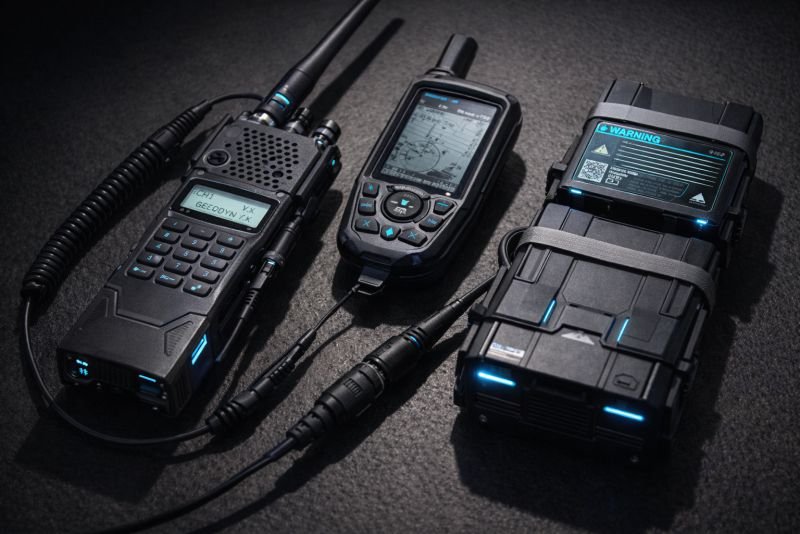
This is the clearest near-term application. A soldier in the field carries 5-15 kg of battery weight on extended operations. GPS, radio, night-vision optics, and body sensors all draw continuous power. In daylight conditions, a solar jacket generating 3-5 W continuously reduces battery consumption by 20-40% over a 10-hour operational day. In a theater where resupply is uncertain, that margin has direct operational value.
The weight penalty of PV fibers woven into existing uniform fabric is negligible – the electrical architecture adds mass, but at the scale of grams per square meter of fabric, not kilograms. Military applications also relax the aesthetic constraints that complicate civilian adoption. Camouflage patterns and dark fabrics can be optimized around photovoltaic performance without worrying about fashion.
The Aesthetic Trap: When Black Is the Wrong Answer
For civilian garments, the photovoltaic argument and the fashion argument pull in opposite directions. Dark fabrics – particularly matte black – absorb light across the full spectrum and provide the best thermal input for the fiber surface. From a photovoltaic standpoint, maximum photon absorption is exactly what the device needs. From a wearability standpoint, a black jacket in summer sun is an uncomfortable object, because the photons that are not converted to electricity are converted to heat, and the wearer absorbs that heat.
Light-colored fabrics reflect more light and would theoretically allow selective absorption – transparent encapsulant over the fiber surface, reflective carrier fiber underneath – but that requires an optical architecture that does not yet exist at the manufacturing scale needed for consumer textiles. The mature version of this device probably involves fabrics that are spectrally selective at the fiber level: absorbing in the photovoltaically active wavelengths while reflecting in the infrared. That is a materials science problem with a clear direction and no current commercial solution.
The Waste Problem Built Into the Premise
A solar garment is a textile with embedded electronics and a semiconductor coating. At end of life, it is not recyclable by any current textile recycling pathway. Shredding the fabric destroys the fiber coatings and contaminates the recycled fiber stream. Chemical recycling of the semiconductor materials requires different processes than textile reclamation. The OPV polymers themselves may contain compounds that require specific disposal handling.
This is not an insurmountable problem, but it is a real one. A mature solar textile ecosystem requires either designing for disassembly – so the PV fiber component can be separated from the carrier textile at end of life – or accepting that solar garments are a specialty item with specialized disposal, not a replacement for ordinary clothing. The environmental math has to account for manufacturing energy and disposal complexity, not just the clean generation numbers during use.
Beyond the Single Garment: The Evolutionary Arc
A solar t-shirt is the obvious entry point, but it is not the endpoint. The interesting question is what happens when photovoltaic textile technology matures beyond the proof-of-concept garment and starts to be treated as an engineering layer that can be integrated into any textile surface.

First Generation: Proof-of-Concept Wearable
The first commercially viable solar textile is probably not a fashion item. It is a functional accessory – a jacket, a hat, a vest – designed for users who have a specific energy need and are willing to pay a premium for passive generation. Output is in the 1-3 W range. Encapsulation provides 2-3 years of outdoor-use reliability. The electrical output connects via a small integrated connector to a cable or wireless charging pad. The design is optimized for sun exposure, which means it looks like gear, not fashion. The market is outdoor recreation, military auxiliary equipment, and early-adopter urban users.
The Body Heat Addition: Combining Thermal and Photovoltaic Harvesting
The human body radiates approximately 80-100 W of thermal energy continuously. Most of that escapes through clothing as low-grade heat. Thermoelectric generators – devices that convert temperature gradients into electricity – can capture a fraction of that flow. A mature energy-harvesting garment combines OPV fibers on exterior surfaces with thermoelectric elements at skin-facing surfaces, capturing photon energy from outside and thermal energy from inside simultaneously.
The numbers for thermoelectric body-heat harvesting are modest. Current flexible thermoelectric generators produce roughly 1-5 mW per square centimeter of skin-contact area at the temperature differential available from body heat to ambient air – typically 5-15 degrees Celsius under normal clothing. For a vest-sized skin-contact area of 0.05 square meters, that is 50-250 mW, adding perhaps 0.5 W to the solar output. Small, but it operates at night, indoors, and in any lighting condition. A combined harvesting system is not dependent on solar availability for its base load.
Civilizational Scale: When Clothing Becomes Distributed Infrastructure
At the scale of a large city’s population wearing energy-harvesting garments, the aggregate generation is a real number. Ten million people in a sun-exposed city, each generating an average of 1 W continuously during active hours, represents 10 MW of distributed micro-generation with no land footprint and no grid infrastructure. The generation is interleaved with consumption at the device level, so the grid never sees it as supply – it appears as reduced demand, which is functionally equivalent.
The more consequential change at civilizational scale is not the wattage. It is the shift in how people relate to energy consumption. A garment that generates power as a background function – no action required, no behavioral change – is a different kind of energy intervention than rooftop solar or electric vehicles. Both of those require a decision, an installation, a location. Solar clothing is invisible infrastructure. The energy appears because the person exists and is outside. Whether that changes energy behavior in any measurable way is an open question, but the design assumption is different from any other renewable technology currently deployed.
The View From NoSuchDevice
I find this device more believable than most things in the wearable energy category, and the reason is not the generation numbers – those are modest. The reason is that the infrastructure already exists. The surface is there. The people are already walking outside. The devices that need power are already in pockets and packs. The only missing component is a fabric that is not passive, and the physics of why that is possible has been established for decades.
What I am less convinced by is the civilian fashion path. The aesthetic constraints are real, and fashion-technology crossovers have a consistent history of solving the wrong problem first – making something look good before making it work reliably. A solar jacket that generates 2 W but degrades after eighteen months and cannot be recycled is a worse outcome than a durable solar vest that nobody would wear to dinner. The technology matures faster if it is treated as gear first and clothing second.
The military and field use case I find genuinely clear. The weight math closes. The operational benefit is concrete. The user is not going to complain about aesthetics. If I had to bet where functional solar textiles reach commercial viability first, it is in a procurement contract, not a fashion show.
The body heat combination is the piece I keep returning to. An exterior PV layer plus an interior thermoelectric layer turns the garment into something that generates power in all conditions, not just in daylight. The combined output is still small. But small and continuous and passive, with no behavioral requirement and no infrastructure – that is a different kind of useful than large and intermittent and installation-dependent. I think the long-term case for this technology depends on it being both of those things at once, not just solar.
The waste problem is the honest constraint that most coverage ignores. A billion solar garments manufactured and then landfilled in five years is not a clean energy story. The device only makes environmental sense if the lifecycle math closes, and that requires recycling infrastructure that does not currently exist for electronic textiles. Solving the encapsulation problem and the recycling problem simultaneously is harder than solving either one alone, and I have not seen serious attention to both at once.
That is probably where the real delay is hiding.
You read the whole thing.
That is rarer than it should be, and it is the exact kind of attention I built this archive for. I make every piece alone, with no ads and no investor deciding what gets written. If you want the next machine taken apart like this one, you can help me make it.
A coffee a month is enough to keep it free for everyone.
Prefer crypto or a one time gift? Other ways to give →