






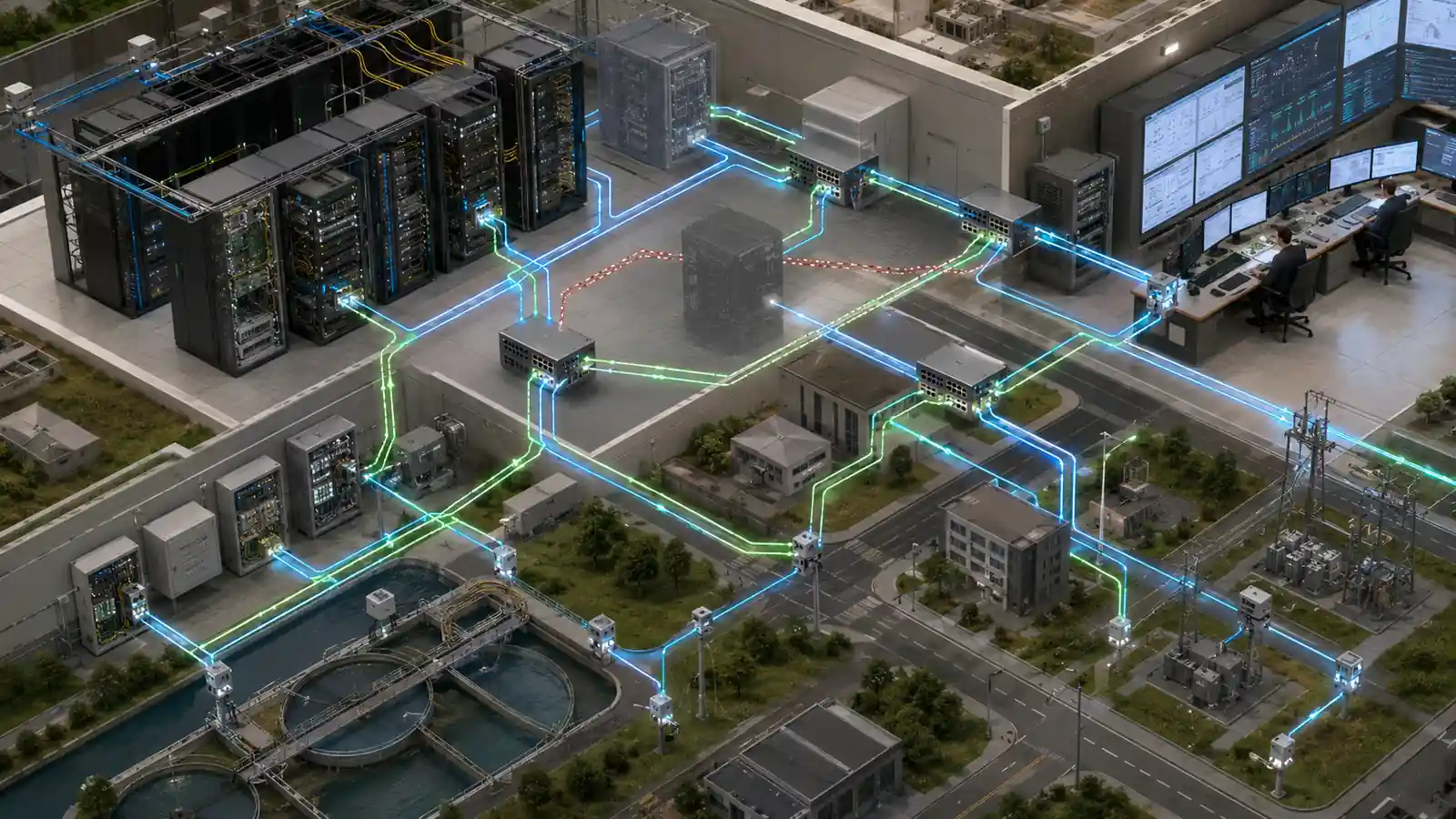
What Is Mesh topology?
Mesh topology is a network architecture in which nodes connect through multiple paths instead of relying on a single central route. In a full mesh, every node connects directly to every other node, giving E_max = N(N – 1)/2 possible links. Partial meshes use fewer links while preserving alternate routes.
In real engineered systems, mesh networks appear in wireless communication, data centers, sensor networks, power control systems, and quantum communication layouts. Routing software chooses paths according to capacity, delay, reliability, and policy. In resilient power networking, a mesh can reroute around failed nodes or overloaded links without making one trunk line carry the whole system.
The concept matters because topology shapes reliability, cost, latency, maintainability, and failure behavior. Used in devices include Wi-Fi mesh routers, industrial sensor nodes, data center switches, smart-grid controllers, and quantum routing nodes. A mesh usually costs more than a simple chain or star, but it provides redundancy and local failure containment that are valuable when interruption, interception, or congestion carries high cost. The same idea applies to radio channels, cables, fibers, and logical routes.
Example:
In a campus wireless mesh, traffic from one building can reach the gateway through several neighboring access points if the shortest path fails.
Related Terms:
- Quantum Repeater
- Network Redundancy
- Routing Node
NoSuchDevice is a free archive of machines that do not exist yet but already have a shadow in physics. I research and write every entry alone, with no ads. Take a look around the archive, or help keep it free.