


What Is Quantum repeater?
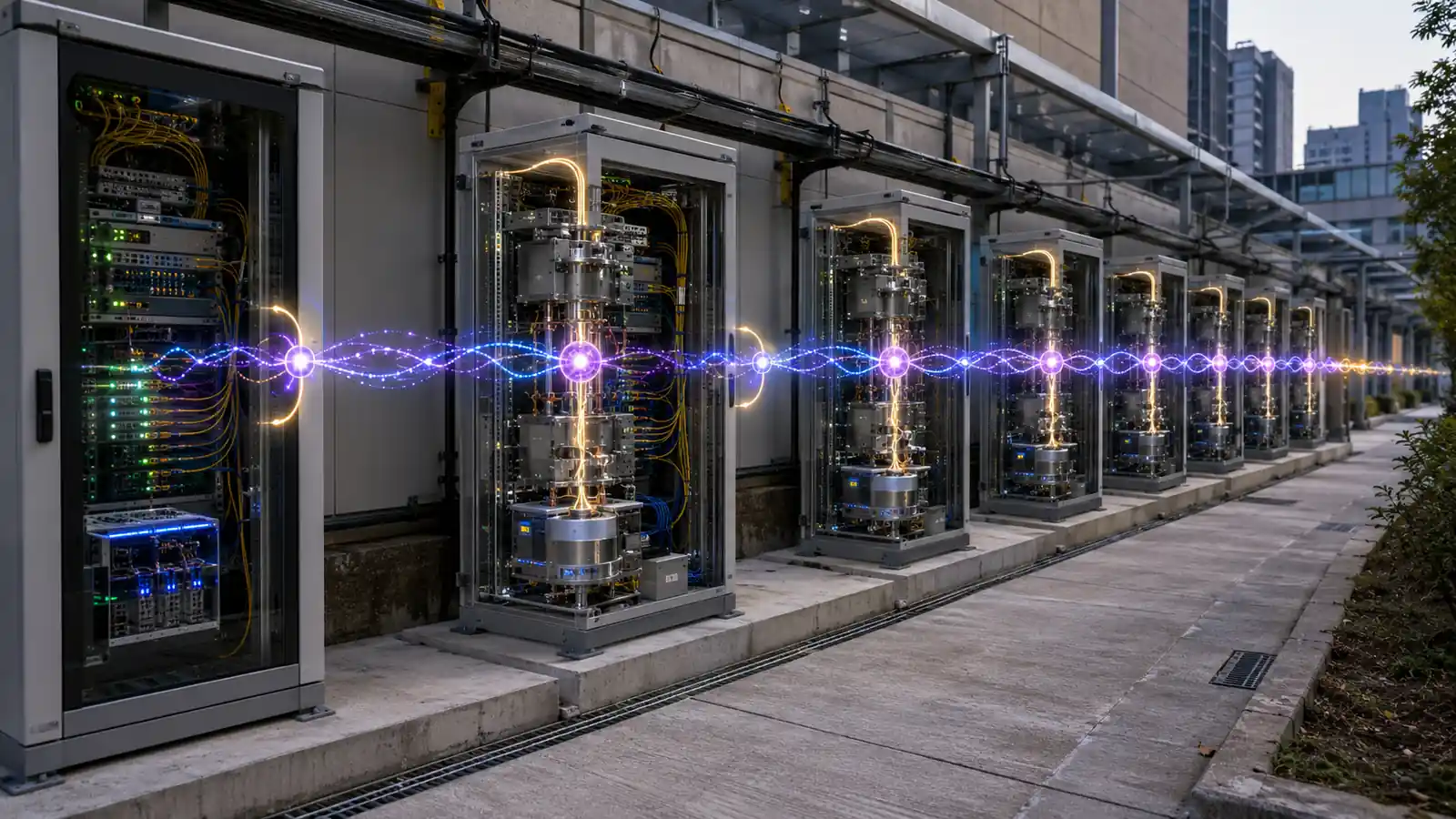
A quantum repeater is a network device that extends entanglement across distances too long for a single low-loss quantum channel. Instead of copying an unknown quantum state, which quantum mechanics forbids, it divides the route into shorter links. A useful layout relation is L_total = N x L_segment, where each segment can be created and verified separately.
In real designs, neighboring nodes generate entangled pairs, store them briefly in quantum memories, and connect them through entanglement swapping. Error correction or purification may be used to raise the quality of the shared state. In metropolitan quantum networks, repeaters would counter fiber loss, detector noise, and environmental decoherence across many short spans.
The concept matters because quantum links weaken rapidly with distance, and direct transmission alone cannot support large networks. Used in devices include quantum internet nodes, quantum key distribution backbones, distributed quantum computers, and quantum sensor networks. Repeaters turn fragile point-to-point entanglement into a scalable infrastructure problem by adding memory, verification, routing, and timing control between end users. They also define where maintenance, synchronization, and security checks occur over time.
Example:
Across a long fiber route, repeater nodes can entangle adjacent spans first and then swap entanglement so the endpoints share a usable quantum correlation.
Related Terms:
NoSuchDevice is a free archive of machines that do not exist yet but already have a shadow in physics. I research and write every entry alone, with no ads. Take a look around the archive, or help keep it free.