





What Is Monomer?
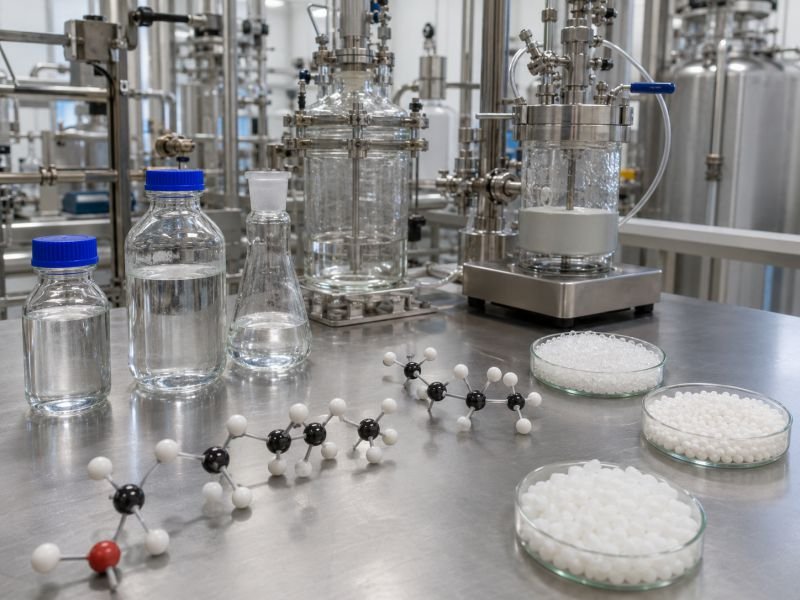
A monomer is a small molecule that can react with others like itself, or with complementary molecules, to build a larger polymer chain or network. The repeat chemistry of the final material begins at the monomer level, because reactive groups, size, symmetry, and stereochemistry are already encoded there. A useful chain-length relation is DP = Mn / M0, where the degree of polymerization depends on polymer molecular weight and repeat-unit mass.
In real systems, monomers control not only what bonds form, but also how easily a polymer crystallizes, absorbs water, softens with heat, or responds to enzymes and pH. Used in devices include packaging films, fibers, adhesives, hydrogel sensors, resorbable implants, and structural coatings. This design role becomes especially important in trigger-responsive polymer synthesis, where selecting monomers with protected or hydrolyzable groups helps define whether a material stays dormant or begins a timed degradation cascade.
The concept matters because polymer performance cannot be understood only from the finished object. Mechanical strength, degradation profile, transparency, and processability often trace directly back to monomer structure and purity.
Engineers therefore treat monomer choice as a first-order design variable, since changing one small molecular building block can alter catalyst behavior, chain architecture, and end-of-life behavior across the entire material system.
Example:
A polyester made from monomers carrying hydrolyzable groups can break down on a different schedule than a visually similar polymer built from inert monomers.
Related Terms:
- Ester Bond
- Dormancy Mechanism
- Polymerization
NoSuchDevice is a free archive of machines that do not exist yet but already have a shadow in physics. I research and write every entry alone, with no ads. Take a look around the archive, or help keep it free.