




There is a yogurt container sitting somewhere in the Pacific right now. It has been there roughly forty years. The yogurt lasted about a week. The container will outlast every person alive today by several centuries – not because anyone needed it to, but because nobody built in a way for it to stop.
That is not a design failure in the usual sense. Durability was the goal. What was never part of the goal was a controlled ending.
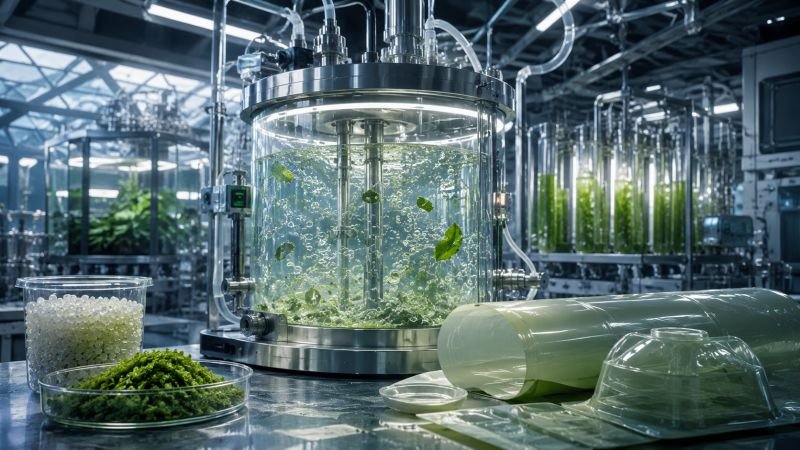
The short version: Bio-programmable polymers are concept materials engineered at the molecular level to degrade on a predetermined schedule or when specific environmental conditions are met simultaneously. The timeline is not a rough estimate. It is set during synthesis by controlling the density of chemically vulnerable bonds within the polymer chain – a parameter that can, in principle, be tuned the way a clock is wound. Nothing like this exists commercially. The chemistry required is already demonstrated in laboratory settings at short chain lengths.
Key Takeaways
- Programmable degradation controls when a polymer fails, not just whether it eventually might
- The molecular clock is encoded in bond density – more trigger bonds per chain length means a shorter timer
- Multi-condition logic (time AND pH, for example) prevents accidental early degradation across real-world environments
- Food safety requires a sharp degradation threshold – partial breakdown mid-use is a different kind of failure
- If single-use packaging carried a 5-year molecular timer, the persistent plastic load in the ocean could fall by an estimated 60-70 percent within two decades without changing production volumes at all
Table of Contents
The “Biodegradable” Label That Means Almost Nothing
The word biodegradable on a plastic label is, at this point, technically accurate and practically useless.
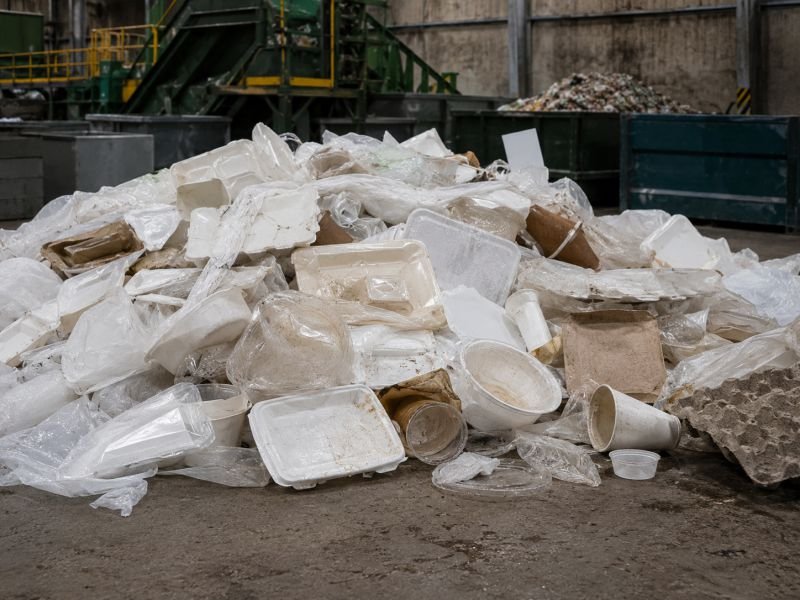
Most plastics marketed as biodegradable today – PLA, PHA, starch composites – degrade under industrial composting conditions: temperatures around 60 degrees Celsius, controlled humidity, specific microbial populations. Take those same plastics to a landfill, a river, or the open ocean, and they behave like conventional plastic for decades. The certification tests for “biodegradable” were written for a world where everything ends up in an industrial compost pile. That world does not exist.
Why Current Bioplastics Cannot Hold a Schedule
The chemistry behind standard bioplastics degrades through bulk hydrolysis or surface erosion, both governed by ambient temperature, moisture, and microbial activity. None of those factors are consistent in real environments. A PLA container buried in cold seawater will still be intact in fifty years. The same container in an industrial composter is gone in ninety days. A degradation window that wide is not a timeline. It is a lottery.
The deeper problem is that current biodegradable plastics have no concept of when. A polymer that degrades randomly whenever conditions eventually cooperate is not a solution to plastic accumulation. The bio-programmable polymer solves a different problem entirely – not whether something degrades, but on what schedule, and under exactly what conditions.
Molecular Memory: How a Polymer Learns When to Forget Itself
A conventional polymer chain is chemically stable by design. The entire history of polymer engineering was aimed at making materials last. Bio-programmable polymers invert that premise: the task is to design in a controlled failure point, precise enough to serve as a clock.
Writing the Timer Into the Chain
Polymer chains are long sequences of repeating molecular units bonded together. The backbone of a typical polyethylene chain is essentially inert – resistant to water, enzymes, and moderate heat. Certain chemical bonds, inserted deliberately into that backbone or as side chains, are selectively vulnerable to specific stimuli.
Ester bonds hydrolyze in water. Photocleavable groups break under UV light. Certain crosslinks dissolve in mild acid. These are not exotic chemistry – they appear routinely in drug delivery research and degradable suture materials. The innovation in bio-programmable polymers is deploying these reactions not as accidental vulnerabilities but as engineered clocks.
The degradation timeline is set by two variables: bond density (how many trigger bonds per unit length of chain) and activation energy (how much stimulus is required to fire them). A chain with 20 hydrolysis-sensitive ester bonds per 1,000 carbon atoms reaches 50 percent mass loss roughly ten times faster than a chain with 2 ester bonds per 1,000 carbons, under identical conditions.
The relationship between trigger bond density and degradation timeline:
If the half-life of a single hydrolyzable bond under ambient conditions is T_b, and the chain contains n trigger bonds per monomer unit, the approximate time to 50 percent mass loss is:
T_half = T_b / n
A polymer with T_b = 10 years per bond and n = 2 bonds per monomer unit reaches half-mass in approximately 5 years. Set n to 10, and that number drops to 1 year. The expiry date is set during synthesis by controlling n – without changing the material’s visible properties, mechanical performance, or food-contact behavior during its designed lifetime. A bottle looks, feels, and performs identically to conventional plastic for its entire working life, then fails on schedule.
That last part deserves more attention than it usually gets: the goal is not a weaker material. It is a material that holds full strength until its clock fires, then degrades completely. A gradual weakening over time would be commercially useless.
The AND/OR Architecture of Molecular Triggers
A single-trigger clock is fragile. A food container programmed to degrade when pH drops might start breaking down inside an acidic drink. Temperature-sensitive bonds could fire in a delivery van on a hot afternoon.
Multi-condition trigger architecture requires two or more simultaneous stimuli to activate the degradation cascade – time AND temperature, pH AND UV exposure, moisture AND enzyme contact. A sealed package in a warehouse satisfies none of these conditions simultaneously. A container discarded in soil after use satisfies all of them.
Combinatorial molecular logic of this kind is not speculative biology. It is a design specification, and the question is whether polymer synthesis can place specific bond types at specific chain intervals with sufficient precision at scale. Laboratory evidence on short test chains suggests the answer is yes. Precision across an industrial production run of 10,000 tonnes is where the engineering challenge actually lives.
Everything here is free. Readers are the reason it stays that way.
I make all of it alone, with no ads. If it is worth a coffee a month to you, that keeps the next one coming.
Keep it alive →How Bio-Programmable Polymers Could Operate
The device is not a single material. It is a family of materials, each calibrated for a specific deployment context and degradation profile – the same underlying principle, tuned differently for each application.
The Packaging Timer: From Shelf to Soil
A food container designed for a six-month product shelf life would carry ester-bond density set to begin hydrolysis chain reactions approximately 18 months after the dormancy seal is broken – giving a margin between normal use and degradation onset. When the cascade triggers, it moves through the bulk of the material over a period of weeks: oligomer fragments first, then water-soluble monomers, then carbon dioxide, water, and biologically digestible organic acids.
A cascade through bulk material fails differently from surface erosion. The container holds its shape for 17 months, reaches 50 percent mass loss by month 19, and is essentially gone by month 24. No visible deterioration during use. No gradual pitting or flaking. A clean transition from functional object to degraded material, with the timing set at manufacture.
Field and Ocean: Condition-Triggered Clocks
For materials deployed outdoors, a time-only trigger creates a shelf life problem: a product manufactured in January that sits in a warehouse for 18 months, travels through distribution for 6 months, sits on retail shelves for 12 months, and then sits in a consumer’s cupboard for 12 more months has consumed 48 of its 60 programmed months before it has done anything useful.
The solution architecture is a dormancy mechanism: the clock does not start until the packaging is first opened or first exposed to ambient conditions. A sealed inner barrier – an oxygen-scavenging layer or moisture-blocking film applied during manufacture – holds the trigger bonds in a protected environment. First use breaks the dormancy seal. Shelf life and product life become independent variables.
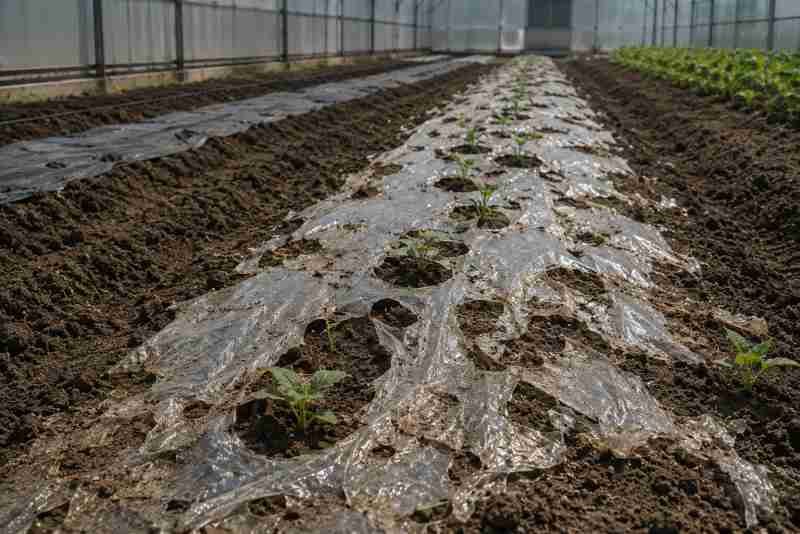
Agricultural mulch film carries a different trigger set: UV-AND-moisture. Sunlight activates the photocleavable bonds; ground moisture completes the hydrolytic cascade. In a warehouse with no UV exposure, nothing activates. In a field through a growing season, both conditions are met consistently. The film survives the crop cycle and then mineralizes into the soil without collection or disposal.
For ocean-facing packaging, the trigger set changes again. Seawater pH sits at approximately 8.1 – slightly alkaline – with marine enzyme populations that differ from soil. A polymer designed for ocean deployment carries base-labile bonds activated at pH 8.0 or above, with a temperature-AND-time secondary trigger to prevent activation in cold deep water. Designed degradation window: 18 to 36 months after ocean entry.
Medical: When the Patient’s Biology Sets the Clock
Medical implants and sutures already use degradable polymers. What they do not yet do is degrade on a schedule that accounts for individual patient variables. A suture that dissolves in 10 to 14 days regardless of patient age, metabolism, and wound healing rate is a compromise based on average behavior.
A bio-programmable suture carries enzyme-sensitive bonds tuned to respond to specific inflammatory markers present during tissue healing. Degradation begins when healing is detected at the molecular level. The patient’s biology triggers the clock rather than the calendar.
Where a Timed Expiry Date Changes the Math on Plastic
The arithmetic on plastic accumulation shifts significantly when you introduce a programmable end-of-life into the calculation.
Global plastic production currently runs at approximately 400 million tonnes per year. Roughly 40 percent – about 160 million tonnes – is single-use packaging with a functional life under 12 months. An estimated 8 to 12 million tonnes of that packaging leaks into waterways and oceans annually. Once there, it does not degrade. It accumulates. Current estimates put the oceanic plastic stock at approximately 170 trillion pieces, growing every year because outflow exceeds any natural removal mechanism by several orders of magnitude.
Introduce a 5-year maximum molecular lifetime across single-use packaging. Annual leakage stays the same in the short term – the same 8 to 12 million tonnes per year still enters the environment. But each piece now carries a hard expiry. By year 5, the material that entered in year 1 is gone. Within one to two decades the standing stock begins to decline rather than accumulate. By year 20 of deployment, the persistent oceanic plastic load could be reduced by an estimated 60 to 70 percent – with zero change in production volumes, collection infrastructure, or consumer behavior.
| Trigger Architecture | Primary Stimulus | Secondary Stimulus | Target Lifetime | Application |
|---|---|---|---|---|
| Hydrolysis timer | Bond density / time | None | 1-10 years | Food and consumer packaging |
| UV-moisture cascade | UV exposure | Soil moisture | 6-18 months | Agricultural mulch film |
| pH-activated | Seawater alkalinity (pH 8.1+) | Temperature | 18-36 months | Ocean-facing packaging |
| Enzyme-responsive | Inflammatory markers | None | Patient-variable | Medical sutures and implants |
| Wash-cycle counter | Hot water and detergent | Repetition count | 3-5 years | Synthetic textiles |
That last row addresses a problem that receives far less attention than oceanic plastic accumulation: microplastic fiber release from laundry. Synthetic garments shed an estimated 500,000 tonnes of microplastic fibers into wastewater annually – not because they are discarded, but because repeated washing mechanically fragments the surface before the garment is ever thrown away. A synthetic fabric designed to hold mechanical integrity for three years of regular washing and then degrade completely would release no microplastic fragments at any point in its life.
What Could Go Wrong When the Timer Fires
The degradation behavior of a bio-programmable polymer is its most critical engineering parameter. It is also the one with the most failure modes, and the most unforgiving context: materials that touch food.
When the Cascade Fires Too Soon – and the Food Safety Problem
A packaging material in contact with food must not leach degradation intermediates into the product during normal use. If a hydrolysis cascade is designed to start at month 18, the pre-cascade behavior at month 17 cannot include partial bond cleavage releasing oligomer fragments into the contents.
The question is pointed: what if a programmed polymer begins a degradation cascade while the food inside is still being consumed? Partial degradation does not produce the same compounds as complete mineralization. Incomplete hydrolysis of an ester-bond polymer can release acid intermediates and low-molecular-weight oligomers – compounds that are not the target end products and whose food-safety profiles have not been established.
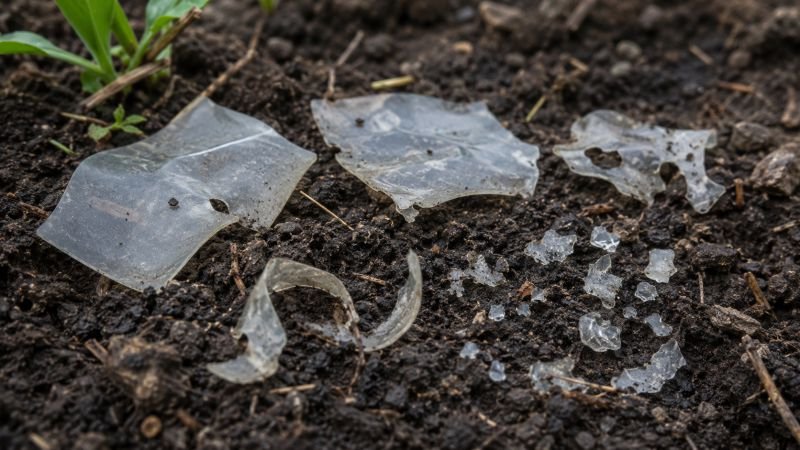
Two design architectures address this. The first is a sharp threshold trigger: the cascade is fully off until a precise set of conditions is met, with no gradual onset. A polymer that hydrolyzes by one percent per year for 18 years before full cascade is a food safety problem. A polymer that fires at a defined threshold and reaches 90 percent mass loss within 60 days is a different device. The second is physical separation: a laminate where the trigger-bond-containing structural layer never contacts food directly. The food-contact surface is a thin, inert film that fails mechanically when the structural layer collapses – not chemically reactive with it, and not carrying trigger bonds of its own.
The cascade also needs to be complete. A polymer that reaches 80 percent degradation and then stalls because local conditions shifted leaves a residue. Complete mineralization under target conditions is not a marketing goal – it is a design requirement.
The View From NoSuchDevice
I have been thinking about why this concept is harder to get excited about than it should be, and I think the answer is that it solves a problem that people have already made peace with.
The ocean plastic situation is catastrophic on a geological timescale. On a human timescale, it is invisible. Nobody sees 170 trillion pieces of plastic. Nobody watches a yogurt container survive for three centuries. The harm is distributed across ecosystems and future generations in a way that activates no immediate instinct.
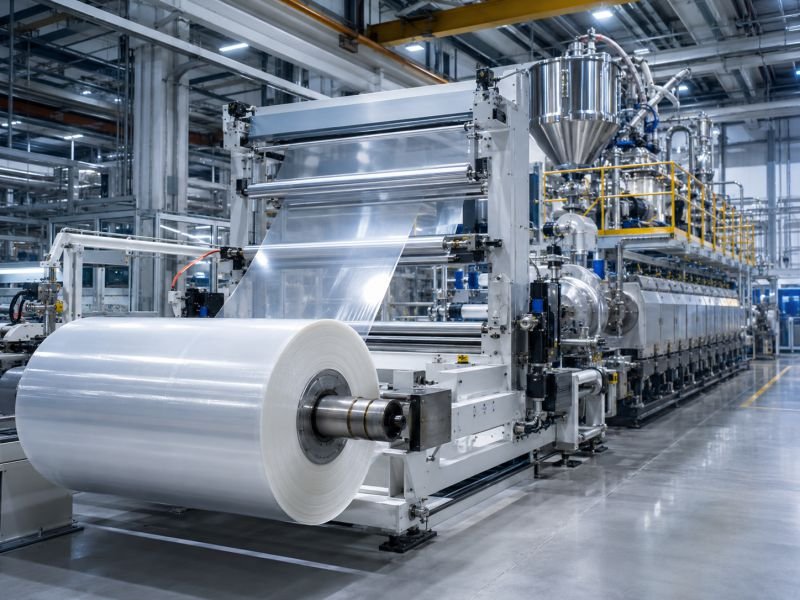
What I find genuinely interesting here is not the environmental argument – though it is real and the arithmetic is stark – but the design inversion. Every plastic ever manufactured was engineered for stability. Bio-programmable polymers would be engineered for a precise ending. That is not incremental improvement. The philosophy of what a material is for changes completely.
The food safety question keeps me honest about the timeline. A material that touches food and is designed to fail requires regulatory frameworks that simply do not exist for this category yet. Proving that degradation intermediates are non-toxic, that cascade thresholds are reliable across temperature extremes, that dormancy mechanisms hold across years of warehouse storage – none of that is a chemistry problem. It is a testing and regulatory problem, and those move on their own timescale.
I think the near-term version of this device – coarse timers, single-trigger architecture, wide degradation windows – will arrive within the next twenty years in non-food applications. Agricultural film, industrial packaging, marine buoys. The precision version, the one that degrades reliably on a six-month window and can touch food, is further out and needs a regulatory apparatus built around it.
If it arrives at scale, it will be invisible in use. Packaging will look identical to what exists today. The difference will show up in soil samples and ocean surveys years after the transition. A device measurable only by the absence it creates. Most engineering leaves something behind. The whole point of this one is to leave nothing.
You read the whole thing.
That is rarer than it should be, and it is the exact kind of attention I built this archive for. I make every piece alone, with no ads and no investor deciding what gets written. If you want the next machine taken apart like this one, you can help me make it.
A coffee a month is enough to keep it free for everyone.
Prefer crypto or a one time gift? Other ways to give →