



What Is orbital motion?
Orbital motion describes the looping path followed by water particles as a surface wave passes. In deep water the paths are close to circular, while in shallower water they flatten into ellipses because the seabed constrains the lower part of the motion. The motion comes from continual exchange between kinetic and gravitational potential energy, and its amplitude falls roughly as e^(-2 pi z / lambda) with depth.
This behavior means wave energy travels forward even though most water does not drift far with the crest. Particle velocity and dynamic pressure are strongest near the surface, then weaken rapidly below. Surface devices such as point absorbers and Oscillating Water Column systems are positioned where that oscillation can be converted into useful mechanical response rather than treated like a river current.
The concept matters because it explains where wave loading is concentrated and why deeply submerged structures feel far less motion than floating ones. In marine wave energy systems, understanding orbital motion helps engineers choose draft, sensor depth, and survivability margins while predicting how efficiently a device can couple to the moving water during different sea states and periods.
Example:
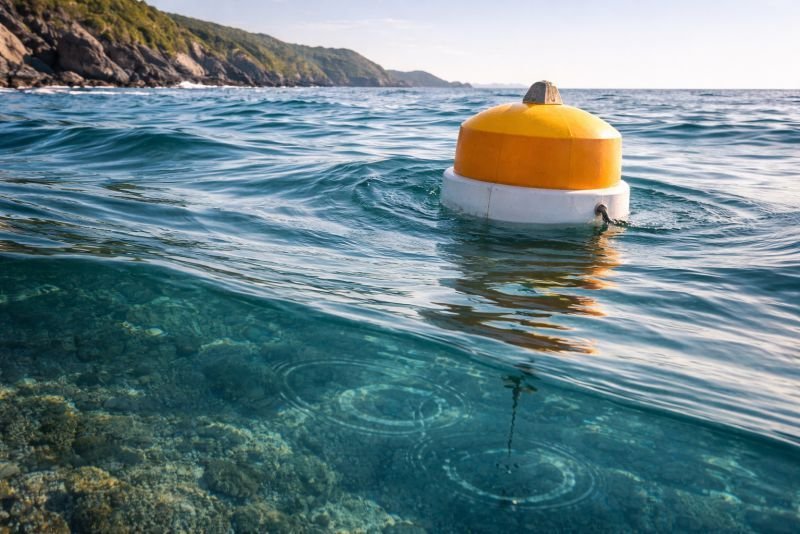
A floating buoy rises and falls as passing swell drives near-circular particle paths beneath the hull.
Related Concepts:
- Particle Velocity
- Wave Height
- Pressure Oscillation
NoSuchDevice is a free archive of machines that do not exist yet but already have a shadow in physics. I research and write every entry alone, with no ads. Take a look around the archive, or help keep it free.