

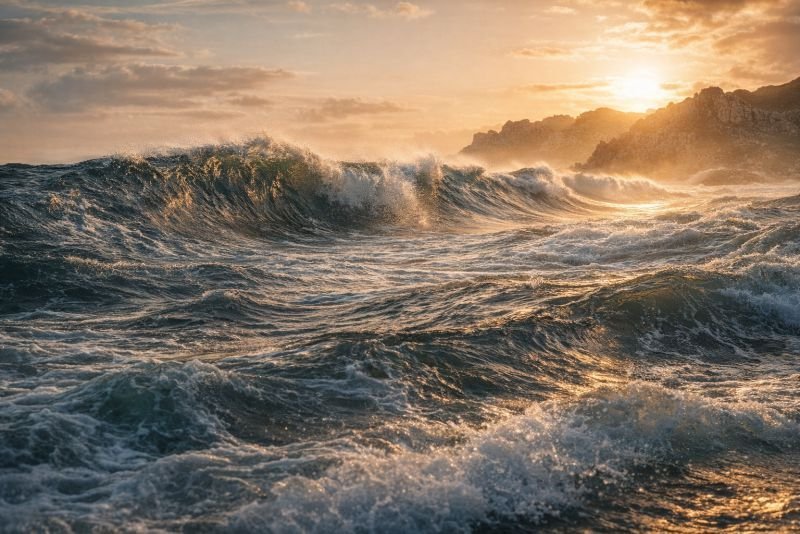
Off the northwest coast of Scotland, near a stretch of coastline called the Orkney Islands, sits one of the most wave-exposed environments in Europe. Researchers there have recorded average wave power densities of 70 kilowatts per metre of wave front. That number is not a theoretical maximum from a computer model. It is a measured figure from real instruments in real ocean conditions. A single kilometre of that coastline, if its energy could be fully harvested, would deliver more power than a large wind turbine operating at peak output. The problem is not that the energy is absent. The problem is catching it.
The short version: Ocean waves are oscillating stores of mechanical energy, with roughly half held as the kinetic motion of water particles and half as potential energy from raised water mass. The power carried per metre of wave front scales with wave height squared and wave period, meaning a wave twice as tall delivers four times the energy. Even in moderate ocean conditions, wave power densities of 20 to 70 kilowatts per metre are typical, making waves one of the densest renewable energy resources on Earth. Converting that energy to electricity requires engineering systems that can match the slow, irregular rhythm of ocean waves to the steady demands of a power grid.
Table of Contents
How Wave Energy Moves Through Water
A wave crossing an ocean does not carry water with it. This is the first thing to understand, and it contradicts what the eye seems to see.
Watch a floating object in open water as a wave passes. The object rises, moves slightly forward, falls, moves slightly back, and returns to nearly where it started. The water particles beneath it trace rough circles, called orbital paths. The energy travels forward. The water itself largely stays in place.
This distinction matters enormously for energy extraction. The wave is a shape that propagates through the medium, not a flow of the medium itself. Engineers cannot simply build a turbine in its path the way a river turbine intercepts flowing water. The mechanism of energy transfer is different.
The circular motion of water particles decreases with depth. At the surface, orbital diameter equals the wave height. At a depth equal to half the wavelength, orbital motion has fallen to about 4 percent of its surface value. This is why submarines submerged below 150 metres feel almost nothing from surface storms. It is also why wave energy converters are surface or near-surface machines: that is where the energy concentrates.
The Two Reservoirs: Kinetic and Potential Wave Energy
Wave energy does not exist in a single form. Every ocean wave carries its energy in two distinct reservoirs, and understanding both is necessary for understanding what a converter has to capture.
The first is kinetic energy. Water particles in motion carry kinetic energy proportional to the square of their velocity. As a wave crest passes, surface particles are moving at their fastest. As the wave trough passes, the particles complete the lower arc of their orbital path. The energy in this motion is not stored anywhere; it is actively present in the moving mass of water throughout the wave cycle.
The second is potential energy. When a wave raises water above the average sea surface, that elevated mass acquires gravitational potential energy. The crest is a hill of water sitting above its surroundings. Gravity will pull it down. When it falls, potential energy converts back to kinetic energy, driving the orbital motion of the next cycle. The wave is continuously exchanging energy between these two forms as it travels.
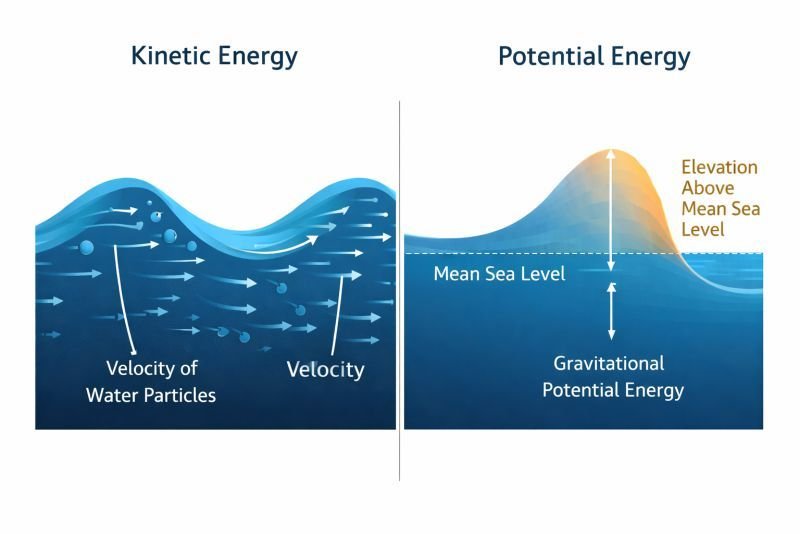
What matters for engineering is that these two reservoirs are roughly equal in magnitude. At any instant, approximately half a wave’s energy is kinetic and half is potential. This has a direct consequence: a converter that captures only one form wastes half the available resource. Effective wave energy systems need to interact with the wave in ways that draw on both.
The total energy per unit area of ocean surface, averaged over one wave cycle, is given by:
E = (1/8) x rho x g x H^2
Here, E is the energy density in joules per square metre, rho is the density of seawater (approximately 1025 kilograms per cubic metre), g is gravitational acceleration (9.81 metres per second squared), and H is the wave height measured from trough to crest in metres.
Substituting real numbers: a wave 2 metres high gives E = (1/8) x 1025 x 9.81 x 4 = 5,033 joules per square metre. A wave 4 metres high gives E = (1/8) x 1025 x 9.81 x 16 = 20,130 joules per square metre. Doubling the wave height quadruples the energy. This square relationship is what makes large storm seas so energetic and what makes wave resources at exposed Atlantic coastlines so much richer than those in calmer enclosed seas.
Wave Power: How Period Amplifies the Energy Flux
Energy density tells us how much energy sits in a given area of ocean surface. Wave power tells us how fast that energy moves past a fixed line. These are related but not identical, and the distinction is what engineers actually need when sizing a converter.
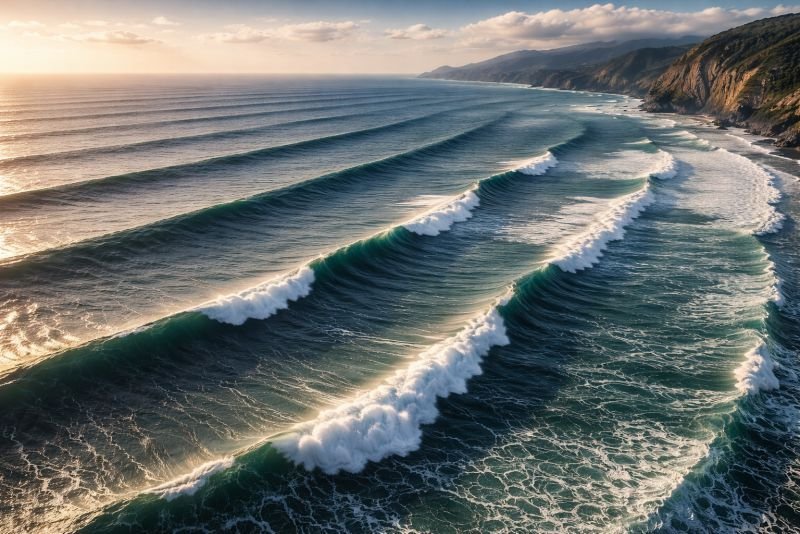
The power transported per metre of wave front, averaged over the wave cycle, is:
P = (rho x g^2 x H^2 x T) / (32 x pi)
In this formula, P is the wave power in watts per metre, rho is seawater density, g is gravitational acceleration, H is wave height in metres, and T is the wave period in seconds (the time between successive crests passing a fixed point).
Working through a realistic example: a wave 2 metres high with a period of 10 seconds gives P = (1025 x 96.04 x 4 x 10) / (32 x 3.14159) = approximately 39,000 watts per metre, or 39 kilowatts per metre. The same wave height with a period of 14 seconds delivers about 54 kilowatts per metre. Period alone, independent of height, shifts the power flux substantially.
This is why ocean swell from distant storms carries so much energy despite often arriving with modest wave heights. Long-period swell (periods of 14 to 20 seconds) generated by storms thousands of kilometres away loses height as it travels, but retains its long period. By the time it reaches a coastline, the wave may look unimpressive but carries a disproportionately large energy flux. Wave energy converters designed for exposed ocean environments must account for this by responding effectively across a wide range of periods, not just large heights.
| Wave Condition | Height (m) | Period (s) | Approx. Power (kW/m) |
|---|---|---|---|
| Calm coastal sea | 0.5 | 5 | 0.6 |
| Moderate ocean swell | 2 | 10 | 39 |
| Energetic Atlantic swell | 3 | 12 | 100 |
| Storm seas | 5 | 14 | 390 |
| Severe storm | 8 | 16 | 1,600 |
These numbers explain both the appeal of wave energy and its engineering difficulty. The resource is dense. But it arrives as a wildly varying flux, from near zero to thousands of kilowatts per metre, demanding systems that can survive storm loading many times greater than their operating design point.
Dispersion: Why Wave Speed Depends on Period
Not all waves travel at the same speed. This seems counterintuitive, since sound and light travel at fixed speeds through a given medium. Water waves behave differently, and the reason matters for understanding how wave energy concentrates and disperses across ocean distances.
In deep water, where depth is greater than half the wavelength, the speed of a wave depends on its period according to:
c = (g x T) / (2 x pi)
A wave with a 10-second period travels at approximately (9.81 x 10) / 6.28 = 15.6 metres per second. A wave with a 5-second period travels at half that speed, roughly 7.8 metres per second. Longer waves travel faster.
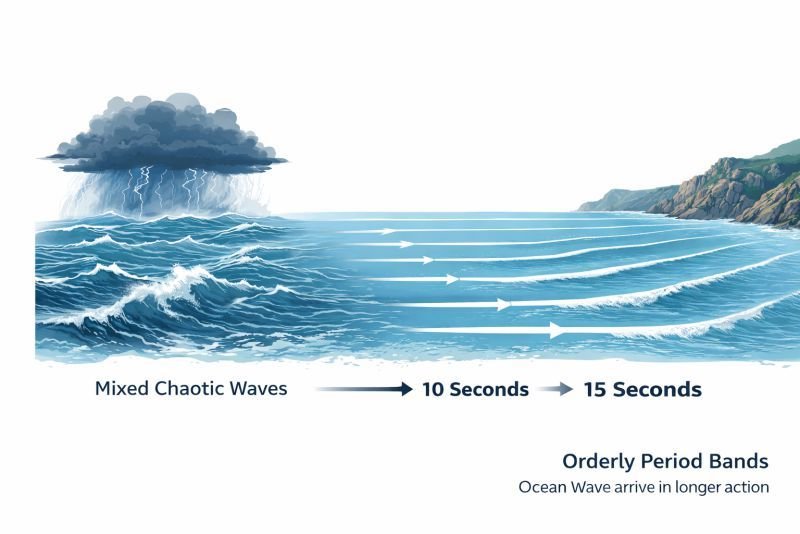
This phenomenon is called dispersion, and it is why a storm generates a chaotic jumble of waves but distant observers receive them sorted by period. The long-period waves arrive first, followed progressively by shorter-period waves. What began as a confused sea becomes organised by travel time. Wave energy forecasters use this predictable sorting to estimate when wave energy from a distant storm will arrive at a shoreline, with useful lead times of 24 hours or more.
For wave energy engineering, dispersion has a practical consequence. A converter tuned to absorb energy most efficiently at a specific period will perform well only when the wave field presents waves near that period. Real ocean conditions mix many periods at once. This is one of several reasons why maximising energy capture from real seas is harder than the physics of idealised single-period waves would suggest.
Everything here is free. Readers are the reason it stays that way.
I make all of it alone, with no ads. If it is worth a coffee a month to you, that keeps the next one coming.
Keep it alive →The Betz Limit and What Wave Converters Cannot Extract
Can a wave energy converter capture all the energy in a wave? Physics sets a ceiling, and it sits well below 100 percent.
The underlying constraint has a counterintuitive source: to extract energy from a wave, the converter must interact with the wave’s orbital motion. But that interaction generates scattered waves of its own, radiating energy away from the converter in all directions. These radiated waves are not a design flaw that better engineering can eliminate. They are a thermodynamic consequence of the extraction process itself.
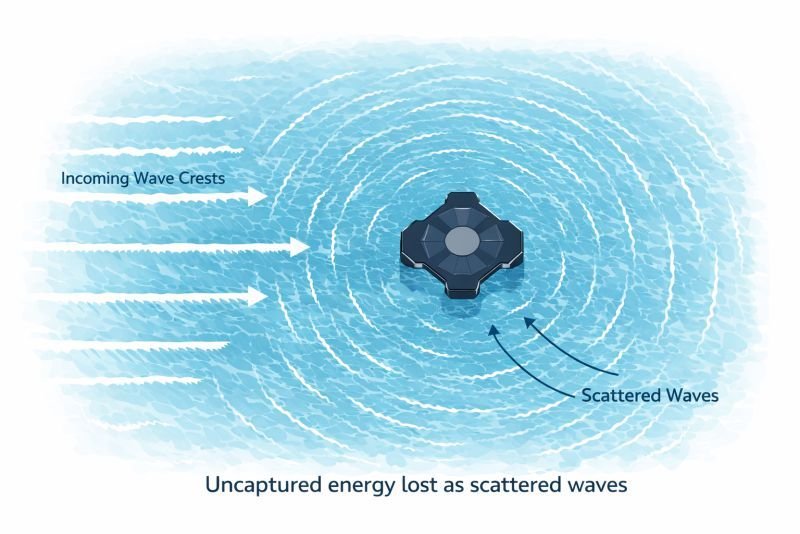
What is the maximum fraction a converter can theoretically take? For an idealised point absorber, a device much smaller than the wavelength that bobs in response to wave motion, the theoretical maximum extraction is 100 percent from waves arriving from one specific direction. In a real sea, where waves arrive from a spread of directions, the theoretical maximum for a point absorber falls to 50 percent.
This is loosely analogous to the Betz limit in wind energy (which caps wind turbine efficiency at 59.3 percent), but the wave case is more complex because wave fields carry directional spread and because devices interact with the medium differently. Real wave energy converters achieve capture widths, the effective cross-section of ocean from which they absorb power, that can actually exceed their physical width under resonant conditions. A device 5 metres wide can sometimes absorb energy from a 10-metre-wide strip of ocean. This apparent paradox arises because resonance allows the device to interact with a region of the wave field broader than its physical footprint.
In practice, real system efficiencies including mechanical and electrical losses settle in the range of 20 to 40 percent from incident wave power to electrical output, with the best laboratory prototypes demonstrating higher values in controlled conditions.
Resonance: The Mechanism That Makes Extraction Efficient
Why does a device tuned to the wave period extract energy so much more effectively than one that is not? The answer is resonance, and it is the central design challenge in wave energy conversion.
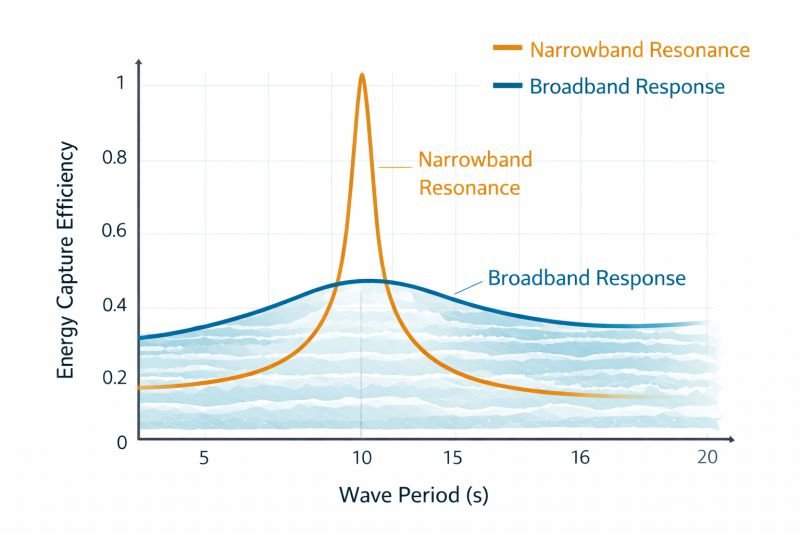
Every floating body has a natural frequency at which it prefers to oscillate. Push it at that frequency and its response amplitude grows large. Push it at a different frequency and the response is smaller. The ratio of response amplitude to forcing amplitude is the key variable, and it peaks sharply when the forcing frequency matches the natural frequency of the device.
Ocean waves arrive at a range of periods, typically 5 to 20 seconds in open ocean conditions. A buoy with a natural period of 10 seconds will absorb energy efficiently from 10-second waves and poorly from 5-second or 20-second waves. Narrowband resonance, which produces a tall narrow peak in the response curve, is efficient at one frequency but poor across the rest. Broadband response, which gives a flatter curve, extracts less at the optimal frequency but more across a wider range.
Engineers pursue broadband response through two main strategies. The first is active control: adjusting the mechanical properties of the device in real time, changing its effective stiffness or damping to track shifting wave periods. The second is structural design: shaping the device geometry so that multiple modes of oscillation each resonate at different periods, summing to a wider overall response. Neither approach is simple, and both increase the cost and mechanical complexity of the system.
This is where the ocean’s irregular character becomes the central engineering problem. A wave energy converter is not dealing with a steady flow or a predictable rotation. It is interacting with a stochastic process that changes every few seconds. The machine must harvest energy from that irregularity without wearing out quickly.
From Orbital Motion to Rotating Generators
The motion that wave energy converters produce is rarely compatible with a standard electrical generator without conversion. This mechanical mismatch is a practical bottleneck that wave energy engineers have approached through several different converter architectures.
Most electrical generators produce power from continuous rotation. Ocean waves deliver slow oscillation, typically completing one cycle every 8 to 14 seconds. Converting oscillation to rotation requires either a mechanical rectification system (using hydraulics or gearboxes to turn back-and-forth motion into one-directional rotation) or a generator designed specifically for slow reciprocating motion.
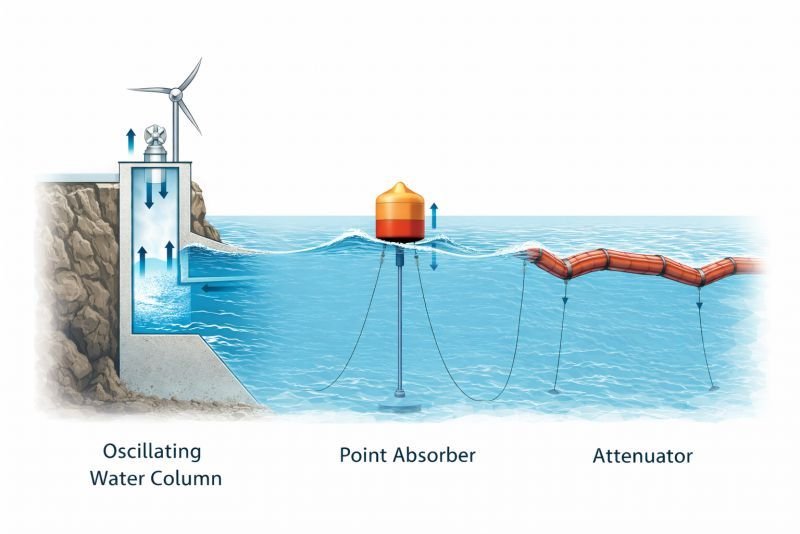
The leading converter types each solve this differently. Oscillating water columns trap air above a water surface inside a chamber. As waves raise and lower the water, the trapped air alternates between compression and expansion, driving air through a turbine. The turbine, called a Wells turbine, is designed to rotate in the same direction regardless of airflow direction, making it compatible with the bidirectional airflow that the oscillating water column produces.
Point absorbers are floating buoys tethered to the seabed or to a fixed structure. The buoy heaves up and down with wave motion, and the relative movement between buoy and tether drives a linear generator or a hydraulic pump. The hydraulic approach smooths out the irregular motion by storing energy in pressurised fluid before using it to drive a conventional rotary generator.
Attenuators are long floating structures oriented parallel to the wave direction. As the wave passes along their length, successive sections flex relative to each other. The flexion drives hydraulic cylinders at each hinge. Several full-scale prototypes have been deployed and tested, including the Pelamis device developed in Scotland, which operated in the ocean from 2004 until its manufacturer ceased operations in 2014.
Each architecture makes a different trade-off between mechanical simplicity, survivability in extreme conditions, and efficiency across varying sea states. None has yet established the dominance that the horizontal-axis turbine achieved in wind energy.
What Distinguishes Good Wave Energy Sites from Poor Ones
Wave energy resources are not distributed evenly. Certain ocean regions carry orders of magnitude more power than others, and the difference comes down to fetch, wind patterns, and local bathymetry.
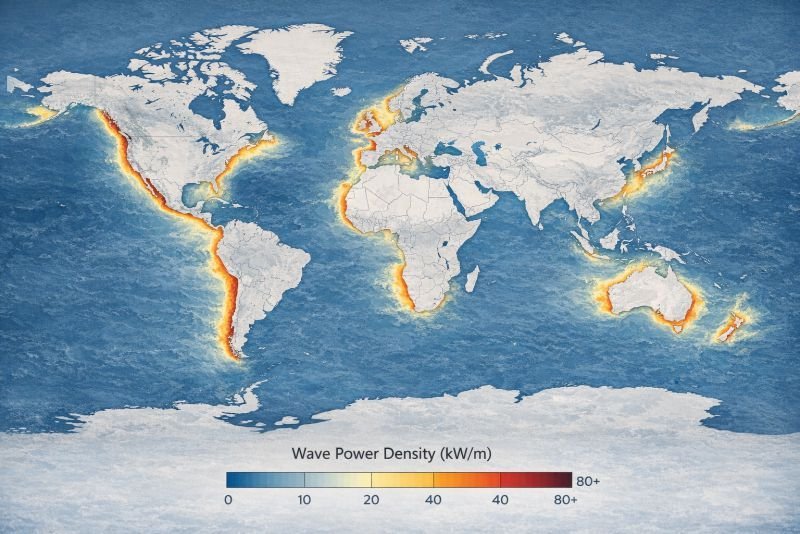
Fetch is the unobstructed distance over which wind has acted on the water surface to build up wave energy. The North Atlantic between Newfoundland and Western Europe has fetch measured in thousands of kilometres. The Mediterranean, enclosed on all sides within a few hundred kilometres, has negligible fetch by comparison. This is why Western European coastlines, particularly those of Ireland, Scotland, Portugal, and the Canary Islands, are among the richest wave energy environments on Earth. The southeast coast of Australia, exposed to the Southern Ocean, is another high-resource region. Coastlines in enclosed seas or sheltered by nearby landmasses see far lower average power densities.
Local bathymetry, the shape of the seabed near the coastline, also concentrates or disperses energy. Waves refract (bend) as they move into shallower water, focusing energy toward headlands and spreading it into bays. This refraction effect can create local concentrations of wave power several times higher than the surrounding average, and wave resource mapping at engineering detail requires bathymetric surveys rather than offshore measurements alone.
The globally averaged wave power resource has been estimated at around 29,500 terawatt-hours per year, roughly equal to global electricity consumption. Practically harvestable fractions of that total are considerably smaller, constrained by geography, grid connectivity, and competing marine uses. But the resource that exists at good sites, at the water’s edge in wave-exposed regions, is large enough that even partial extraction would constitute a significant generating capacity.
Wave Energy in the Context of Future Ocean Power Systems
Wave energy conversion is older as a concept than most people realise. The first patent for a wave energy device was filed in Paris in 1799. The modern engineering push began in the 1970s following the oil crisis, driven by researchers including Stephen Salter at the University of Edinburgh, whose Salter’s Duck device achieved theoretical capture efficiencies above 80 percent in laboratory testing. Despite this early promise, wave energy has consistently lagged wind and solar in commercial development, held back by the difficulty of surviving ocean conditions long enough to recoup capital costs.
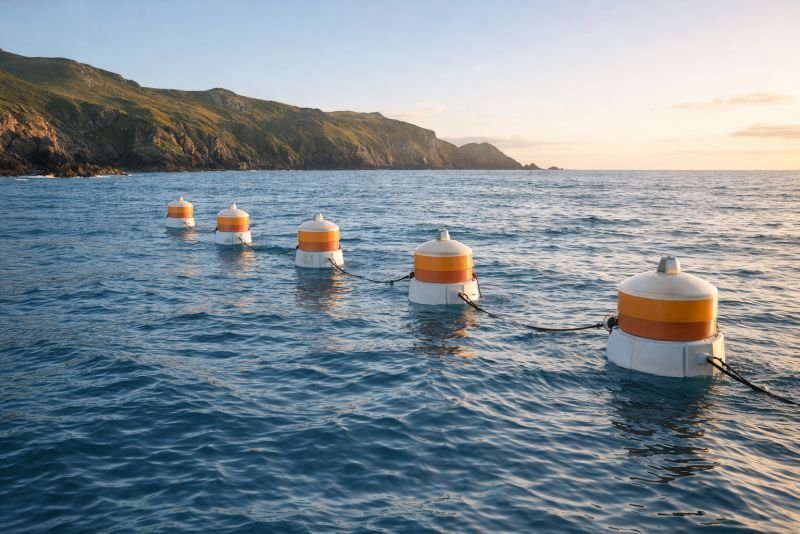
What has changed in recent years is the emergence of specific applications where wave energy’s characteristics align well with grid needs. Offshore islands and remote coastal communities often have poor grid connectivity and high energy costs, making wave energy economically competitive even at current technology readiness levels. The combination of wave energy with offshore wind on shared marine platforms is another area of active investigation, since waves and wind are often but not always correlated, and combining the two resources on a single structure could reduce the cost of offshore foundations and cable connections.
Wave energy also carries a resource characteristic that solar and wind do not: predictability on the timescales relevant to grid operators. Because long-period swell can be tracked from storm origin to coastline arrival over 24 to 48 hours, wave energy output can be forecast with useful accuracy in ways that wind and solar, sensitive to much shorter-timescale atmospheric changes, cannot match. This predictability has economic value in power markets that charge premiums for reliable capacity, though the irregular nature of wave-by-wave output still requires storage or grid buffering at shorter timescales.
The remaining engineering barriers are real. Reliable survivability through 25-year device lifetimes in storm-exposed ocean environments, at costs that compete with offshore wind, has not yet been demonstrated at commercial scale. The diversity of converter architectures still competing for market position reflects an industry that has not yet found its dominant design. Wave energy conversion remains a physics problem that is well understood and an engineering problem that is not yet solved.
You read the whole thing.
That is rarer than it should be, and it is the exact kind of attention I built this archive for. I make every piece alone, with no ads and no investor deciding what gets written. If you want the next machine taken apart like this one, you can help me make it.
A coffee a month is enough to keep it free for everyone.
Prefer crypto or a one time gift? Other ways to give →
Technologies Related to This Concept
| Technology | Concept |
|---|---|
| Tidal Energy in Coastal Cities: Powering Urban Areas with Ocean Tides | Concept: Utilizing tidal movements to generate electricity for coastal cities. |
| Tidal Energy Bridges | Concept: Bridges equipped with turbines to capture tidal energy beneath them. |
| Energy-Harvesting Surfboards | Concept: Surfboards that generate power from the motion of waves and rider movements. |
| Micro Hydrokinetic Generators for City Rivers | Concept: Small-scale generators that harness energy from low-flow urban waterways. |
| Underwater Turbines – The Future of Urban Renewable Energy | Concept: Implementing underwater turbines in city rivers and canals. |