





What Is oscillating water column?
An oscillating water column is a wave energy device that traps a pocket of air above a partially enclosed water chamber. As waves raise and lower the internal water surface, the air is alternately compressed and decompressed, forcing it through a turbine duct. The pneumatic power available is often described as P = delta p Q, where chamber pressure difference drives airflow rate.
The concept works on shorelines, breakwaters, and floating platforms, but performance depends strongly on chamber geometry and local wave period. Because the airflow reverses every half cycle, the turbine must keep producing torque in both directions; many systems therefore use a Wells Turbine or another self-rectifying design. Air compressibility and losses in the duct set practical efficiency limits.
The device matters because it converts wave motion without placing the main rotating machinery underwater, which can simplify access and sealing. In pneumatic wave power conversion, engineers tune chamber resonance, opening area, and structural strength so the system captures energy across useful sea states without suffering damaging pressure excursions. That balance between capture and survivability dominates the design.
Example:
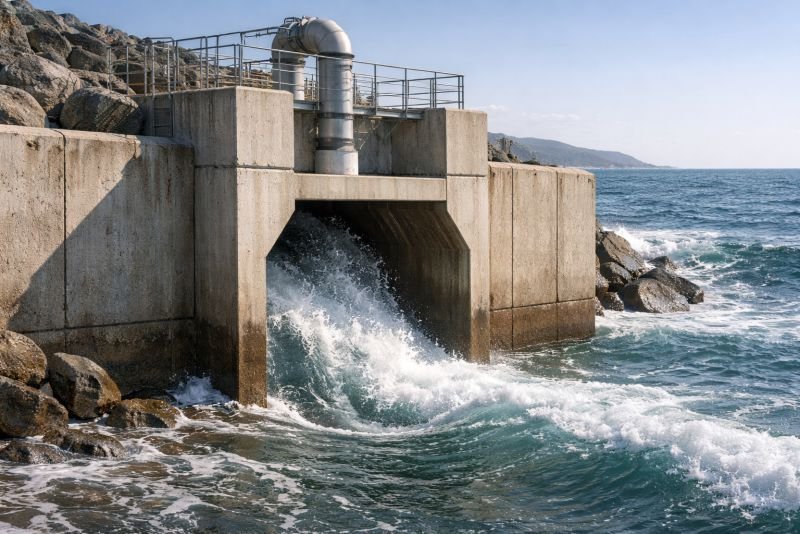
A breakwater chamber can drive alternating airflow through a turbine each time incoming swell lifts and drops the water inside.
Related Concepts:
- Pneumatic Damping
- Resonance Frequency
- Wells Turbine
NoSuchDevice is a free archive of machines that do not exist yet but already have a shadow in physics. I research and write every entry alone, with no ads. Take a look around the archive, or help keep it free.