






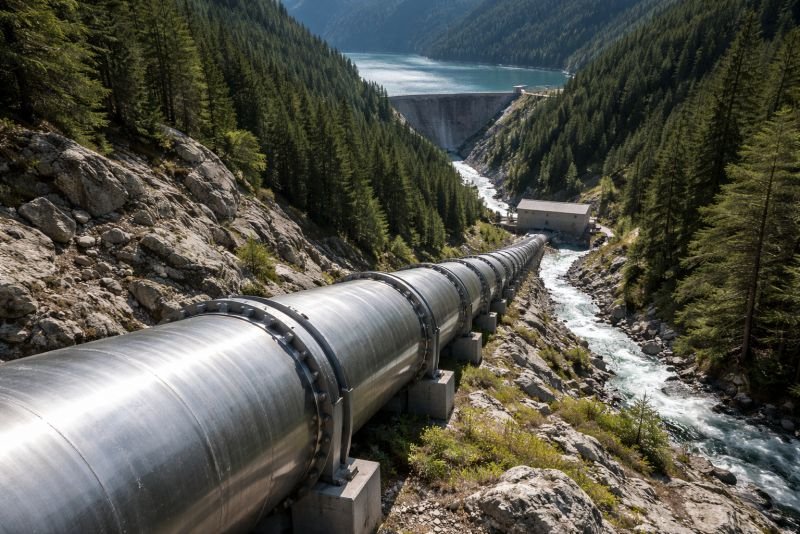
What Is Penstock?
A penstock is the pressurized conduit that carries water from a reservoir or surge tank to a hydro turbine. It converts elevation head into controlled flow while containing large internal loads from static pressure, transients, and friction. Designers track both flow continuity, Q = Av, and head loss along the pipe because diameter strongly affects velocity, pressure drop, and construction cost.
A narrower pipe lowers material cost but forces the same water through at higher speed, which raises wall shear, noise, and pressure losses. Those losses are often estimated with the Darcy-Weisbach Equation, while bends, valves, and surface roughness can intensify Turbulence and water hammer during operating changes.
The concept matters because penstock sizing shapes the net head that actually reaches the runner. In high-head hydroelectric flow design, engineers balance steel thickness, anchor loads, allowable velocity, and friction so the pipe delivers strong turbine input without wasting too much energy as pressure loss or risking damaging transients. Penstock design also affects installation cost, long-term inspection access, support spacing, civil foundation loads, and the plant’s response to rapid load changes.
Example:
A mountain hydro plant may use a long steep penstock to carry reservoir water down to a Pelton turbine at high pressure.
Related Concepts:
- Net Head
- Water Hammer
- Flow Continuity
NoSuchDevice is a free archive of machines that do not exist yet but already have a shadow in physics. I research and write every entry alone, with no ads. Take a look around the archive, or help keep it free.