






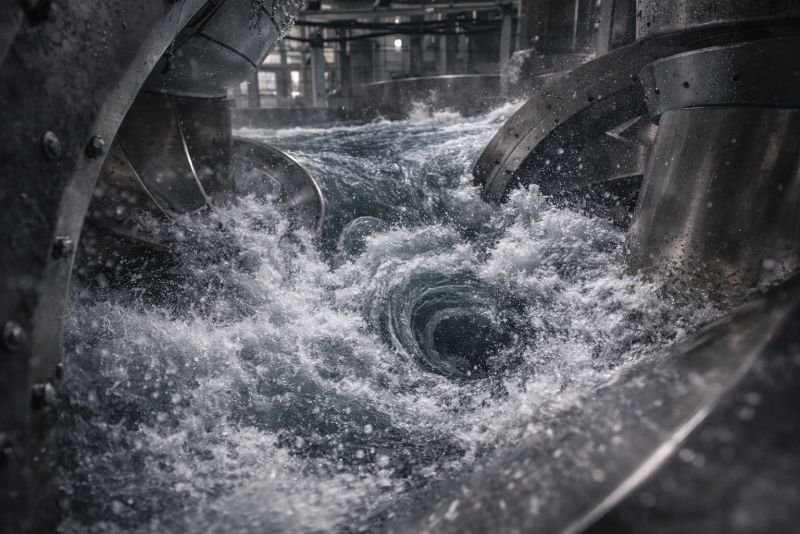
What Is Turbulence?
Turbulence is a flow regime in which velocity and pressure fluctuate irregularly across many interacting eddies rather than remaining organized in smooth layers. It usually appears when inertial forces dominate viscous damping, often described with Reynolds number, Re = rho v D / mu. In hydro systems, fast jets, curved passages, and abrupt area changes all promote turbulent motion.
Inside wicket gates, draft tubes, and spillways, turbulence improves mixing but also converts useful mechanical energy into heat and noise. Compared with Laminar Flow, it produces larger shear stresses and more uneven loading on surfaces. Strong local fluctuations can also deepen pressure dips enough to support Cavitation in poorly conditioned zones of a turbine or nozzle.
The concept matters because hydro plants depend on moving large water volumes without losing too much head before the runner. In hydropower internal flow engineering, turbulence models guide blade shape, passage geometry, and diffuser design so the machine transfers momentum efficiently while limiting vibration, fatigue, sediment erosion, and unstable operating behavior. Those models also help explain important scale effects between laboratory tests and full-size machines.
Example:
Water leaving a guide vane passage can break into swirling eddies that raise losses before the flow reaches the runner blades.
Related Concepts:
- Reynolds Number
- Eddy Dissipation
- Boundary Layer
NoSuchDevice is a free archive of machines that do not exist yet but already have a shadow in physics. I research and write every entry alone, with no ads. Take a look around the archive, or help keep it free.