





What Is Planck’s constant?
Planck’s constant is the proportionality constant that connects a quantum’s energy to the frequency of its associated radiation or matter wave. It is written h, with h = 6.62607015 x 10^-34 J s, and appears in E = h f. The constant marks the scale at which energy exchange occurs in discrete packets rather than as a continuous range.
In real systems, Planck’s constant sets the spacing of allowed energy states, the momentum-wavelength relation, and the photon energy carried by light. In solar photon energy analysis, it links wavelength, frequency, and whether radiation has enough energy to interact with a semiconductor bandgap. The same relation explains the color-dependent response of optical detectors.
The concept matters because quantum behavior controls how atoms absorb light, how electrons occupy materials, and how sensors convert radiation into electrical signals. Used in devices include lasers, LEDs, photovoltaic cells, spectrometers, atomic clocks, and scanning tunneling microscopes.
Planck’s constant is fixed exactly in the SI system, so it also helps define the kilogram through quantum electrical measurements. Practical work usually uses it with frequency, wavelength, or electron-volts to compare microscopic energies.
Example:
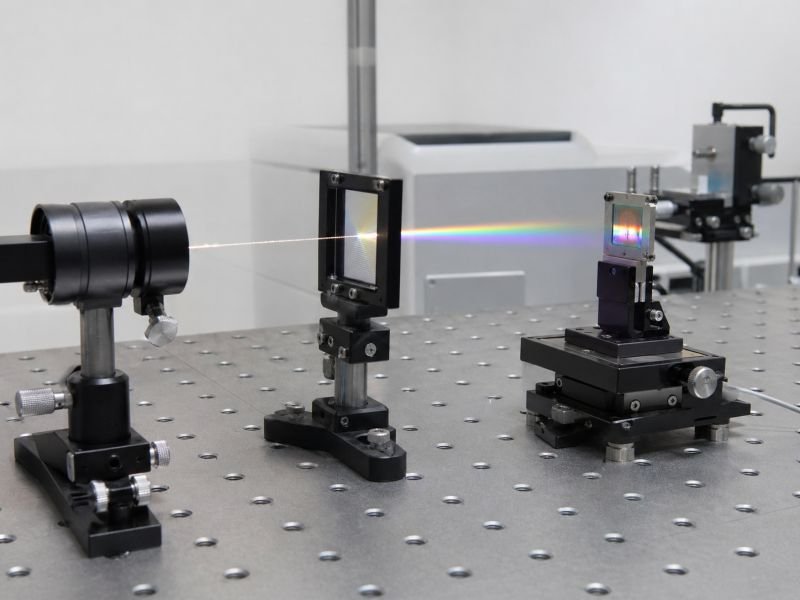
A spectrometer uses Planck’s constant to convert measured light frequency into photon energy for identifying electronic transitions in a material.
Related Terms:
- Electron-Volt
- Photon Energy
- Quantum Mechanics
NoSuchDevice is a free archive of machines that do not exist yet but already have a shadow in physics. I research and write every entry alone, with no ads. Take a look around the archive, or help keep it free.