




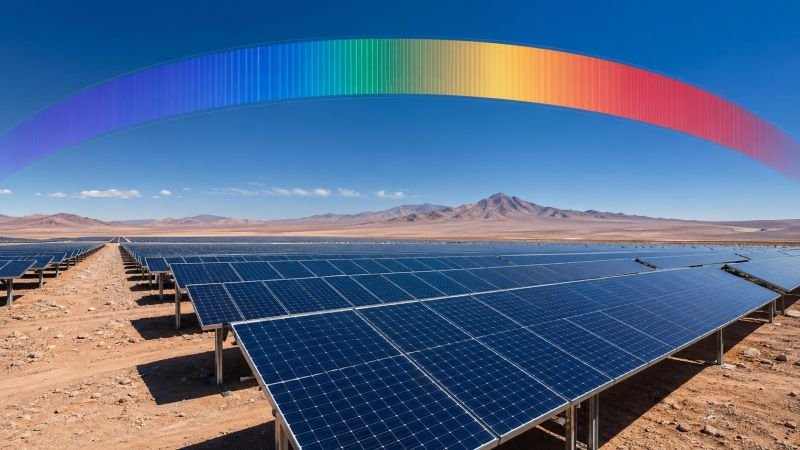
In the Atacama Desert in northern Chile, the average annual irradiance exceeds 2,500 kilowatt-hours per square meter. No other inhabited landmass receives more solar energy per unit of ground. The panels installed across those high, dry plateaus face conditions that most solar engineers only ever model in software. And even there, at the most favorable solar geography on Earth, a standard silicon photovoltaic panel converts somewhere between 20 and 22 percent of the energy that lands on it into electricity.
The rest becomes heat. The question worth asking is why.
The short version: Sunlight is not just visible light. The electromagnetic spectrum spans from ultraviolet through visible to infrared, and roughly 54 percent of solar energy arrives as infrared radiation that standard silicon panels barely touch. Photovoltaic conversion depends on matching photon energy to material bandgap: too low and photons pass through, too high and excess energy burns off as heat. A perfect single-material solar cell cannot theoretically exceed 33.7 percent efficiency regardless of engineering refinements, a limit set entirely by the shape of the electromagnetic spectrum.
Table of Contents
What the Solar Electromagnetic Spectrum Actually Contains
Sunlight does not arrive as a uniform stream of light. It arrives as a continuous spread of radiation spanning wavelengths from about 250 nanometers in the ultraviolet through to beyond 2,500 nanometers in the mid-infrared. The human eye responds to a narrow slice of that range, roughly 380 to 700 nanometers. Everything outside that window is invisible, but it carries real energy.
The solar spectrum reaching Earth’s surface can be divided into three broad regions. Ultraviolet radiation makes up about 5 percent of total solar energy. Visible light accounts for roughly 43 percent. Near-infrared and infrared radiation carries the remaining 52 percent.
| Spectral Region | Wavelength Range | Share of Solar Energy | Silicon Panel Response |
|---|---|---|---|
| Ultraviolet | 250 – 400 nm | ~5% | Partially absorbed; excess energy lost as heat |
| Visible | 400 – 700 nm | ~43% | Most efficiently converted |
| Near-infrared | 700 – 1100 nm | ~30% | Partial conversion near silicon bandgap |
| Infrared | 1100 nm and above | ~22% | Passes through silicon; essentially lost |
More than half the energy arriving from the sun lands outside the range where silicon solar cells work well. That fact alone explains a significant portion of the efficiency ceiling that photovoltaic panels have been pushing against for decades.
Photon Energy in the Electromagnetic Spectrum and the Silicon Bandgap
Every photon in the electromagnetic spectrum carries a specific amount of energy, and that energy is determined entirely by its wavelength. The relationship is described by a formula first developed by Max Planck in 1900:
E = hc / λ
Here, E is the energy of one photon measured in joules. The letter h is Planck’s constant, equal to 6.626 × 10⁻³⁴ joule-seconds. The letter c is the speed of light, 3 × 10⁸ meters per second. And λ is the wavelength of the photon in meters.
Take a photon of green visible light with a wavelength of 550 nanometers, or 5.5 × 10⁻⁷ meters:
E = (6.626 × 10⁻³⁴ × 3 × 10⁸) / (5.5 × 10⁻⁷) E = 3.6 × 10⁻¹⁹ joules, or about 2.26 electron-volts
Now compare that to an infrared photon at 1200 nanometers:
E = (6.626 × 10⁻³⁴ × 3 × 10⁸) / (1.2 × 10⁻⁶) E = 1.66 × 10⁻¹⁹ joules, or about 1.04 electron-volts
Silicon has a bandgap of 1.12 electron-volts. A photon must carry at least that much energy to free an electron from the silicon lattice and generate current. The infrared photon at 1200 nanometers delivers 1.04 electron-volts. It falls short by 0.08 electron-volts and passes straight through the cell without doing anything useful.
That is the first loss. Photons below the bandgap energy are transparent to the material.
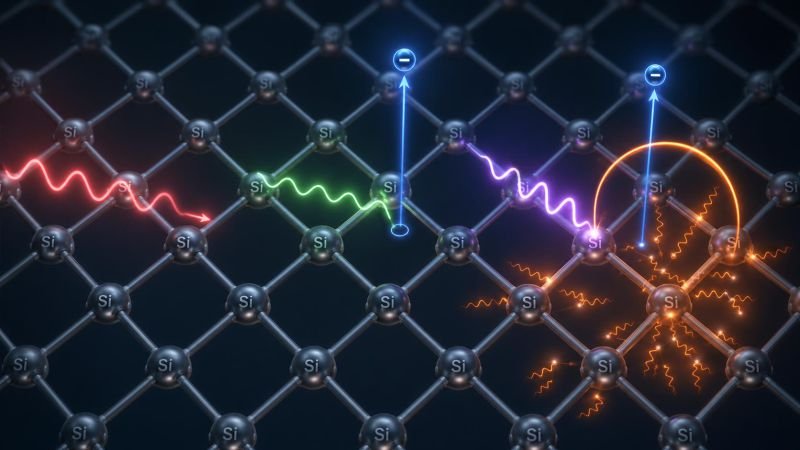
The second loss works the opposite way. An ultraviolet photon at 300 nanometers carries about 4.14 electron-volts, which is nearly four times the silicon bandgap. The photon frees an electron with excess energy of 3.02 electron-volts. That excess does not go into the electrical current. It thermally relaxes through the crystal lattice and becomes heat in under a picosecond. Four times the photon energy, but only the same one electron-volt’s worth of electricity as any photon just above the bandgap.
Infrared Light in the Solar Electromagnetic Spectrum: The Silent Majority
More than half of solar energy arrives in the infrared. To a silicon panel, most of it is invisible.
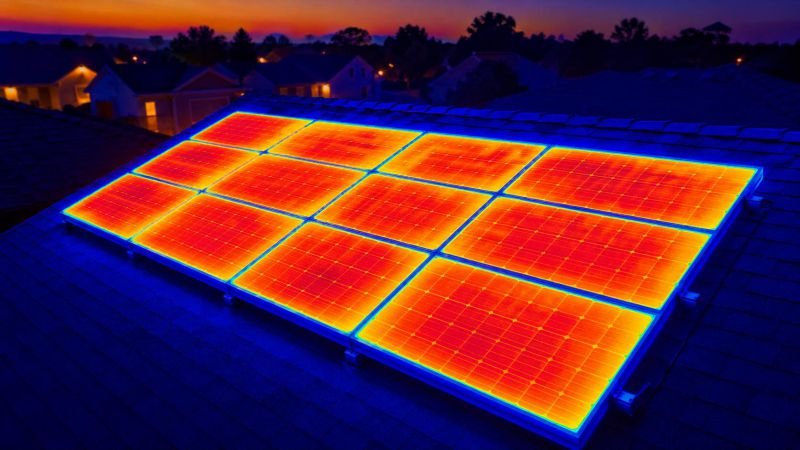
Silicon absorbs photons efficiently up to about 1100 nanometers, the point at which photon energy drops below the 1.12 electron-volt bandgap. Beyond that boundary, the photons continue into the panel and pass through as if the material were glass. Near-infrared wavelengths between 1100 and 2000 nanometers alone carry roughly 20 percent of total solar irradiance. They land on the panel, generate no electricity, and slowly heat the cell.
Elevated temperature is not a neutral outcome. For every degree Celsius rise in cell temperature, silicon panel efficiency drops by approximately 0.45 percent relative to its rated output. A panel running at 70 degrees Celsius on a hot afternoon, compared to its standard test condition of 25 degrees Celsius, loses around 20 percent of its rated performance. The infrared energy that failed to generate current has now actively reduced the conversion of the visible energy that could have.
Can anything be done with infrared before it turns into waste heat? This is where several emerging approaches are trying to break from the silicon-only paradigm. Thermophotovoltaic systems, for instance, absorb infrared radiation thermally and re-emit it at a narrower wavelength band tuned to a photovoltaic cell’s bandgap. The concept is physically sound. The engineering is not yet solved at commercial scale, which is precisely why the full version of those devices belongs to a different article.
Everything here is free. Readers are the reason it stays that way.
I make all of it alone, with no ads. If it is worth a coffee a month to you, that keeps the next one coming.
Keep it alive →Ultraviolet Energy in the Electromagnetic Spectrum: High Yield, Short Life
Ultraviolet photons carry the most energy per particle in the solar electromagnetic spectrum reaching Earth’s surface. That sounds like an advantage. In practice, it creates two separate problems.
The first is thermalization, which the previous section already covered: excess energy above the bandgap becomes heat. A UV photon at 300 nanometers generates the same single electron as a near-infrared photon at 1100 nanometers, while discarding three times as much energy in the process.
The second problem is material degradation. Ultraviolet radiation attacks the encapsulant layers that protect silicon cells from moisture and mechanical stress. The ethylene-vinyl acetate polymer used as a standard encapsulant begins to yellow under prolonged UV exposure, reducing optical transmission and accelerating cell delamination. Modern panel manufacturers add UV-absorbing additives to slow this process, which partially filters out the radiation that was already being inefficiently converted anyway.
Does UV light therefore contribute nothing useful to a silicon panel? Not quite. The wavelength range between 400 and 500 nanometers, the violet edge of visible light, is efficiently absorbed and converted. The real UV cutoff for meaningful silicon photovoltaic response sits around 380 nanometers. Below that, photons are either absorbed by the glass cover, the encapsulant, or the silicon itself with negligible electrical benefit and measurable material cost.
The Shockley-Queisser Limit and What the Electromagnetic Spectrum Imposes
In 1961, William Shockley and Hans-Joachim Queisser worked through the thermodynamics of a single-junction solar cell exposed to blackbody radiation and arrived at a ceiling. For a material with silicon’s bandgap, the theoretical maximum efficiency under standard solar illumination is approximately 33.7 percent. This figure is known as the Shockley-Queisser limit.
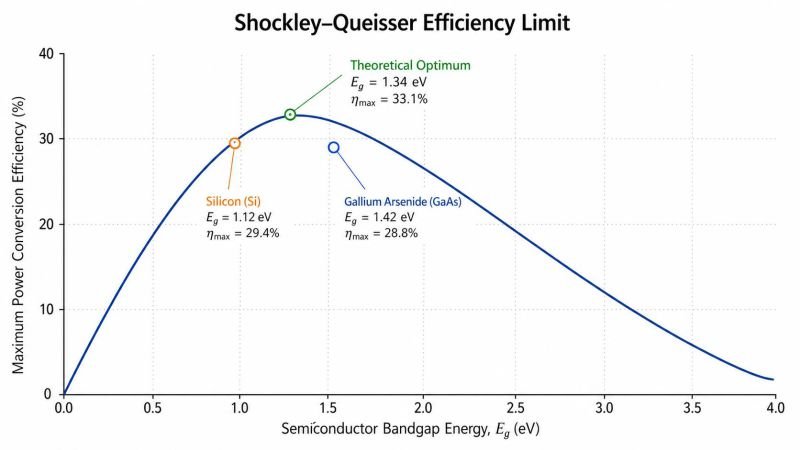
The calculation is not an engineering constraint. It is a consequence of the electromagnetic spectrum itself.
For any given bandgap, photons below that energy are lost entirely. Photons above it lose their excess energy to thermalization. Photons near the bandgap convert efficiently. The optimal bandgap turns out to be around 1.34 electron-volts, which would capture a slightly better slice of the solar spectrum than silicon’s 1.12 electron-volts. Silicon comes close but is not optimal, which is one reason the thin-film material gallium arsenide, with a bandgap of 1.42 electron-volts, holds the record for single-junction efficiency in controlled conditions.
What makes the Shockley-Queisser limit genuinely uncomfortable is that it applies to the best possible single-junction cell of any material, not just to silicon. A solar cell made of a perfectly engineered new material with an ideal bandgap, with zero reflection losses and zero resistive losses, still cannot exceed 33.7 percent under the solar electromagnetic spectrum as it arrives at Earth’s surface. The limit is written into the shape of the spectrum.
Engineering Across the Electromagnetic Spectrum: Multi-Junction Cells and Spectrum Splitting
The most direct response to the Shockley-Queisser limit is to stop asking one material to convert the whole electromagnetic spectrum and divide the job across several materials instead.
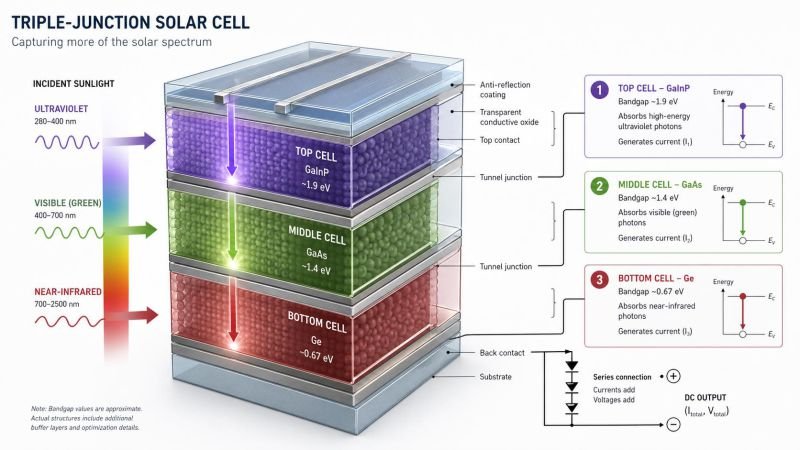
Multi-junction solar cells stack semiconductor layers with different bandgaps. The top layer absorbs high-energy photons from the ultraviolet and blue visible range. Those it cannot use pass through to the next layer, which has a lower bandgap and captures mid-range photons. A third layer handles near-infrared. Each layer only converts photons near its own bandgap, and the thermalization losses that destroy efficiency in a single-junction cell are largely avoided.
Triple-Junction Cells and the Aerospace Benchmark
The record-holding triple-junction cells used in spacecraft achieve efficiencies above 40 percent in laboratory conditions. The standard configuration uses indium gallium phosphide for the top junction at around 1.9 electron-volts, followed by indium gallium arsenide at about 1.4 electron-volts, followed by germanium at 0.67 electron-volts. The layers work in series and address three distinct bands of the solar electromagnetic spectrum simultaneously.
Manufacturing cost prevents these cells from appearing on residential rooftops. The materials and deposition processes required for multi-junction structures are compatible with space program budgets, not with utility-scale ground installation. Concentrating photovoltaic systems, which use optical lenses to focus sunlight onto small areas of expensive multi-junction cells, represent the current practical route toward high-efficiency full-spectrum conversion in terrestrial conditions.
Spectrum Splitting by Physical Separation
An alternative to stacking is splitting. Dichroic optical elements can physically separate the incoming solar electromagnetic spectrum into wavelength bands and direct each band to a photovoltaic cell optimized for it. Near-infrared radiation can be routed to a thermophotovoltaic converter or used directly for thermal applications, while visible light goes to silicon. The optical losses in the splitting elements have so far prevented this approach from matching the efficiency of monolithic multi-junction cells, but the architecture has practical appeal for systems where waste heat can also be put to use.
The View From NoSuchDevice
I find the Shockley-Queisser limit more clarifying than discouraging. It tells us exactly where the problem is, which is more useful than an open-ended mystery.
The fact that more than half of solar energy arrives as infrared and that silicon ignores most of it is not a design flaw. It is a consequence of using one material to do a job the electromagnetic spectrum has already divided into at least three. The physics has not changed and will not change. The engineering question is whether the cost of addressing the full spectrum eventually falls below the value of the extra electricity recovered.
For space applications, it already has. For ground applications, it has not, at least not outside concentrating systems. The gap between laboratory efficiency records and commercial panel efficiency has been narrowing for twenty years and is likely to keep narrowing. Whether it narrows fast enough to matter before cheaper silicon panels and better storage economics make the whole discussion irrelevant is a genuinely open question. The electromagnetic spectrum does not care which answer arrives first.
You read the whole thing.
That is rarer than it should be, and it is the exact kind of attention I built this archive for. I make every piece alone, with no ads and no investor deciding what gets written. If you want the next machine taken apart like this one, you can help me make it.
A coffee a month is enough to keep it free for everyone.
Prefer crypto or a one time gift? Other ways to give →
Technologies Related to This Concept
| Technology | Concept |
|---|---|
| Tandem Perovskite-Silicon Solar Panels | Concept: Stacked cell architecture combining silicon and perovskite layers to capture a wider spectral range. |
| Dynamic Liquid Crystal Energy Converters | Concept: Devices using liquid crystal technology to adjust optical properties and convert light to electricity. |
| Transparent Solar Fabrics for Window Curtains | Concept: Semi-transparent fabrics that generate electricity while allowing light to pass through, ideal for curtains and blinds. |
| Photovoltaic Window Shades and Blinds | Concept: Window coverings that generate electricity while controlling light and privacy. |
| Solar-Active Wallpaper for Indoor Energy Generation | Concept: Wallpaper embedded with photovoltaic materials to generate electricity from indoor lighting. |