




What Is Quantum tunneling?
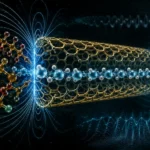
Quantum tunneling is the process by which a particle passes through a potential-energy barrier that classical mechanics says it should not cross. In quantum theory, the particle is described by a wave function whose amplitude extends into and beyond the barrier, creating a finite transmission probability. A common approximation is T ~ exp(-2ka), where k depends on barrier height and particle mass, and a is barrier width.
In real systems, tunneling becomes more likely when the barrier is thinner, the energy gap is smaller, or the particle is lighter. The effect appears in semiconductors, nuclear fusion, molecular charge transfer, and surface microscopy because barriers at atomic scales are narrow enough for wave behavior to matter. In quantum energy conversion, tunneling helps explain how carriers or reactive particles reach states that thermal motion alone would not access efficiently.
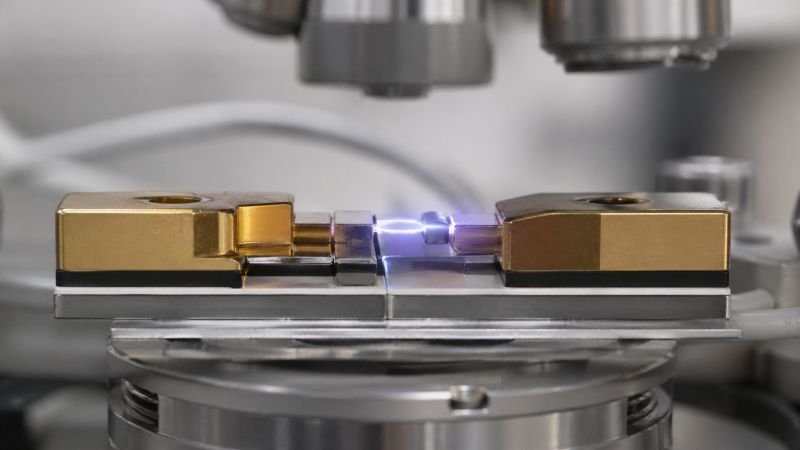
The concept matters because it sets hard limits and useful opportunities in device design, from leakage currents to catalytic rate enhancement. Used in devices include tunnel diodes, flash memory cells, Josephson junctions, and scanning tunneling microscopes. Engineers account for tunneling whenever nanoscale spacing, low-mass particles, or sharp energy barriers make classical barrier models incomplete.
Example:
An electron can tunnel through the thin insulating layer of a flash memory cell during programming when the electric field becomes strong enough.
Related Terms:
- Quantum Coherence
- Superposition
- Wave Function
NoSuchDevice is a free archive of machines that do not exist yet but already have a shadow in physics. I research and write every entry alone, with no ads. Take a look around the archive, or help keep it free.