





In 2007, a research team at UC Berkeley put a sample of green sulfur bacterium into a laser spectrometer and watched energy move through its photosynthetic machinery in real time. The bacteria had been collected from an anoxic sulfur spring. The experiment was designed to measure how quickly an absorbed photon transferred its energy from one chlorophyll molecule to the next. What the team observed did not fit any classical model. The energy was not hopping from molecule to molecule in sequence. It was propagating as a quantum wave, exploring multiple pathways at once, and landing at the reaction center with a transfer efficiency close to 95%. No engineer had built anything close to that.
The short version: Quantum mechanics describes how energy and matter behave at the scale of individual atoms and molecules, where the rules of classical physics no longer apply. Three quantum phenomena are particularly relevant to eco-tech: tunneling, which allows particles to pass through energy barriers they classically could not cross; coherence, which lets energy travel as a wave across multiple molecules simultaneously; and quantum confinement, which allows nanoscale semiconductors to absorb light at precisely tunable wavelengths. Together, these effects explain why photosynthesis achieves 95% energy transfer efficiency and why quantum dot solar cells may eventually exceed the 33% Shockley-Queisser limit that caps conventional silicon panels.
Table of Contents
What Quantum Mechanics Actually Governs at Molecular Scale
Classical physics describes the world at human scales well enough to build bridges, engines, and power grids. The moment the relevant length scale drops below a few nanometers, classical physics starts producing wrong answers. Quantum mechanics takes over.
At that scale, particles do not have definite positions or velocities in the classical sense. They are described by wave functions: mathematical objects that encode the probability of finding a particle at any given location. Two wave functions can overlap, interfere, and combine. A particle can exist in a superposition of states, meaning it effectively occupies multiple conditions at once until an interaction forces a definite outcome.
Why Energy Transfer Cares About Wave Functions
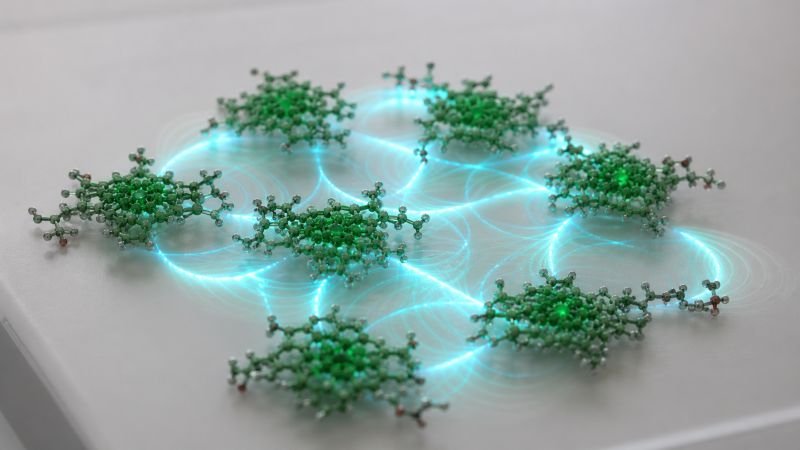
The Berkeley experiment worked because energy transfer in photosynthesis is not a billiard-ball process. Each chlorophyll molecule has a characteristic quantum state. When a photon arrives and excites one molecule, the excitation does not transfer by physical collision. It transfers because the quantum states of nearby molecules overlap. The energy propagates as a delocalized wave, sampling every available pathway simultaneously, and settles into the lowest-energy route. Classical random-walk diffusion would lose most of that energy to heat. The quantum wave finds the efficient path before thermal noise can interfere.
This is not a minor refinement to the classical picture. It is a categorically different mechanism that produces a categorically different result.
Quantum Tunneling: The Mechanism Quantum Mechanics Uses to Defeat Energy Barriers
Imagine pushing a ball up a hill. If the ball does not have enough energy to reach the top, it rolls back. That is classical physics. In the quantum world, a particle approaching a barrier has a nonzero probability of appearing on the other side without ever occupying the space in between. This is quantum tunneling, and it is not a theoretical curiosity. It is the mechanism that keeps the sun burning.
Nuclear fusion in stellar cores relies on protons tunneling through the electrostatic repulsion that would otherwise prevent them from getting close enough to fuse. At the temperatures inside the sun, classical mechanics predicts fusion should not happen. The observed fusion rate requires tunneling.
The Numbers Behind Tunneling Probability
The probability of a particle tunneling through a barrier depends on the particle’s mass, the barrier height, and the barrier width. For a particle of mass m approaching a barrier of height V and width d, the tunneling probability T scales approximately as:
T ~ exp(-2d * sqrt(2m(V – E)) / h-bar)
Here, E is the particle’s energy, V is the potential barrier height, and h-bar is the reduced Planck constant, equal to 1.055 x 10^-34 joule-seconds. The exponential is negative, meaning the probability drops steeply as the barrier gets wider or taller.
For a hydrogen nucleus (proton, mass 1.67 x 10^-27 kg) approaching a barrier 1 femtometre wide with 10 keV of kinetic energy against a 100 keV Coulomb barrier: substituting V – E = 90 keV = 1.44 x 10^-14 J, the exponent evaluates to roughly -7, giving a tunneling probability around 0.1%. That sounds small. But in a stellar core containing 10^57 protons, even a 0.1% tunneling rate produces enough fusion events to power a star for billions of years.
For eco-tech, the relevant domain is electron tunneling in enzyme catalysis. Certain enzymes transfer hydrogen atoms across gaps too large for classical thermal diffusion to explain at biological temperatures. Tunneling fills the gap. The implication is that life has been running quantum-assisted chemistry for billions of years inside machinery that fits inside a single cell.
Quantum Coherence and the 95% Efficiency That Photosynthesis Reaches
The Berkeley result pointed at something engineers had been circling for decades. Conventional solar cells convert sunlight to electricity at 20 to 25% efficiency in commercial products. Photosynthesis transfers absorbed photon energy to the reaction center at efficiencies approaching 95%. The gap is not explained by material quality or manufacturing precision. The mechanism is different.
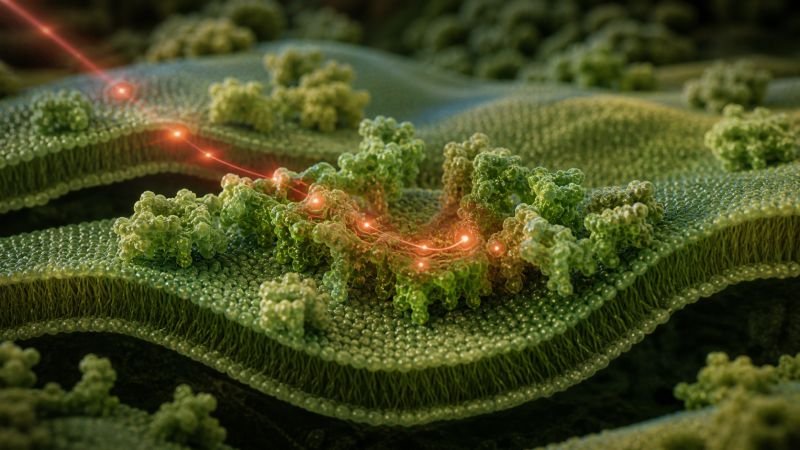
Quantum coherence means that quantum states maintain a fixed phase relationship over time. When chlorophyll molecules in a photosynthetic complex are coherent with each other, their wave functions interfere constructively along the fastest energy-transfer pathway and destructively along slower ones. The energy is guided, not diffused.
How long does this coherence last? In the green sulfur bacterium studied at Berkeley, coherence times were measured at around 660 femtoseconds at 77 Kelvin. Later experiments found evidence of coherence surviving at room temperature in certain systems, including marine algae. The debate over exactly how much quantum coherence contributes to biological efficiency at physiological temperatures is ongoing. What is not in dispute is that the efficiency exists and that classical models do not reproduce it.
The Photon Energy Calculation Photosynthesis Is Built Around
The chlorophyll a molecule, which drives the primary photochemical reaction in most oxygenic photosynthesis, has its main absorption peak at 680 nanometres in the red region of the visible spectrum. The energy of a single photon at that wavelength is given by Planck’s relation:
E = hf
where h is Planck’s constant (6.626 x 10^-34 joule-seconds) and f is the photon frequency. Frequency relates to wavelength through f = c / lambda, where c is the speed of light (3 x 10^8 metres per second) and lambda is the wavelength.
At 680 nm = 680 x 10^-9 m:
f = (3 x 10^8) / (680 x 10^-9) = 4.41 x 10^14 Hz
E = 6.626 x 10^-34 x 4.41 x 10^14 = 2.92 x 10^-19 joules = 1.82 eV
This is the photon energy that chlorophyll has evolved to absorb with near-perfect quantum efficiency. A silicon solar cell absorbing a photon of that energy converts only a fraction of it to usable electricity. The rest becomes heat as the photon’s excess energy above the silicon bandgap dissipates. Quantum dot materials can be tuned to absorb photons at exactly this energy without the excess-energy loss, which is why they matter for the next generation of solar technology.
Everything here is free. Readers are the reason it stays that way.
I make all of it alone, with no ads. If it is worth a coffee a month to you, that keeps the next one coming.
Keep it alive →Quantum Confinement and the Solar Cell Problem Quantum Mechanics Can Solve
| Mechanism | Photon Energy Use | Efficiency Range | Engineering Status |
|---|---|---|---|
| Classical molecular diffusion | Loses energy to thermal randomness | ~50% transfer | Not used in devices |
| Silicon solar cell (bandgap absorption) | Loses excess photon energy as heat | 20-25% (commercial) | Widely deployed |
| Quantum coherent transfer (photosynthesis) | Wave-guided, minimal thermal loss | ~95% transfer | Biological only |
| Quantum dot solar cell | Tunable bandgap, multiple exciton generation | 45% (theoretical) | Lab stage |
| Enzyme quantum tunneling | Bypasses classical activation barrier | Near-complete for H transfer | Not engineered |
The silicon solar cell problem has a formal name: the Shockley-Queisser limit. A single-junction cell with a fixed bandgap can only efficiently absorb photons whose energy is close to that bandgap. Photons with more energy waste the excess as heat. Photons with less energy are not absorbed at all. Under ideal conditions, the theoretical maximum efficiency for a single-junction silicon cell is approximately 33%.
Quantum dots are semiconductor nanocrystals whose bandgap is not fixed by the bulk material. It is determined by the physical size of the crystal. A 2-nanometre cadmium selenide quantum dot absorbs green light. A 5-nanometre dot of the same material absorbs red light. Size sets the bandgap because quantum confinement changes the energy spacing between electronic states. A solar cell built from a layered stack of quantum dots of different sizes can absorb sunlight across the full spectrum, attacking the Shockley-Queisser limit from below.
Quantum dots also allow a process called multiple exciton generation, where a single high-energy photon produces two electron-hole pairs rather than one. That doubles the charge carriers available from a single absorbed photon. In laboratory measurements, certain quantum dot systems have demonstrated this effect at efficiencies above 100% per photon, meaning more than one unit of electrical work per photon absorbed.
Whether this can be commercialized at scale is a manufacturing and stability problem, not a physics problem. The quantum mechanics permits it. The question is whether anyone can build a panel that survives outdoors for twenty years.
Temperature and Noise: Why Quantum Mechanics Survives in Warm, Wet Biology
One of the standard objections to quantum biology is thermal noise. At room temperature, the thermal energy available per degree of freedom is on the order of kT, where k is Boltzmann’s constant (1.38 x 10^-23 J/K) and T is temperature in Kelvin. At 300 K, kT is approximately 25 meV. Quantum coherence effects in photosynthetic complexes operate at energies of around 100 to 400 meV, which means they are well above the thermal noise floor.
Coherence in biology does not require the low temperatures needed in superconducting quantum computers. The photosynthetic antenna complex achieves what it achieves inside a chloroplast at 25 degrees Celsius because the relevant energy gaps are larger than the thermal fluctuation energy. This is not an accident of evolution. It is a design constraint that three and a half billion years of selection pressure has optimized.
The same logic does not automatically apply to every proposed quantum device. Quantum computers need millikelvin temperatures because their qubit energies are comparable to kT at room temperature. Any eco-tech device hoping to exploit quantum coherence must operate in an energy regime where coherence is not swamped by thermal noise. Photosynthesis tells us this is achievable in principle. It does not tell us it is easy to engineer.
What Quantum Mechanics Makes Possible in Next-Generation Eco-Tech Devices
The path from quantum biology to engineered devices is not speculative. It is a matter of understanding mechanisms well enough to replicate them in non-biological materials. Several directions are already being explored with real physics behind them.

Quantum catalysts for nitrogen fixation are one serious target. Nitrogenase, the enzyme that bacteria use to fix atmospheric nitrogen into ammonia, operates at room temperature and atmospheric pressure. The industrial Haber-Bosch process does the same reaction at 400 to 500 degrees Celsius and 150 to 300 atmospheres of pressure, consuming roughly 1 to 2% of global energy annually. The nitrogenase reaction involves electron tunneling through the enzyme’s iron-molybdenum cofactor. If that mechanism could be reproduced in a synthetic catalyst, the energy cost of fertilizer production would collapse.
Quantum-enhanced sensors represent another direction. Entangled photon pairs allow measurements of molecular concentrations, temperature gradients, and photon flux at precisions that classical detectors cannot reach. In environmental monitoring, the ability to detect trace gases or pollutants at the single-molecule level would change what eco-tech systems can observe and respond to.
Artificial photosynthesis built around quantum-coherent energy transfer is the longest-range target, and arguably the most consequential. A synthetic antenna complex that routes photon energy to a catalytic center with 90% efficiency would produce hydrogen fuel or reduce CO2 at efficiencies that make current electrolysis look crude. The physics is understood. The materials engineering is not solved.
Conclusion
Quantum mechanics in eco-tech sits in an odd position. The physics is not speculative. It is established, peer-reviewed, and in several cases observed directly in natural systems. The gap is engineering. Nobody has built an artificial photosynthetic antenna complex that works at scale. Nobody has synthesized a room-temperature quantum catalyst for nitrogen fixation. Nobody has shipped a quantum dot solar panel that matches silicon on cost per watt and lifetime.
I find the gap frustrating in the specific way that gaps are frustrating when the answer is clearly on the other side of them. The evidence that quantum mechanics can be exploited for clean energy is not found in theory papers. It is found in every blade of grass in sunlight. Nature solved these engineering problems without silicon fabs, venture capital, or clean rooms. The fact that we cannot yet replicate what a bacterium does routinely is more an indictment of where engineering attention has gone than a statement about whether it is possible.
The devices that will eventually come out of this are not incremental improvements on existing technology. A quantum-coherent solar cell that approaches photosynthetic efficiency would not be a better silicon panel. It would be something categorically different. That is the kind of device this site exists to think about.
You read the whole thing.
That is rarer than it should be, and it is the exact kind of attention I built this archive for. I make every piece alone, with no ads and no investor deciding what gets written. If you want the next machine taken apart like this one, you can help me make it.
A coffee a month is enough to keep it free for everyone.
Prefer crypto or a one time gift? Other ways to give →
Technologies Related to This Concept
| Technology | Concept |
|---|---|
| Quantum Flux Energy Harvesters | Concept: Devices that tap into quantum fluctuations to generate limitless clean energy. |
| Quantum Recycling Machines | Concept: Devices that disassemble waste at the atomic level to reassemble it into new materials. |
| Nano-Photonic Energy Cells | Concept: Nanotechnology-based cells that capture and store light at the quantum level. |
| Quantum Dot Energy Windows | Concept: Windows made with quantum dots that generate electricity while remaining transparent. |
| Quantum-Integrated Solar Fuel Cells | Concept: Solar cells integrated with quantum technology for direct fuel production. Quantum Dot Catalysts for Fuel Synthesis |