




What Is Regenerative Braking?
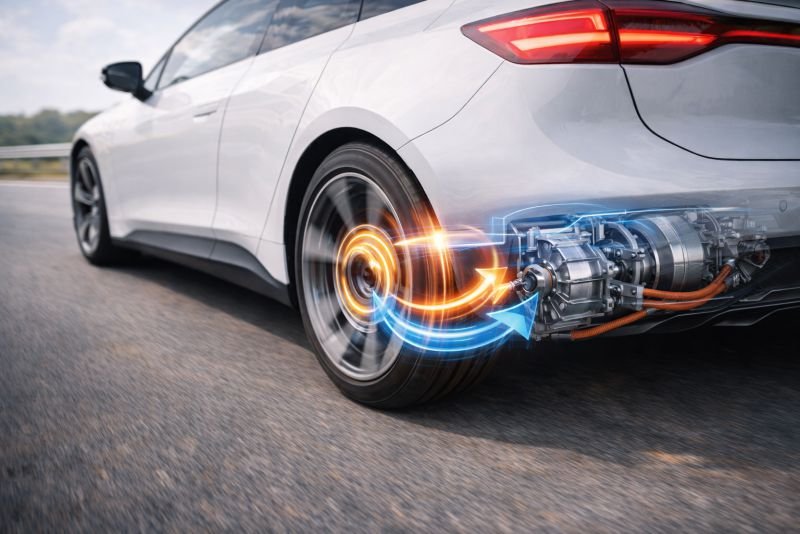
Regenerative braking is a vehicle control strategy that recovers part of the kinetic energy normally lost as heat during deceleration and converts it into stored electrical or mechanical energy. Instead of relying only on friction brakes, the drive motor operates as a generator while slowing the vehicle. The recoverable motion energy is described by E_k = 0.5mv^2, where m is mass and v is velocity before braking.
In real systems, an inverter redirects generated current into a battery, capacitor bank, flywheel, or another storage element able to absorb short, high-power pulses. In vehicle energy recovery systems, storage acceptance rate is as important as total capacity because braking events are brief and intense. Used in devices include electric cars, hybrid buses, rail systems, industrial cranes, and elevators.
The method matters because it improves efficiency, reduces brake wear, and lowers waste heat in repeated stop-start operation. Recovery is never total, however. Tire grip, vehicle speed, storage state of charge, thermal limits, and control software all determine how much of the available energy can actually be captured and reused.
Engineers evaluate regenerative braking through recovered kilowatt-hours, round-trip efficiency, deceleration profiles, and thermal loading on the storage system. These measurements show whether the control strategy is capturing useful energy without compromising stability or braking feel.
Example:
An electric tram can return energy to an onboard capacitor bank during each station approach and reuse part of that energy for the next acceleration.
Related Terms:
NoSuchDevice is a free archive of machines that do not exist yet but already have a shadow in physics. I research and write every entry alone, with no ads. Take a look around the archive, or help keep it free.