






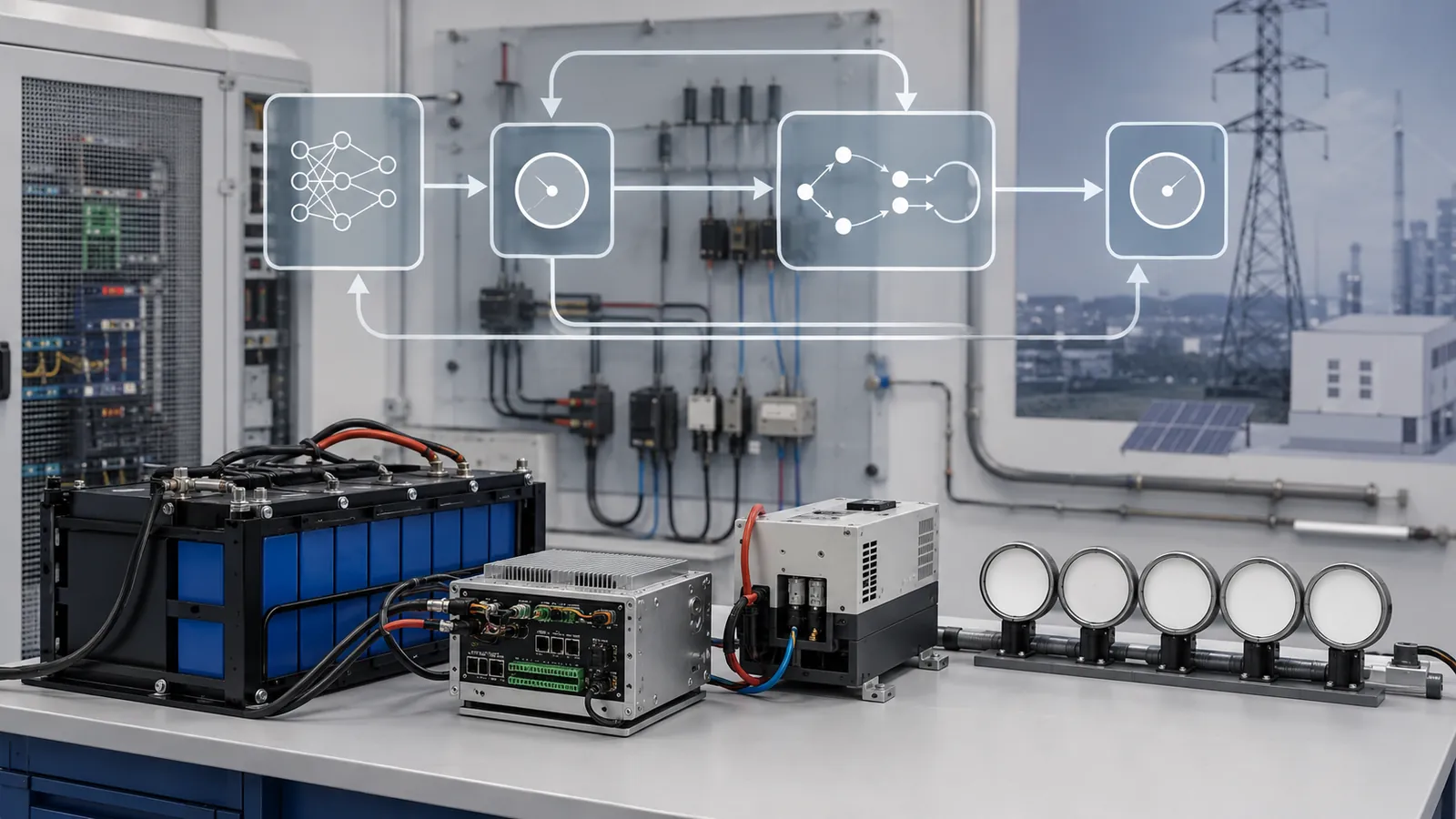
What Is Reinforcement Learning?
Reinforcement learning is a machine learning approach in which an agent learns actions by interacting with an environment and receiving rewards or penalties. Its core objective is to maximize expected return, often written as E[G_t], where G_t = r_t + gamma r_{t+1} + gamma^2 r_{t+2} + … . The learned policy maps observed states to actions that improve long-term outcome.
In real systems, the agent must balance exploration, which tests unfamiliar actions, with exploitation, which uses actions already known to perform well. It is useful in adaptive environmental control when a controller adjusts energy storage, traffic flow, irrigation, or ventilation in response to changing conditions. Used in devices include robotic controllers, smart thermostats, grid dispatch systems, autonomous vehicles, and industrial process controllers.
The concept matters because many engineering problems unfold as sequences rather than isolated predictions. A choice that looks good immediately may reduce future performance, while a costly action now may protect later efficiency or safety. Reinforcement learning formalizes that tradeoff, making it valuable for control, operations research, robotics, and simulation-based design.
Practical systems usually train in models, simulators, or constrained trials before deployment, because reward design, delayed feedback, and unsafe exploration can strongly affect real-world behavior.
Example:
A battery controller can use reinforcement learning to charge during low-carbon supply periods and discharge when local demand peaks.
Related Terms:
- Machine Learning
- Markov Decision Process
- Control Theory
NoSuchDevice is a free archive of machines that do not exist yet but already have a shadow in physics. I research and write every entry alone, with no ads. Take a look around the archive, or help keep it free.