





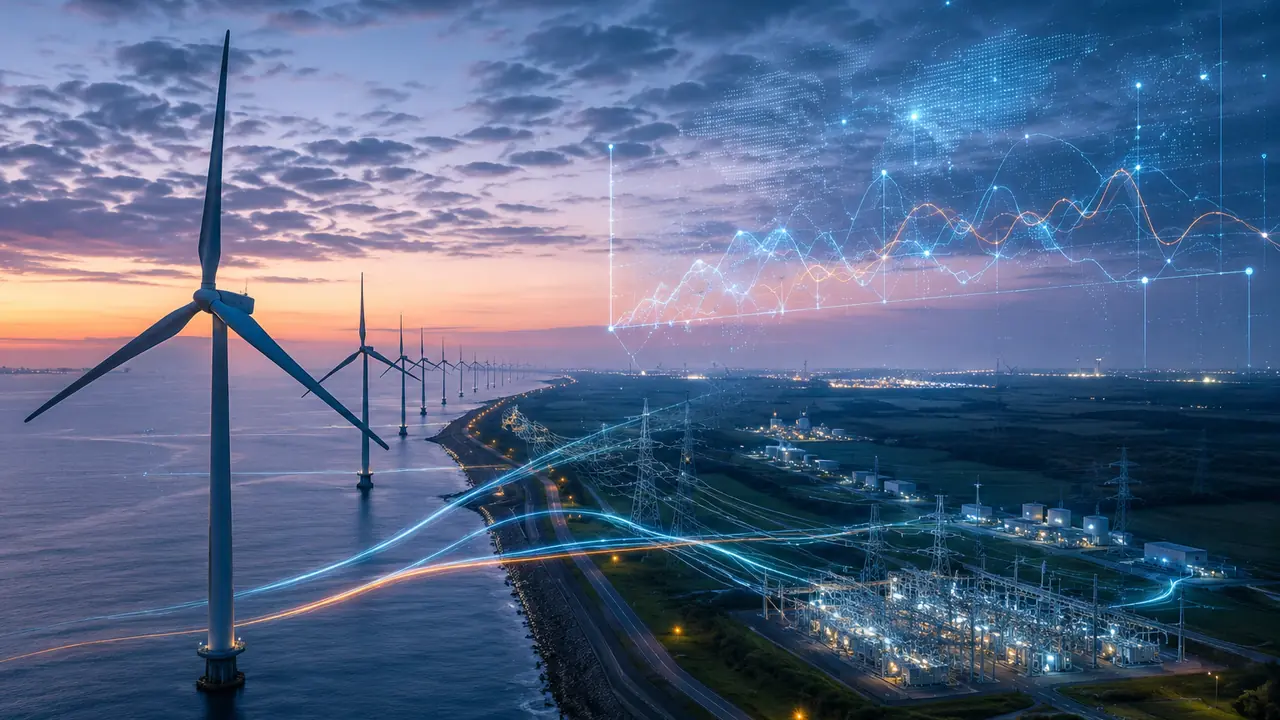
In the Energinet control room in Fredericia, the operators running Denmark’s national grid watch a dashboard that updates every five seconds. On a January morning in 2023, wind output on the western interconnect jumped from 3.1 to 4.7 gigawatts in under an hour. The export schedules to Norway and Germany had already been adjusted. The AI forecasting system embedded in Energinet’s dispatch software had called that generation window 14 hours earlier, before any human analyst had flagged it as significant. By the time the wind arrived, the grid was already configured to absorb it.
The short version: Artificial intelligence in eco tech is not a capability waiting to arrive. Grid dispatch systems, satellite deforestation alerts, and water treatment optimization already run on machine learning in dozens of countries. The core mechanism is pattern recognition applied to environmental data at a scale and speed no human team could match: modern AI grid forecasting reduces renewable curtailment by up to 20% compared to manual scheduling, which translates directly to clean electricity that would otherwise be wasted. Environmental systems generate far more data than any person can act on in real time. Artificial intelligence in eco tech is the tool that closes that gap.
Table of Contents
What Artificial Intelligence Actually Does Inside an Eco Tech System
There is a gap between how AI gets described in press releases and what it is doing inside an energy grid or a deforestation monitoring system, and the gap is wide enough to matter.
Artificial intelligence in eco tech refers almost entirely to machine learning: algorithms that adjust their internal numerical parameters based on data until their outputs predict or optimize a target variable with acceptable accuracy. The target might be tomorrow’s wind power output, the probability that a forest pixel in satellite imagery represents recently cleared land, or the optimal chemical dosage for a water treatment plant processing river input that changes quality hour by hour. In each case, the AI does not understand the system it is managing. Finding statistical patterns in historical data and applying those patterns to new inputs is the entire mechanism.

What makes this useful in environmental applications is resolution. A human grid operator monitoring 50 sensor feeds is near the edge of cognitive capacity. An AI system monitoring 50,000 feeds and updating decisions every five seconds faces no such constraint. Environmental systems generate data at a volume and frequency that human teams cannot act on. The value of artificial intelligence in eco tech comes almost entirely from that mismatch.
How AI in Eco Tech Learns: The Gradient Descent Mechanism
The core learning mechanism behind most artificial intelligence in eco tech is gradient descent. Understanding how it works removes the mystery around what these systems are actually doing.
A machine learning model contains a set of numerical parameters called weights. For a wind power forecasting model, these weights determine how the model transforms incoming atmospheric data into a predicted generation figure. The inputs might include sea surface temperature, atmospheric pressure gradients, upper-air wind speed, and recent turbine output. The output is a power generation forecast 24 hours ahead.
Training the model means finding the weight values that produce accurate forecasts. That is done by running the model against historical data where the actual outcome is already known, measuring the prediction error, and adjusting the weights to reduce it. The error is described by a loss function, typically the mean squared error between predicted and actual values. The update rule is:
θ = θ – α × ∇L(θ)
Here, θ represents the model’s current weights. The symbol α is the learning rate, a small positive number controlling how aggressively the weights shift after each error measurement. The term ∇L(θ) is the gradient of the loss function relative to the weights: it points in the direction that would increase the error, so subtracting it moves the weights toward lower error.
Run through a concrete example: a wind forecasting model predicts 2.4 gigawatts of output for a given hour, and the measured output is 2.1 gigawatts. The squared error is 0.09. The gradient calculation identifies which weights contributed most to that overestimate. With a learning rate of 0.001, each weight shifts by a small amount proportional to its contribution. Repeat this process across ten years of hourly measurements and the weights converge toward values that accurately describe the statistical relationship between atmospheric conditions and turbine output. No one programmed that relationship into the model. The numbers found it by measuring what was wrong and correcting.
The Environmental Data That Powers AI in Eco Tech
What does artificial intelligence in eco tech actually read? The data types matter because they determine what decisions are possible and where the limits appear.
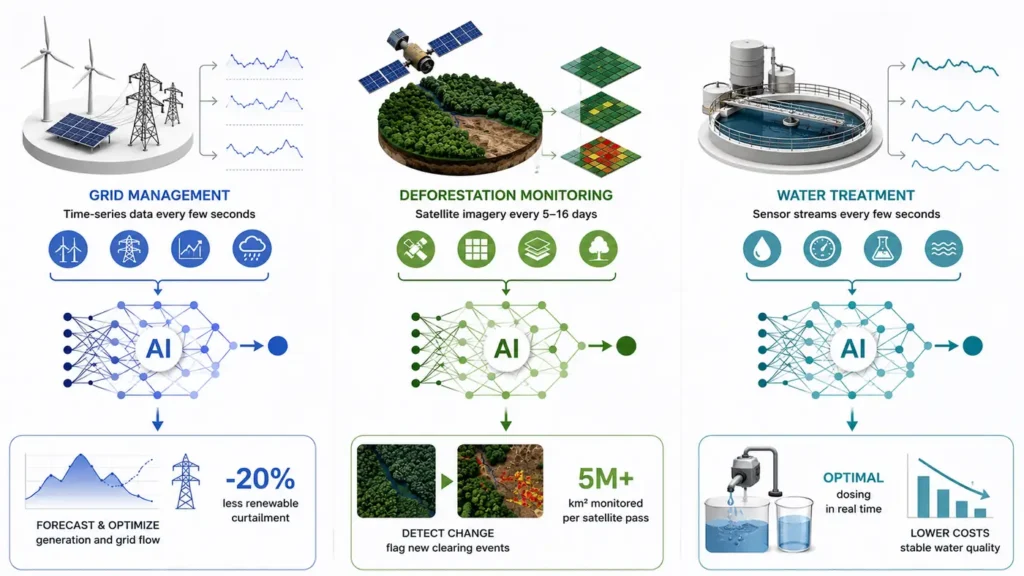
Grid management systems ingest time-series data: power output by generator, transmission line loads, real-time market prices, and meteorological forecast feeds updated every few minutes. The data is numerical, continuous, and arrives in intervals as short as five seconds. That structure is well-matched to forecasting models because the volume is high and the format is consistent across years of records.
Deforestation monitoring works from a different data source entirely. Brazil’s DETER system processes imagery from Landsat and Sentinel-2 satellites, where each pixel represents roughly 30 square meters of land surface. A convolutional image classifier trained on thousands of labeled images learns to distinguish standing canopy from recently cleared ground, then flags new events for enforcement follow-up. DETER has been issuing near-real-time deforestation alerts since 2004, and its AI-assisted detection now covers more than 5 million square kilometers of Amazon basin in each satellite pass.
Water treatment systems use a third data structure: continuous sensor streams measuring turbidity, pH, chemical oxygen demand, and flow rate from river intakes that can change character substantially after heavy rainfall. Here the AI’s job is optimization under variable conditions rather than classification or forecasting. Finding the chemical dosing rate that keeps treated water within regulatory parameters while managing treatment costs is a continuous real-time problem with no stable fixed answer.
Each application handles a different data structure, a different decision frequency, and a different consequence if the model fails. That range is what makes artificial intelligence in eco tech a meaningful category rather than a single technique applied uniformly.
Physical Limits That Constrain AI in Eco Tech Systems
Can artificial intelligence solve environmental optimization completely? Not remotely, and the reasons are physical rather than algorithmic.
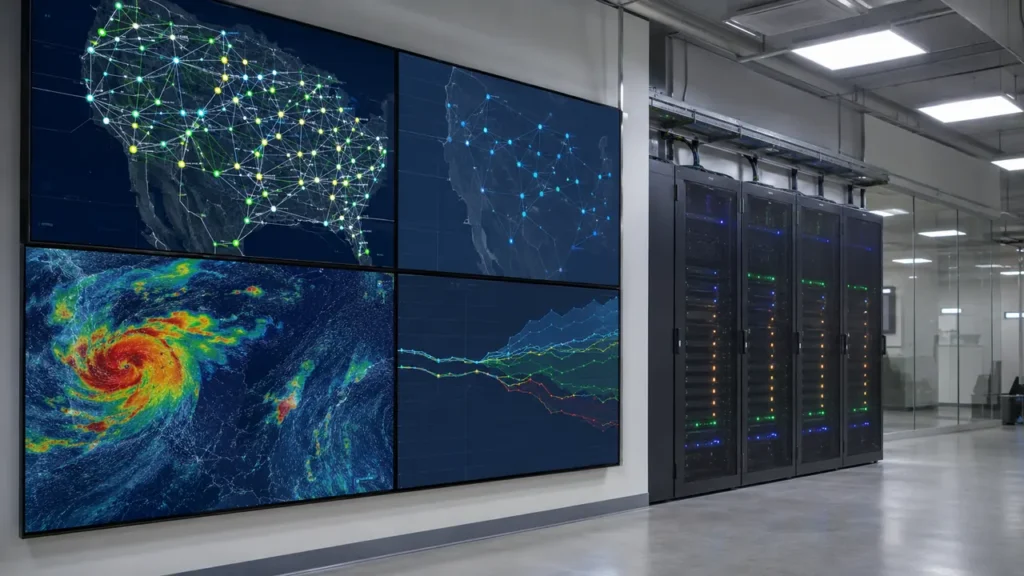
The first limit is distributional shift. Machine learning models learn from historical data and produce accurate outputs when future conditions resemble past conditions. In climate and ecology, that resemblance is weakening. A wind forecasting model trained on 20 years of North Sea atmospheric measurements performs less well as jet stream positioning shifts toward configurations the training data did not contain. A species distribution model trained on historical range records drifts from reality as temperature gradients move. Researchers at the European Centre for Medium-Range Weather Forecasts have documented measurable degradation in numerical weather models under novel atmospheric configurations, and machine learning models face the same challenge without the physical constraints that bound equation-based prediction systems.
Inference energy is a second constraint that receives less attention than it deserves. Running a large machine learning model continuously consumes electricity. A data center operating continuous grid forecasting and dispatch optimization for a national grid may draw several megawatts of power. For most applications, the environmental arithmetic of that energy cost versus the renewable curtailment avoided is clearly positive. For large-scale satellite image classification running continuously across continental areas, the accounting is worth doing explicitly rather than assuming.
Data density is the third limit. AI performs well where historical data is dense, consistently structured, and accurately labeled. A Danish grid forecasting system has decades of high-resolution measurements from thousands of sensors. A grid in sub-Saharan Africa with 30% of that sensor density and a decade of reliable records faces a fundamentally different modeling problem. The accuracy that Scandinavian systems achieve does not transfer automatically.
How Engineers Deploy Artificial Intelligence Across Environmental Systems
Environmental engineers do not deploy AI as a single product. Different classes of algorithm get matched to different problem structures, and that matching matters as much as the algorithm itself.
| Application | AI Approach | Decision Frequency | Key Constraint |
|---|---|---|---|
| Grid dispatch optimization | Reinforcement learning, forecasting models | Every 5-15 minutes | Grid stability requirements |
| Deforestation detection | Convolutional image classification | Daily satellite pass | Cloud cover, labeling cost |
| Water treatment dosing | Model predictive control with ML | Continuous | Sensor drift, input variability |
| Emissions monitoring | Anomaly detection on sensor streams | Near real-time | Sensor placement, industrial cooperation |
| Biodiversity tracking | Species distribution modeling | Seasonal | Historical range data quality |
What the table does not show is the maturity gap between the most and least developed of those applications. Reinforcement learning in grid dispatch has been deployed at national scale in multiple countries. Biodiversity tracking with AI produces results that field ecologists spend considerable time auditing and correcting. Those two applications sit at very different points on the same development curve.
The engineering decision that gets the most public attention is algorithm selection. The decision that actually consumes most deployment effort is failure mode design: what happens when the model produces a bad output. A grid dispatch AI making an incorrect decision can cause a frequency excursion that trips generators offline. The engineers who build these systems spend most of their time on fallback logic and operator override procedures. The AI architecture is often the simpler part of the problem.
Everything here is free. Readers are the reason it stays that way.
I make all of it alone, with no ads. If it is worth a coffee a month to you, that keeps the next one coming.
Keep it alive →Open Questions in AI-Driven Ecological Optimization
The field has not resolved whether artificial intelligence in eco tech remains reliable as the environment changes in ways its training data did not contain. Deployed systems prove the technology works in the conditions it was trained on. They do not yet prove it works in conditions it has not seen.
Climate change is simultaneously the reason AI in eco tech is worth deploying and the reason its long-term reliability is under pressure. A model trained on a stable system has a tractable problem. A model trained on a system drifting toward novel configurations is a model with an unknown performance floor, and that floor matters when the application is grid stability or flood-risk forecasting.
Explainability is a separate problem with regulatory consequences. When an AI grid management system makes an unusual dispatch decision, operators need to understand why before deciding whether to override it. Most high-performance machine learning models produce outputs from patterns that cannot easily be expressed as human-readable rules. Grid regulators in the European Union have begun requiring that AI systems in critical infrastructure produce decision explanations that qualified operators can audit in real time. Satisfying that requirement without sacrificing forecasting accuracy is an open technical problem with no clean solution available today.
A third question involves data ownership. A deforestation monitoring AI trained on satellite imagery of a sovereign nation’s territory raises questions about who controls the model, who receives the alerts, and what accountability exists when an AI classification output proves wrong and enforcement action has already been taken. Better algorithms do not resolve that.
What Artificial Intelligence Makes Possible in Future Eco Technology
The most consequential applications of artificial intelligence in eco tech are not the systems running today. They are the systems that become possible once AI accuracy in environmental domains reaches the level grid management has already achieved, combined with sensor infrastructure that does not yet exist at scale.
Continuous ecosystem health monitoring at continental scale is one such application. Current satellite-based biodiversity assessment requires substantial manual correction and operates on timescales of months. An AI system integrating multi-spectral satellite imagery, distributed acoustic sensor networks, and automated soil chemistry sampling could in principle produce near-real-time ecosystem health assessments across entire biomes, identifying stress signatures weeks before they produce visible damage at conventional monitoring resolution.
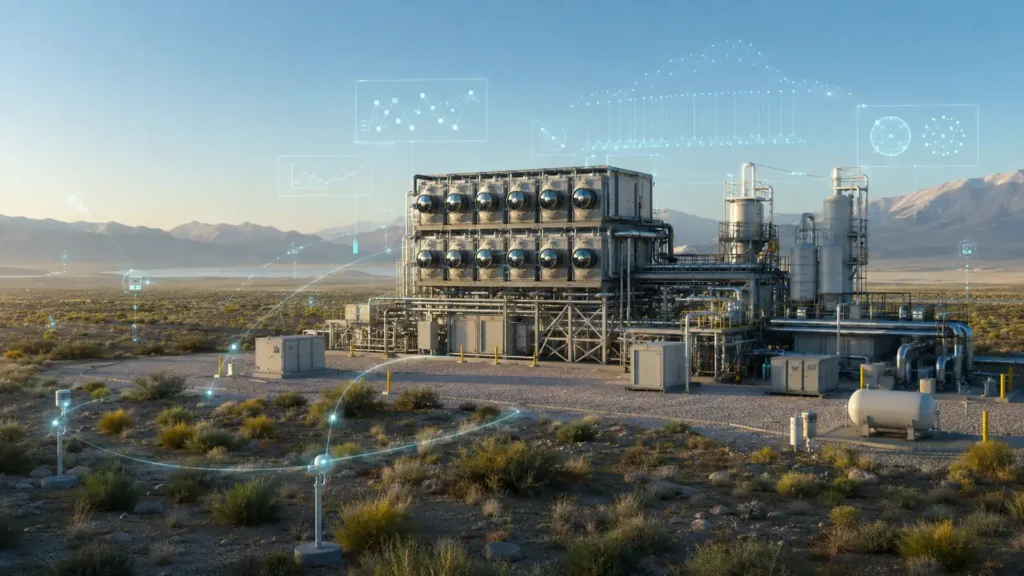
Autonomous optimization of direct air carbon capture is another direction. Facilities currently operating use fixed protocols for sorbent regeneration cycles, airflow rates, and thermal management. A reinforcement learning system trained on the physical chemistry of the capture reaction and the real-time carbon intensity of the grid supplying the facility could optimize those variables continuously, adjusting the process to maximize CO2 captured per unit of energy consumed. For a technology currently constrained by economics as much as by physics, that kind of continuous optimization compounds over time.
Both possibilities depend on the same development: machine learning models with physical governing equations built into their architecture, not just statistical patterns learned from historical records. Pure data-driven AI is good at interpolation and unreliable in extrapolation. Hybrid models combining physics-based equations with machine learning pattern recognition are where the most promising future applications of artificial intelligence in eco tech will come from.
The View From NoSuchDevice
I find AI in eco tech interesting for a reason that is not the one usually given. The interesting part is not the AI. It is what the AI reveals about how badly environmental systems were being managed before real-time optimization became technically possible.
Grid operators were manually scheduling renewable dispatch on systems that needed decisions at a resolution they could not physically reach. Water treatment plants were dosing chemicals from daily manual measurements when the input quality was changing by the hour. Deforestation was being reported months after it happened because no one had built a fast enough classification pipeline. The AI did not invent better environmental management. It made the management that was already obviously necessary technically achievable.
Where AI in eco tech genuinely earns its description is in monitoring applications that were impossible before. No team of human analysts could review daily satellite imagery of the entire Amazon. No regulator could read every industrial emission sensor across a large country in real time. Those capabilities are not improvements on what was being done. They are things that were not being done at all.
What I do not find convincing is the suggestion that AI will produce deep understanding of ecological systems. Pattern recognition in historical data is not the same as understanding. A model that predicts deforestation probability is not a model of why deforestation happens. If the underlying economic conditions change sharply, the model’s accuracy changes with them, and more training data does not fix that.
The physics already casts the shadow here. The engineering is genuinely interesting. The hype around it is not.
Technologies Related to This Concept
| Technology | Concept |
|---|---|
| Quantum Soil Enhancers | Concept: Devices that use quantum mechanics to optimize soil nutrient distribution at the subatomic level. |
| Atmospheric Bio-Filters with Sensors | Concept: Filters that clean air pollution and monitor environmental data. |
| Graphene Supercapacitors for Environmental Monitoring | Concept: Powering remote sensors with efficient energy storage. |
| Hydrogen Fuel Cells in Portable Air Quality Sensors | Concept: Portable sensors that track air quality with independent clean power. |
| Hydrogen-Powered Personal Air Quality Drones | Concept: Drones that monitor environmental conditions. |
You read the whole thing.
That is rarer than it should be, and it is the exact kind of attention I built this archive for. I make every piece alone, with no ads and no investor deciding what gets written. If you want the next machine taken apart like this one, you can help me make it.
A coffee a month is enough to keep it free for everyone.
Prefer crypto or a one time gift? Other ways to give →