



What Is Spacetime curvature?
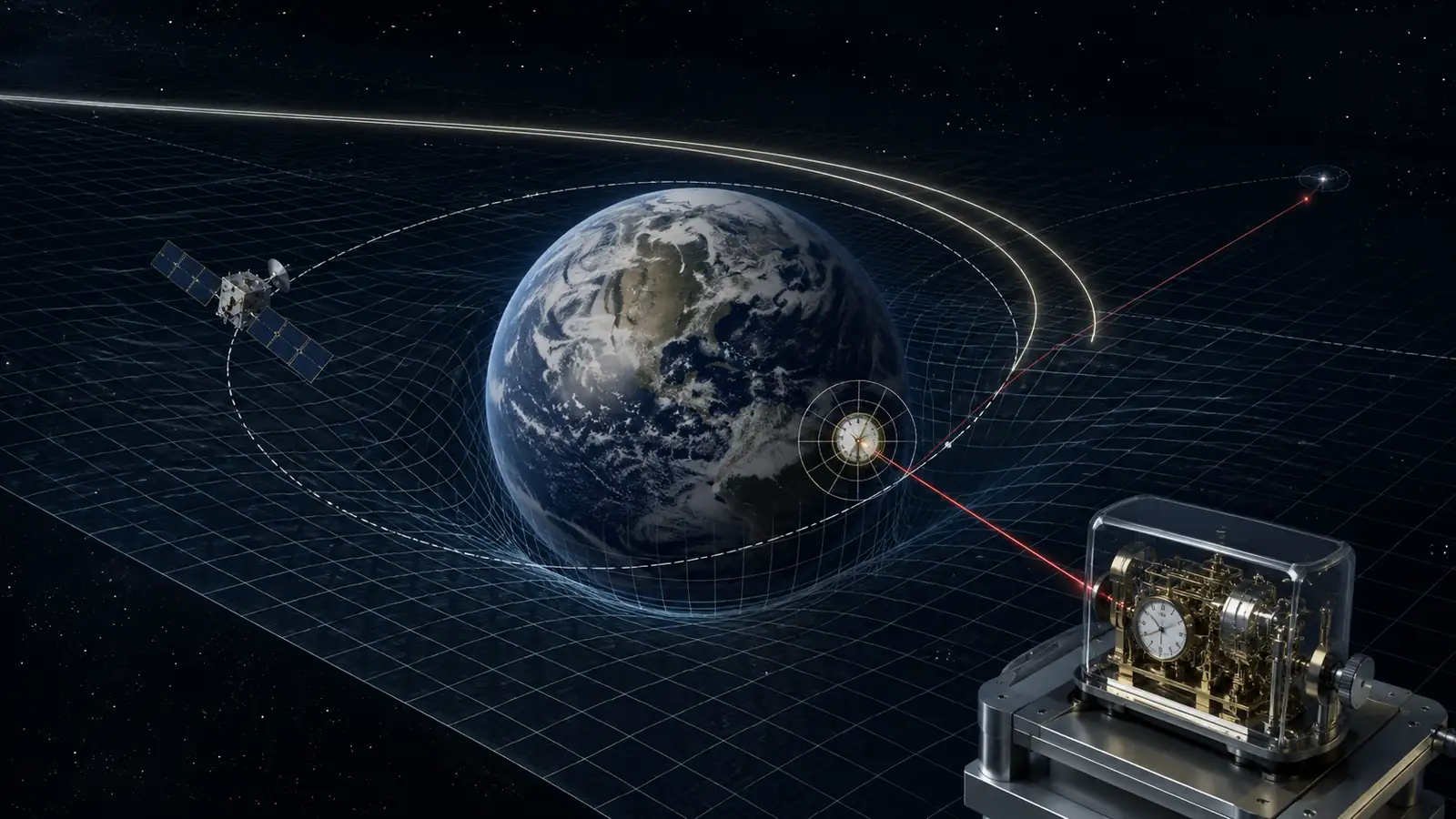
Spacetime curvature is the bending of the four-dimensional geometry that combines space and time. In general relativity, mass and energy shape this geometry, and objects follow the straightest possible paths within it. The central relation is G_mu nu = 8 pi G T_mu nu / c^4, linking curvature to the stress-energy content of matter, radiation, and fields.
In real systems, curvature is weak near ordinary objects but measurable around planets, stars, black holes, and dense astrophysical bodies. It changes clock rates, light paths, orbital motion, and gravitational-wave propagation. In relativistic field engineering, any proposed gravity-control mechanism must ultimately describe how effective geometry is produced, bounded, and stabilized.
The concept matters because gravity is not treated as a conventional force in modern physics; it is geometry influencing motion. Used in devices include atomic clocks, gravitational-wave interferometers, satellite navigation systems, precision gravimeters, and proposed compact gravity-field generators. Even when engineering uses Newtonian approximations, spacetime curvature defines the deeper limit on what gravitational manipulation can mean physically. It also explains why gravity affects light, time, and signal timing in high precision measurement systems.
Example:
GPS satellites require relativistic clock corrections because Earth’s gravity and orbital motion make their onboard clocks tick at different rates than clocks on the ground.
Related Terms:
- Gravitational Field Vector
- Localized Gravitational Field Modification
- General Relativity
NoSuchDevice is a free archive of machines that do not exist yet but already have a shadow in physics. I research and write every entry alone, with no ads. Take a look around the archive, or help keep it free.