






What Is Thermohaline circulation?
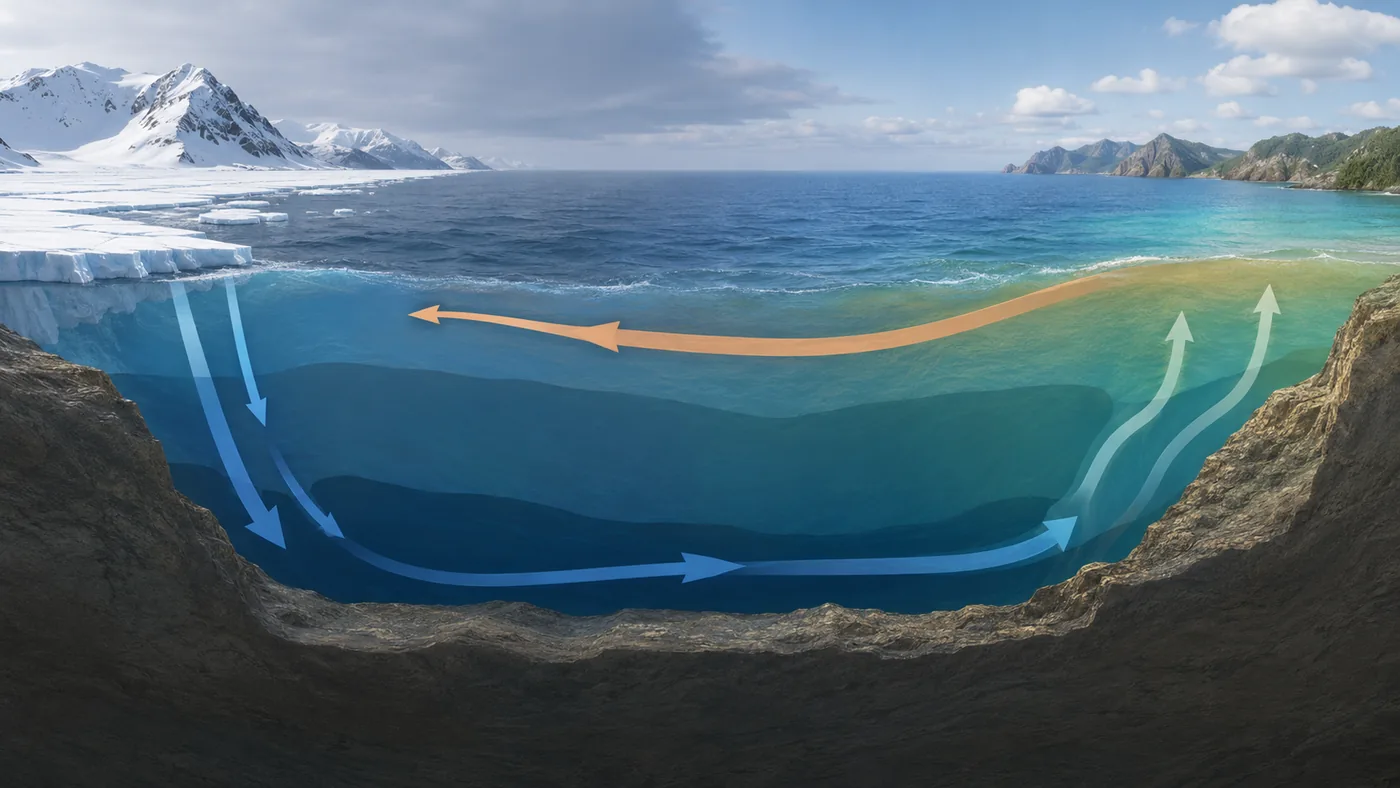
Thermohaline circulation is the large-scale movement of ocean water driven by differences in temperature and salinity, which together determine seawater density. Cold, salty water becomes denser and can sink, while warmer or fresher water remains more buoyant. A simplified density relation is rho = rho0[1 – alpha Delta T + beta Delta S], showing how heat and salt push density in opposite directions.
In the ocean, this circulation links surface currents, deep-water formation, abyssal flow, and eventual upwelling across basins. It changes slowly compared with weather, but it responds to freshwater input, polar cooling, sea ice formation, wind-driven mixing, and regional heat exchange. Because the ocean stores huge amounts of heat, small density changes can alter transport over decades.
The concept matters because it redistributes heat, carbon, oxygen, and nutrients through the climate system. In ocean climate dynamics, thermohaline circulation helps determine how regional surface changes propagate into deeper water. Used in devices include profiling floats, conductivity-temperature-depth sensors, ocean moorings, satellite altimeters, and autonomous underwater gliders.
Researchers track it with salinity, temperature, current velocity, pressure, tracer chemistry, and satellite measurements that reveal how surface height and density structure evolve.
Example:
When polar surface water becomes colder and saltier during sea ice formation, it can sink and feed deep ocean circulation.
Related Terms:
- Ocean Stratification
- Temperature Inversion
- Tracer Dispersion
NoSuchDevice is a free archive of machines that do not exist yet but already have a shadow in physics. I research and write every entry alone, with no ads. Take a look around the archive, or help keep it free.