






What Is Valence Band?
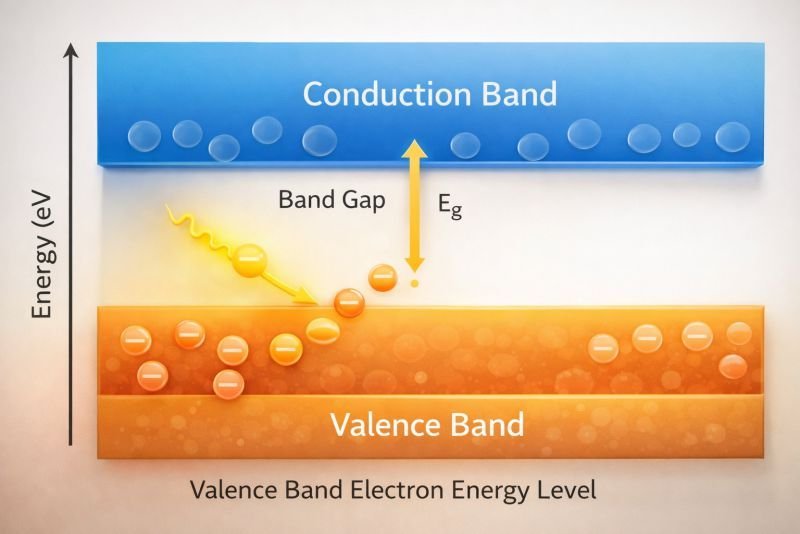
The valence band is the highest range of electron energy levels in a solid material that is normally occupied by electrons at equilibrium. In atoms, electrons exist in discrete orbitals, but in crystalline solids those orbitals combine into continuous energy ranges called bands. The valence band contains electrons that participate in chemical bonding and determine many electrical properties of the material.
Electrons in the valence band are typically bound to atoms and cannot move freely through the crystal lattice. For electrical conduction to occur, an electron must gain enough energy to move into the higher-energy conduction band, leaving behind a positively charged vacancy known as a hole. In semiconductor systems used in photovoltaic semiconductor energy conversion architectures, incoming photons can supply this energy and promote electrons from the valence band into the conduction band, enabling the generation of electrical current.
The separation between the valence band and the conduction band is called the band gap. The size of this gap determines whether a material behaves as a conductor, semiconductor, or insulator, and it plays a central role in the design of electronic and optoelectronic devices.
Example:
When a semiconductor absorbs light with sufficient energy, electrons can move from the valence band to the conduction band and contribute to electrical current.
Related Concepts:
- Conduction Band
- Band Gap
- Electron-Hole Pair
NoSuchDevice is a free archive of machines that do not exist yet but already have a shadow in physics. I research and write every entry alone, with no ads. Take a look around the archive, or help keep it free.