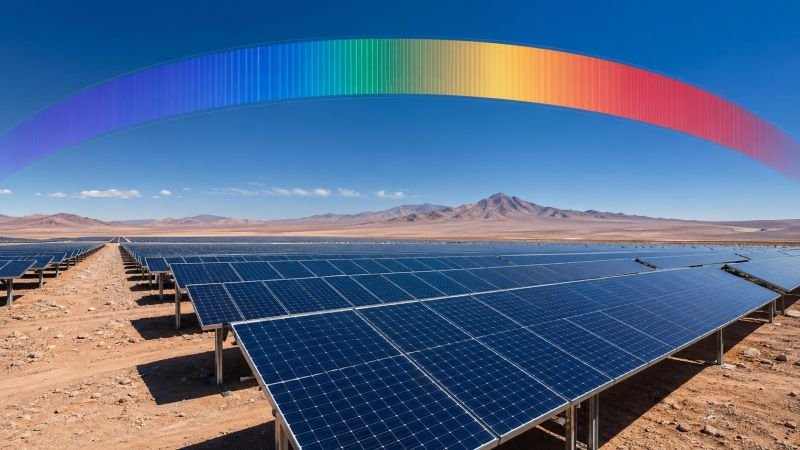





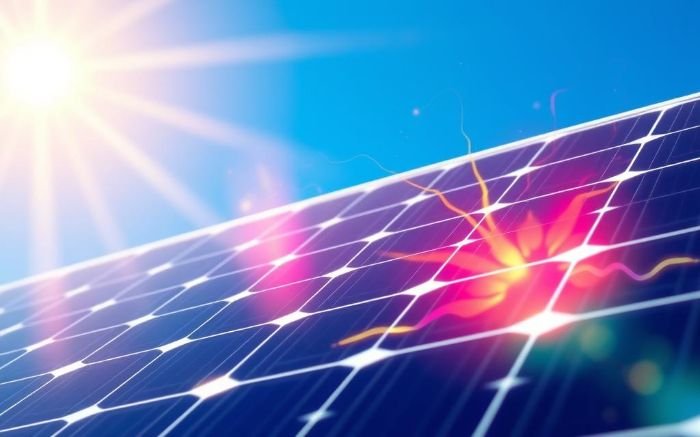
Stand in sunlight for a moment and you can feel energy arriving on your skin. That same energy, when it strikes a thin slice of specially prepared silicon, can push electrons out of their resting positions and send them through a wire. The result is electricity generated from light with no moving parts, no combustion, and no fuel being consumed. This process is called the photovoltaic effect, and it sits at the heart of every solar panel on every rooftop and spacecraft in existence.
The photovoltaic effect was first observed in 1839 by French physicist Edmond Becquerel, who noticed that certain materials produced a small electric voltage when exposed to light. It took more than a century of physics research before scientists understood the mechanism behind it. The explanation draws on quantum mechanics, solid-state physics, and the behavior of electrons inside crystalline materials. Understanding this effect means understanding one of the most productive intersections of fundamental science and modern engineering.
Table of Contents
What is the Photovoltaic Effect?
Light is not a smooth, continuous stream of energy. It arrives in discrete packets called photons, and each photon carries a specific amount of energy determined by its frequency. Higher-frequency light, like ultraviolet radiation, carries more energy per photon. Lower-frequency light, like infrared radiation, carries less. This discrete nature of light is central to why the photovoltaic effect works at all.
Electrons in Solids and the Band Gap
Inside a solid material, electrons occupy specific energy levels organized into bands. The valence band is the highest energy band that is normally filled with electrons. The conduction band sits above it and is where electrons can move freely through the material. Between these two bands lies a gap called the band gap. In an insulator this gap is too wide for electrons to cross under normal conditions. In a conductor there is no gap and electrons flow freely. In a semiconductor the gap is narrow enough that energy from an external source can push electrons across it.
Silicon has a band gap of approximately 1.1 electron volts. When a photon strikes a silicon atom carrying at least 1.1 electron volts of energy, it transfers that energy to an electron in the valence band. The electron absorbs the photon and jumps across the band gap into the conduction band. It leaves behind a positively charged vacancy called a hole. This electron-hole pair is the raw material of the photovoltaic effect.
The P-N Junction and Charge Separation
Why does a solar cell require charge separation?
Generating an electron-hole pair alone does not produce useful electricity. Without a mechanism that separates the charges, the electron and hole recombine quickly, releasing their energy as heat or light and contributing nothing to a circuit. The p-n junction solves this problem.
Solar cells are built from two layers of silicon doped with different impurities. One layer is doped with phosphorus, which donates extra electrons and creates n-type silicon. The adjacent layer is doped with boron, which creates an absence of electrons, and is called p-type silicon. Where these two layers meet, electrons from the n-type side diffuse into the p-type side and holes from the p-type side diffuse into the n-type side. This diffusion creates a region with no free charge carriers, called the depletion region, along with a built-in electric field pointing from the n-side toward the p-side.
When a photon creates an electron-hole pair near this junction, the built-in electric field acts as a one-way gate. It pushes the freed electron toward the n-type side and the hole toward the p-type side, separating the charges before they can recombine. Connect a wire between the two sides and the electrons flow through it as current, doing useful work before returning to recombine with holes on the p-type side. This completes the photovoltaic circuit.
Key Variables and Conditions
Several physical variables determine how efficiently a solar cell converts light into electricity. These variables reveal both why real solar cells fall short of theoretical limits and where engineering improvements can be made.
Photon Energy and the Band Gap Match
A photon carrying energy below the band gap passes straight through the material without being absorbed. A photon carrying energy at or just above the band gap is absorbed most efficiently. A photon carrying significantly more energy than the band gap is absorbed, but the excess is lost to the crystal lattice as heat before it can contribute to electrical output. This mismatch between the broad spectrum of sunlight and the fixed band gap of a single material is one of the core limits on solar cell performance.
Key Variables Affecting Photovoltaic Efficiency
| Variable | Effect on Performance | Engineering Response |
| Photon energy vs. band gap | Photons below the gap are not absorbed; excess energy above it escapes as heat | Multi-junction cells stack materials with different band gaps to capture more of the spectrum |
| Carrier recombination | Electron-hole pairs that reunite before reaching the junction produce no current | Surface passivation and high-purity silicon reduce the number of recombination sites |
| Operating temperature | Higher temperatures increase recombination rates and reduce voltage output | Cooling systems and reflective coatings manage heat accumulation at the cell surface |
| Material defects | Crystal imperfections trap charge carriers and promote recombination | Czochralski growth produces high-purity single-crystal silicon with minimal defect density |
Why does heat reduce solar cell output?
Elevated temperatures increase the rate at which electrons and holes recombine before contributing to current. A typical silicon solar cell loses roughly 0.4 percent of its efficiency for every degree Celsius of temperature rise. On a hot rooftop in summer, a panel may operate at 60 to 70 degrees Celsius above ambient, which noticeably reduces output compared to a cool, sunny day.
The Role of Material Purity
Crystal defects in silicon create extra energy states within the band gap. These defect states act as traps where electrons pause temporarily before recombining with holes. Every recombination event at a defect site represents energy lost. Commercial solar-grade silicon is refined to extreme purity levels to minimize these traps and extend how far charge carriers can travel before recombining.
Physical Limits of the Principle
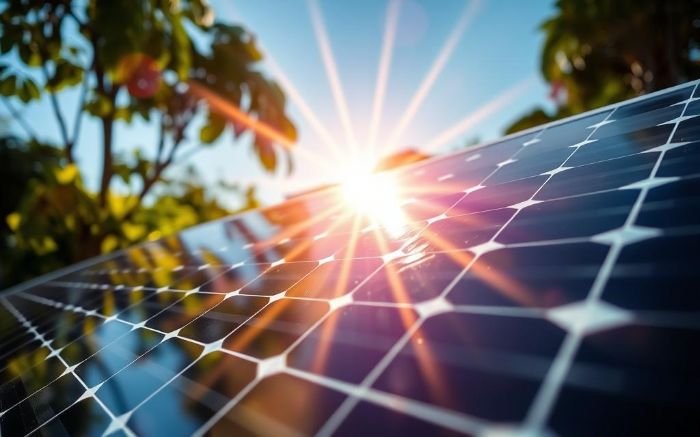
Fundamental physics sets a ceiling on how efficiently any single-junction solar cell can convert sunlight into electricity, even with perfect materials and engineering. In 1961 physicists William Shockley and Hans-Joachim Queisser calculated this theoretical maximum for a single p-n junction cell illuminated by sunlight. Their result, approximately 33 percent for a material with an ideal band gap near 1.34 electron volts, is called the Shockley-Queisser limit.
The losses accounted for in this limit include photons below the band gap that are never absorbed, excess photon energy above the band gap that escapes as heat, the thermal equilibrium between the cell and the sunlight, and unavoidable radiative recombination. Even under ideal conditions these losses consume roughly two-thirds of incoming solar energy.
Real-world commercial silicon solar cells typically achieve efficiencies between 20 and 24 percent in mass production. Laboratory record cells using silicon approach 29 percent. These figures reflect additional losses from surface reflections, electrical resistance within the cell, and the fact that silicon has a band gap of 1.1 electron volts, somewhat below the theoretically optimal 1.34 electron volts.
Everything here is free. Readers are the reason it stays that way.
I make all of it alone, with no ads. If it is worth a coffee a month to you, that keeps the next one coming.
Keep it alive →How Engineers Interpret the Principle
For an engineer designing a solar cell, the photovoltaic effect presents a set of simultaneous problems. The goal is to maximize the fraction of incoming photon energy that becomes useful electrical output. Losses from reflection, recombination, thermal dissipation, and electrical resistance each demand a different engineering solution.
Anti-Reflection Coatings
Bare silicon reflects roughly 35 percent of visible light. Those reflected photons never enter the cell. Engineers coat the front surface of solar cells with thin layers of silicon nitride or titanium dioxide, chosen so that their thickness causes destructive interference between light reflected from the top and bottom surfaces of the coating. The two reflections cancel each other out, and most of the light passes through into the silicon. This is why commercial solar cells typically appear deep blue or black, not the silver color of uncoated silicon.
Surface Passivation
The front and back surfaces of a silicon solar cell are sites of intense recombination because the crystal structure is interrupted there and many dangling atomic bonds exist. Passivation layers, often made from silicon dioxide or aluminum oxide, fill these dangling bonds and sharply reduce surface recombination. In high-efficiency cells, passivated emitter and rear cell designs apply passivation to both sides of the wafer, extending carrier lifetimes and pushing efficiency upward.
Multi-Junction and Concentrating Designs
One path beyond the Shockley-Queisser limit is to stack multiple p-n junctions made from different semiconductor materials, each absorbing a different portion of the solar spectrum. A triple-junction cell might use indium gallium phosphide for high-energy photons, gallium arsenide for middle-energy photons, and germanium for lower-energy photons. Each junction handles the spectral range it is best suited for. Combined efficiencies for such cells can exceed 40 percent under concentrated sunlight. The manufacturing cost is high, so these devices appear mainly in space applications and concentrating solar power systems.
Open Scientific Questions
The basic mechanism of the photovoltaic effect is well understood. Active research fronts remain, driven by the need to push efficiency higher and manufacturing costs lower at the same time.
Perovskite semiconductors have become one of the most intensely studied materials in solar research. These crystalline compounds can be manufactured from inexpensive precursors using low-temperature solution processing, which could enable roll-to-roll manufacturing on flexible substrates. Perovskite solar cells have achieved certified efficiencies above 25 percent in the laboratory, matching commercial silicon. The persistent challenge is long-term stability, as perovskites degrade when exposed to moisture, oxygen, and heat. Researchers are working on encapsulation strategies and compositional changes to extend their operational lifetimes toward the 25 to 30 years expected of silicon panels.
Can a solar cell extract energy that conventional designs waste as heat?
Hot carrier solar cells are designed to do exactly that. In a conventional cell, excess energy carried by high-frequency photons above the band gap is lost to the crystal lattice within picoseconds. A hot carrier cell would extract that energy before thermalization occurs, potentially breaking the Shockley-Queisser limit for a single junction. Achieving this requires extremely thin absorption layers and carefully engineered contacts that allow hot electrons to exit the cell before losing their excess energy. No practical hot carrier cell has been demonstrated at useful scale.

Relevance to Emerging Technologies
The photovoltaic effect is not confined to rooftop solar panels. Its core physics connects to a wide range of emerging technologies at different stages of development.
Building-integrated photovoltaics embed solar cells directly into construction materials such as window glass, roof tiles, and facade panels. This approach requires cells that can be made semitransparent or shaped to fit architectural constraints. It has pushed development of thin-film technologies using cadmium telluride or copper indium gallium selenide, materials whose band gaps can be tuned by adjusting their chemical composition.
Organic photovoltaics use carbon-based semiconductor molecules deposited onto flexible substrates like plastic films. They can be printed at low cost, enabling solar-powered wearable electronics and lightweight deployable power systems for remote locations. Their efficiency is currently lower than silicon, but manufacturing cost per unit area is also far lower, and they can be produced in a range of colors and transparencies.
Space-based solar power proposals call for large arrays of solar cells in geostationary orbit to collect sunlight without atmospheric losses and transmit the energy to Earth as microwave radiation. In that environment the photovoltaic effect operates under the same fundamental physics but without weather, atmospheric filtering, or the temperature constraints that affect ground-level panels.
At a smaller scale, the same physics drives photodetectors, image sensors, and light-to-current converters inside fiber optic communication systems. Understanding the photovoltaic effect at its most fundamental level is not only a path to cleaner energy generation. It is a foundation for many of the technologies that will define the next century of engineering.
You read the whole thing.
That is rarer than it should be, and it is the exact kind of attention I built this archive for. I make every piece alone, with no ads and no investor deciding what gets written. If you want the next machine taken apart like this one, you can help me make it.
A coffee a month is enough to keep it free for everyone.
Prefer crypto or a one time gift? Other ways to give →
Technologies Related to This Concept
| Technology | Concept |
| Solar Power-Generating Textiles for Smart Clothing | Fabrics woven with photovoltaic fibers that generate electricity from sunlight, powering wearable electronics. |
| Transparent Solar Fabrics for Window Curtains | Semi-transparent fabrics that generate electricity while allowing light to pass through, ideal for curtains and blinds. |
| Energy-Harvesting Road Markings with Solar Paint | Roads painted with solar-absorbing materials that generate electricity from sunlight. |
| Photovoltaic Fabrics for Vehicle Interiors | Car seat covers and interiors made from solar fabrics to power onboard electronics. |
| Solar Paint for Aircraft and Spacecraft | Lightweight energy-generating paints applied to the exterior surfaces of aircraft and spacecraft. |
| Solar-Active Wallpaper for Indoor Energy Generation | Wallpaper embedded with photovoltaic materials to generate electricity from indoor lighting. |
| Photovoltaic Umbrellas for Outdoor Events | Solar fabric umbrellas that provide shade and electricity for charging stations and small devices. |