



What Is Venturi Effect?
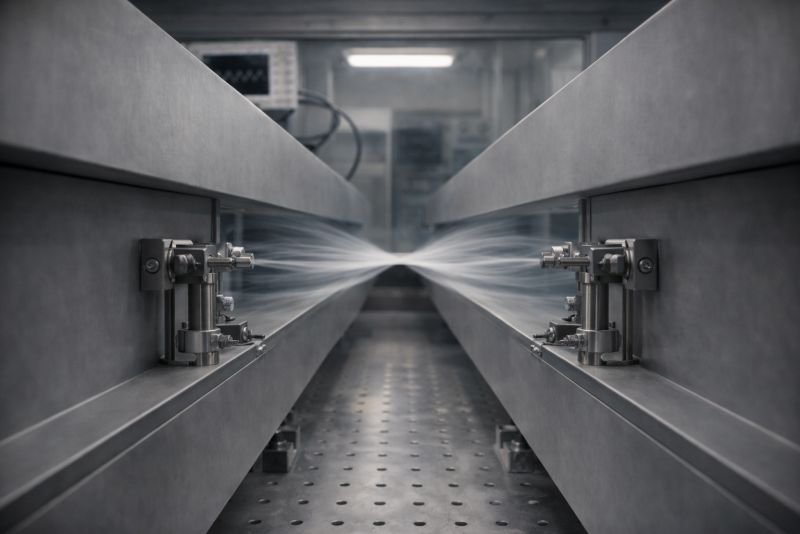
The Venturi effect is the drop in static pressure that occurs when a fluid speeds up while passing through a constricted section of a flow path. It follows from continuity and energy conservation: if the same flow must pass through a smaller cross-section, velocity rises and the pressure available at that narrow region falls.
In street-level gap flows, the Venturi effect can accelerate wind between buildings and increase the local input available to a tuned harvester. That does not create new energy, but it redistributes velocity and pressure in ways that strongly influence downstream vibration, suction, and aerodynamic loading.
A useful continuity relation is A1 x V1 = A2 x V2, showing how reduced area drives higher velocity for an incompressible flow. Why it matters is that designers use the effect to predict nozzle behavior, mixing, suction, and local wind amplification in ducts, instruments, and built environments.
Used in devices include carburetors, atomizers, and differential-pressure flow meters. Engineers also account for losses, turbulence, and geometry details because real constrictions do not behave like ideal Bernoulli diagrams once viscosity, separation, and wall friction begin to shape the flow.
Example:
A narrow passage between buildings can accelerate wind enough to raise local vibration input on facade-mounted airflow devices.
Related Terms:
- Strouhal Number (St)
- Vortex-Induced Vibration (VIV)
- Pressure Differential
NoSuchDevice is a free archive of machines that do not exist yet but already have a shadow in physics. I research and write every entry alone, with no ads. Take a look around the archive, or help keep it free.