




What Is Auxotrophic Dependency?
Auxotrophic dependency is a biological condition in which an organism cannot synthesize a compound required for growth and must obtain it from its environment. In engineered systems, that limitation can be introduced intentionally as a containment control. A useful growth relation is mu = mu_max S / (Ks + S), where growth rate depends on the concentration of the required supplement.
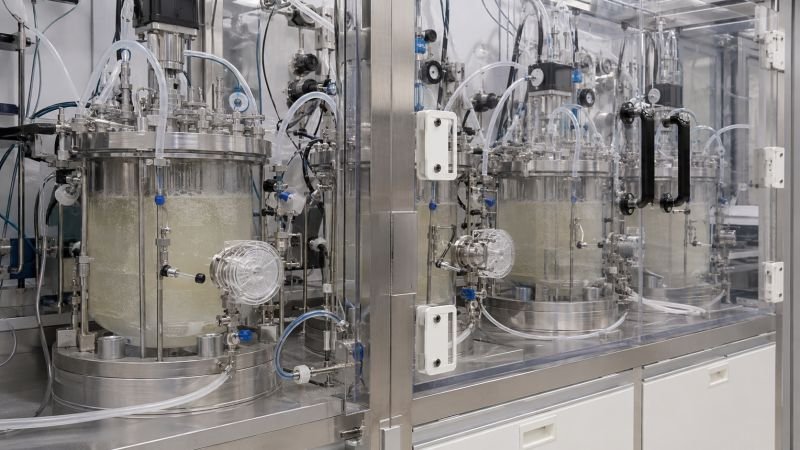
In real systems, the missing compound may be an amino acid, vitamin, nucleotide precursor, or synthetic nutrient not normally available outside a controlled process. Used in devices include sealed bioreactors, biosafety test rigs, fermentation lines, and deployment-restricted microbial platforms where operators want cells to survive only under managed conditions. This makes auxotrophy valuable in contained engineered bioreactor systems that need a built-in limit on accidental persistence after escape.
The concept matters because physical containment alone does not address every failure scenario. A nutrient dependency adds a second control layer by tying cell viability to a chemical input that can be withheld outside the intended process.
Designers therefore study leakiness, mutation escape, and nutrient carryover carefully, since a weak auxotrophic control can erode over time if the missing function is restored or bypassed by selection.
Example:
An engineered bacterium may grow normally in a reactor feed containing a synthetic amino acid but lose viability after transfer to unsupplemented water.
Related Terms:
- Synthetic Biology
- CRISPR-Based Pathway Editing
- Biocontainment
NoSuchDevice is a free archive of machines that do not exist yet but already have a shadow in physics. I research and write every entry alone, with no ads. Take a look around the archive, or help keep it free.