




A person throwing a PET bottle into a waste bin in 2024 is, in most cases, postponing a decision rather than making one. The bottle will be sorted, maybe baled, possibly shipped across a continent, and in a meaningful fraction of cases will end up in a landfill or incinerator regardless. The chemistry that makes plastic so useful – its long, stable polymer chains resistant to heat, moisture, and biological attack – is precisely what makes disposing of it difficult. The word “resistant to biological attack” is worth pausing on. Because in a soil sample taken near a Japanese bottle recycling facility in 2016, a bacterium was doing exactly that: attacking PET biologically. Slowly, clumsily, at rates that would take centuries to dent global plastic accumulation. But the enzymatic machinery was present.
That discovery is the seed. What grows from it, engineered properly and housed inside the right kind of system, is a device unlike anything in current waste management – a living platform built to consume plastic and produce compounds worth recovering.
The short version: A bioengineered plastic-eating organism is a genetically modified microorganism whose metabolic pathways have been redesigned to target specific polymer chains, break them enzymatically into smaller molecules, and release recoverable outputs. The key enabling enzymes already exist in nature. The device described here assumes those enzymes have been optimized through synthetic biology, the organism’s thermal tolerance has been extended for industrial conditions, and the whole system operates inside a controlled bioreactor. At projected efficiency, a 10,000-liter installation running continuously could process approximately 1.2 tonnes of PET per day.
Key Takeaways
- The enzymatic chemistry for dismantling PET already exists in a natural bacterium – the distance between that and an industrial device is an engineering gap, not a physics gap
- Different plastics require fundamentally different enzymatic machinery; PET is the most accessible target, while polyethylene is near-biologically unreachable with current approaches
- First-generation deployment belongs inside a controlled bioreactor – open-environment release introduces risks that require separate engineering solutions before they become responsible
- Organisms in a running bioreactor accumulate mutations over hundreds of generations that gradually degrade their plastic-eating function, and managing this evolutionary drift is a central operational challenge
- If the system works as designed, the primary outputs from PET – terephthalic acid and ethylene glycol – re-enter plastic manufacturing, closing the material loop without incineration or landfill
Table of Contents
The Biology Was Already Pointing at This
The bacterium at the center of this concept was not engineered. Ideonella sakaiensis evolved – or acquired through horizontal gene transfer – the ability to break ester bonds in PET after decades of exposure to plastic-rich soil near a recycling facility. What synthetic biology does with that discovery is take the enzymatic logic nature worked out and apply it at a speed and scale nature would never reach independently. The gap between the two is large. That does not make it a physics gap.
What the Enzyme Actually Does
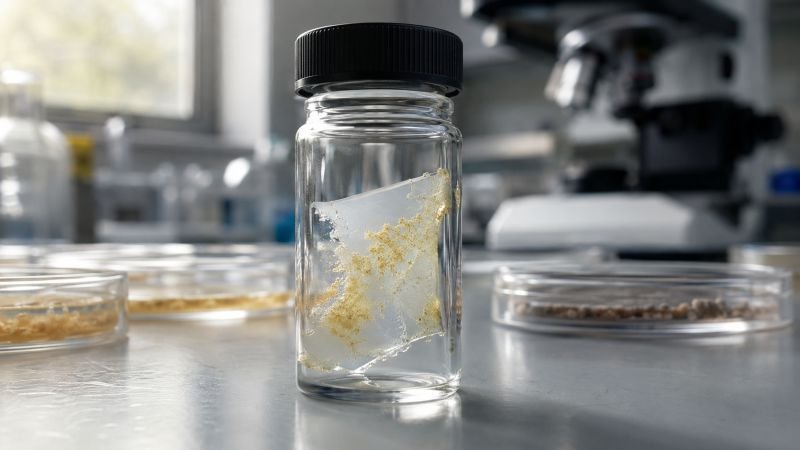
PETase and MHETase work as a sequential pair. PETase attacks the ester bonds linking PET’s monomer units, producing two intermediates: BHET (bis(2-hydroxyethyl) terephthalate) and MHET (mono(2-hydroxyethyl) terephthalate). MHETase handles the second stage, converting those intermediates into terephthalic acid (TPA) and ethylene glycol (EG) – the exact same two feedstocks used to manufacture virgin PET. The organism does not destroy plastic in the way fire or acid would. It disassembles it, bond by bond, back into reusable components. For a deeper look at the chemical mechanics of ester bond hydrolysis in polymer recycling, the recycling chemistry article covers the underlying mechanisms.
The synthetic biology layer rewires the rest of the organism’s metabolism to support that function at industrial pace. Wild-type I. sakaiensis degrades PET film at roughly 0.13 mg per cm² per day at 30-35°C – a rate at which clearing the current global PET stockpile would take longer than recorded human civilization has existed. Engineered variants operating at 45-50°C with enhanced enzyme expression can degrade PET in hours. The performance gap between what nature produced and what an industrial system needs is real, but it closes through known tools: directed evolution of the enzyme, CRISPR-based metabolic pathway editing, and iterative optimization of expression rates. None of that requires inventing new biology. It requires rearranging existing biology with precision, which is precisely what synthetic biology is designed to do.
A Hierarchy of Plastic Degradability
The organism in this concept is not a universal plastic eater, and that specificity is not a design flaw. Ester bonds, the structural feature making PET enzymatically accessible, are absent from the most common plastics by volume. Polyethylene, polypropylene, and polystyrene all use carbon-carbon backbones that enzymatic hydrolysis cannot attack through the same mechanism. The device is powerful within a defined range.
| Plastic Type | Structural Bond | Enzymatic Degradability | Primary Recoverable Output |
|---|---|---|---|
| PET (polyethylene terephthalate) | Ester | High | Terephthalic acid + ethylene glycol |
| PLA (polylactic acid) | Ester | High | Lactic acid monomers |
| Polyurethane | Ester/urethane | Moderate | Diols + isocyanate fragments |
| Nylon (polyamide) | Amide | Moderate | Amino acid precursors |
| Polystyrene | C-C backbone + aromatic ring | Low | Partial styrene oxidation products |
| Polyethylene / Polypropylene | C-C backbone only | Very low | Trace oxidation products |
| PVC | C-C backbone + chlorine | Near zero | Chlorine release creates secondary hazard |
The practical implication of that table: a first-generation bioengineered recycler targets PET and potentially PLA almost exclusively. Global PET production alone runs at roughly 70-80 million tonnes per year – large enough to justify building something designed exclusively for it. What happens when the architecture extends to mixed streams is a question for the evolutionary arc, not the first bioreactor.
How the Device Could Operate
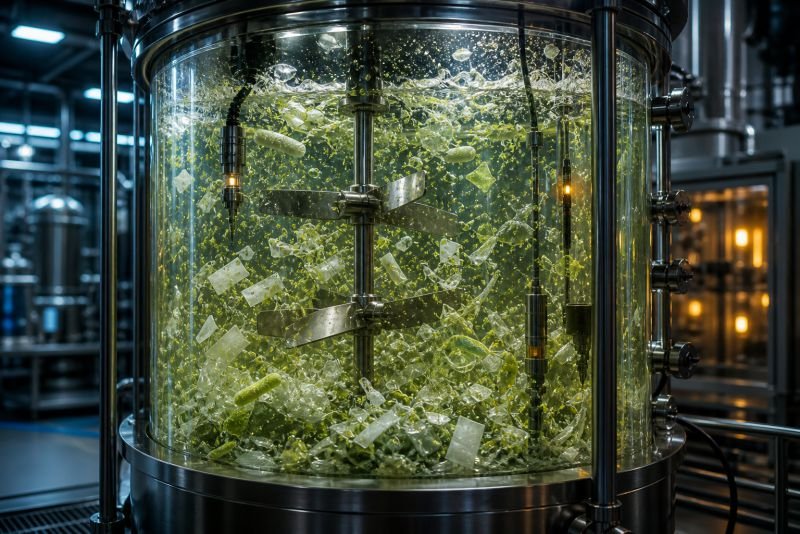
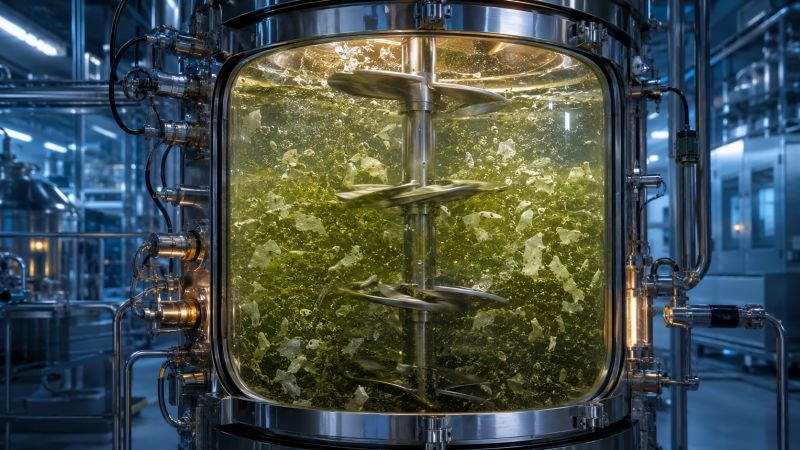
The central engineering challenge is that the substrate here is a solid, not a dissolved nutrient. Conventional industrial fermenters handle liquid-phase inputs. A plastic-eating bioreactor has to process solid polymer – which makes mechanical pre-treatment as important to the system’s performance as the biology inside the vessel.
Inside the Bioreactor
Plastic waste enters the system pre-sorted and passes through an upstream shredder before reaching the bioreactor. Surface area is the primary rate-controlling variable: enzymatic degradation happens at the solid-liquid interface, and a 1 mm particle carries roughly 1,000 times the surface-area-to-volume ratio of a 1 mm-thick sheet. Getting the plastic into fine uniform suspension, finely divided and evenly distributed through the liquid, is one of the most effective engineering levers available for accelerating throughput – and it costs far less than engineering the organism for higher enzyme expression.
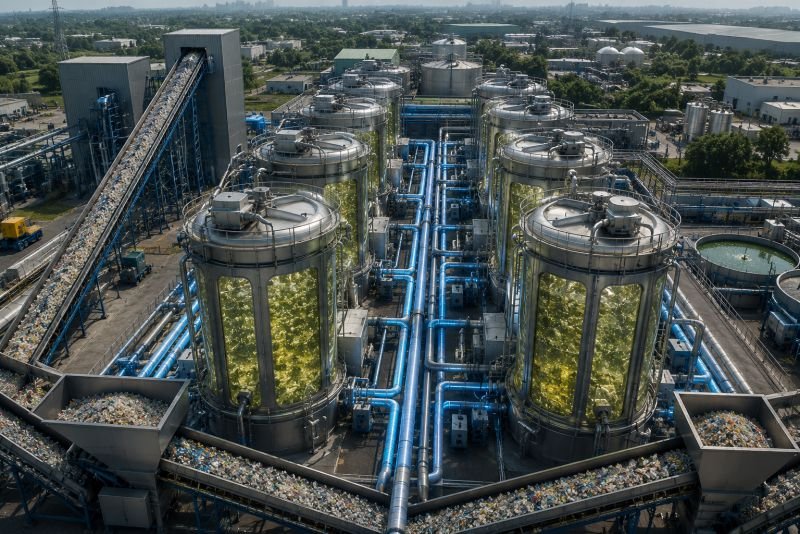
Inside a continuously stirred tank bioreactor operating at 10 g/L bacterial density and 45-50°C, and drawing on performance data from optimized PETase variants already demonstrated in laboratory conditions, the working degradation rate is approximately 0.5 g of PET per gram of bacteria per hour. A 10,000-liter vessel at those parameters carries roughly 100 kg of active biomass. At 0.5 g/g/h throughput, that processes 50 kg of PET per hour, or just over 1.2 tonnes per day. A typical municipal recycling facility handles 150-200 tonnes of mixed plastic daily. Its PET fraction, roughly 30-35% of total input, represents 50-70 tonnes. Full biological processing of that fraction would require 40-60 bioreactors of this size running in parallel – not a small installation, but a calculable one. For a broader look at the material engineering challenges in designing bio-compatible industrial infrastructure of this scale, the sustainable manufacturing materials article addresses the wider context.
The Energy and Nutrient Math
Hydrolysis of each ester bond in PET releases approximately 40-50 kJ/mol. One kilogram of PET contains about 5.2 moles of ester bonds – the repeating unit (one TPA + one EG) has a molecular weight of 192 g/mol, so 1,000 g / 192 g/mol gives 5.2 moles of bonds available for cleavage. At 50 kJ/mol, that releases roughly 260 kJ per kilogram processed.
For comparison: combusting the same kilogram of PET releases approximately 22,000 kJ. Biological degradation through enzymatic hydrolysis captures less than 2% of PET’s energy content. The organism uses most of that captured energy for its own metabolism and growth; what the system recovers is not heat but the chemical value of TPA and EG, which together represent approximately 85% of PET’s original monomer mass. Whether the overall energy balance is favorable depends on a lifecycle comparison against virgin monomer production – which itself requires substantial energy input – making the biological route competitive on a full-materials accounting, even though the direct energy yield looks small in isolation.
Beyond carbon, the organisms require nitrogen, phosphorus, and trace minerals. A C:N:P ratio of approximately 100:10:1 sustains most bacterial cultures at healthy growth rates. In a controlled bioreactor, these nutrients can be supplied in precise ratios, and organic co-waste present in the plastic input stream can partially contribute to the nitrogen budget, reducing the need for external nutrient supplementation.
Everything here is free. Readers are the reason it stays that way.
I make all of it alone, with no ads. If it is worth a coffee a month to you, that keeps the next one coming.
Keep it alive →What the Device Needs to Stay Functional
Getting a bioreactor to process PET at projected rates in the first week of operation is the tractable part. Keeping it at those rates for months without significant degradation is where the engineering becomes genuinely hard – and where the failure modes are less dramatic but more insidious than any single technical challenge.
The Contamination Problem and Its Solutions
Real-world PET waste is not pure polymer. It carries adhesive labels, food residues, colorant additives, flame retardants, and plasticizer compounds. Several of these act as enzymatic inhibitors – occupying active sites on PETase and MHETase, reducing throughput. Some are toxic to the bacterial culture at even low concentrations. A bioreactor operating directly on unsorted, unwashed stream plastic would see measurable performance decline within weeks, not years.
Two engineering responses address the problem in parallel. Physical pre-treatment – optical sorting to isolate PET from mixed streams, combined with hot-water washing – removes a large fraction of surface contaminants before material enters the vessel. For compounds that survive pre-treatment, engineered tolerance pathways can be introduced into the organism: metabolic routes that degrade or sequester common inhibitors before they reach the enzymatic machinery. Neither approach resolves every contamination event, but the combination brings the problem into a manageable operational window. A two-stage system – physical cleaning as the first pass, engineered tolerance as the safety net – is more robust than either method alone.
Keeping the Organism Honest
Bacteria in a running bioreactor divide every 20-30 minutes. Over continuous operation, a culture generates more than 1,000 generations per month. Mutations accumulate across those generations – most neutral, some harmful to the plastic-eating function. An organism developing a mutation that reduces PETase expression while improving growth efficiency on trace nutrients in the reactor will, over time, outcompete its more productive neighbors. The culture gradually fills with organisms that are metabolically comfortable but industrially useless. Evolutionary drift is one of the most underappreciated failure modes in applied microbiology – not because it is difficult to understand, but because it operates slowly and invisibly until the performance curves start moving.
The engineering response requires two layers running simultaneously. Regular culture refreshment from cryogenically preserved master stocks resets the mutation clock at defined intervals – essentially replacing the drifted culture with a fresh copy of the original organism. Real-time monitoring of TPA and EG output concentrations provides the early warning signal: a sustained 15-20% drop in output over a two-week window flags a probable drift event before it becomes a throughput crisis. A genomic surveillance layer – periodic whole-genome sequencing of culture samples to identify emerging mutation patterns – can deliver earlier warning and pinpoint which pathways are degrading. The technology for all of this exists. The engineering challenge is integrating it into a running industrial system at acceptable operational cost.
Risks That Can Damage the Concept
Two failure modes matter more than the rest. One involves the organism attacking materials it was never designed to touch. The other involves the organism leaving the system entirely and operating somewhere no one can monitor it.
When the Organism Eats the Wrong Thing
An organism engineered to hydrolyze ester bonds does not inherently distinguish between a PET bottle and a polyurethane foam panel in a nearby wall, or a polyester synthetic fabric passing through the facility, or a plastic seal inside its own bioreactor housing. Cross-degradation – the organism attacking non-target materials – is a credible risk in any deployment scenario, and it has an obvious consequence: a device that quietly damages its own infrastructure while appearing to function correctly.
Prevention operates primarily through substrate binding pocket engineering. PETase’s active site is geometrically shaped to accommodate PET’s specific aromatic ring configuration. Narrowing that binding pocket makes the enzyme more sterically specific, reducing the range of substrates it will accept. A tighter pocket trades generality for safety – the correct trade-off for an industrial device with a defined input stream. Physical containment provides the second prevention layer: the organism operates inside a sealed system where only the intended plastic stream enters the reactor environment. Binding pocket engineering and containment together bring cross-degradation risk to acceptable engineering tolerances; relying on either alone does not.
The Kill Switch and the Carbon Question
Any organism engineered for industrial function and capable of autonomous reproduction needs a controlled deactivation mechanism before deployment outside a controlled laboratory. The two most technically mature approaches are auxotrophic dependency and toxin-antitoxin systems. In auxotrophic dependency, the organism is engineered to require a synthetic amino acid absent from the natural environment for essential protein synthesis – withdraw the synthetic amino acid from the growth medium and the culture collapses within days. In a toxin-antitoxin system, the organism continuously produces both a toxin and its specific antidote; cutting the antidote signal triggers self-destruction within hours.
A containment failure without a reliable kill switch releases organisms into an environment where selective pressure is unpredictable. Beyond the cross-degradation concern, open-environment plastic degradation without output capture converts fossil carbon locked in plastic polymers into atmospheric CO2 – adding to the carbon cycle rather than closing it. The preferred outcome is always monomer recovery inside the bioreactor. TPA and EG captured from PET degradation can re-enter polymer manufacturing; CO2 released from uncontrolled biological degradation in open environments cannot. A containment failure is not just a biosafety problem. It is a carbon problem.
Where the Device Fits Into the World
A single bioreactor handling sorted PET is meaningful at one facility’s scale. Getting from a contained installation to something that affects the actual rate of global plastic accumulation requires a different kind of thinking – not about the single organism, but about the architecture that emerges when the concept matures.
From Bioreactor to Distributed System
The developmental arc here is not primarily about making the organism better in isolation. A plausible first generation: a single-strain PETase bioreactor at a plastic sorting facility proves the operational economics and demonstrates stable long-term performance. Success with PET creates the engineering template and justifies the investment needed to develop parallel organisms targeting polyurethane and nylon streams – different enzymatic machinery, similar containment architecture, installed alongside the PET unit as additional modules. Over time, a modular biological platform emerges: pre-sorted plastic streams routed to organism-specific bioreactors in sequence, outputs captured and returned to the relevant manufacturing chains. The result is not one device but a distributed biological recycling infrastructure, analogous to how water treatment plants run multiple biological processes in coordinated stages – each stage handling what the previous one passed through.
Microplastics fit naturally into this architecture at a specific point. Particles under 5 mm carry high surface-area-to-volume ratios that make them, counterintuitively, more accessible to enzymatic degradation than large fragments once concentrated. The engineering challenge with microplastics is collection from dispersed environments, not degradation. Wastewater filtration and soil remediation systems can concentrate microplastic particles before routing them to a bioreactor; inside the vessel, they process efficiently. Open-environment deployment for marine microplastic remediation is a different problem with different containment requirements – one worth examining separately.
A direct comparison locates the biological approach relative to the primary chemical alternatives:
| Recycling Method | Operating Temperature | Energy Demand | Output Purity | Feedstock Requirement |
|---|---|---|---|---|
| Enzymatic biodegradation | 45-50°C | Low | High – pure monomers | Sorted, pre-cleaned input |
| Pyrolysis | 500-700°C | Very high | Low – mixed fuel oil | Tolerates mixed streams |
| Solvolysis | 250-300°C | High | Medium-high | Moderate sorting required |
The biological route wins on energy cost and output quality. Its dependence on sorted, pre-cleaned input is a genuine constraint – one that upstream sorting infrastructure can address, but that makes the device dependent on a system that does not exist at full coverage everywhere yet. Neither weakness is inherent to the biology. Both are engineering gaps in the surrounding infrastructure.
The View From NoSuchDevice
I find this concept interesting for one specific reason that tends to get buried under the more vivid versions of the story. The outputs matter. Incineration converts plastic to heat and emissions. Pyrolysis converts it to low-grade fuel. Landfill converts it to a centuries-long liability. Enzymatic biodegradation, done correctly, converts PET back to terephthalic acid and ethylene glycol – the exact feedstocks used to manufacture PET. A material that returns to its own precursors after processing has a genuine material loop, the kind that does not require carbon accounting tricks to close.
The part I am more skeptical about is timeline optimism. The gap between a laboratory PETase variant and an organism that runs reliably inside an industrial bioreactor for 18 months without significant drift is large – not in the physics, but in the operational engineering. The contamination problem is harder than it looks on paper. The kill-switch requirement is not a regulatory formality. No current organism meets that standard well enough to justify open-environment release, and treating that as a near-term possibility conflates two problems that need to be solved in sequence, not in parallel.
The ocean deployment version of this concept – organisms dispersed into surface waters to consume floating plastic – is the version that circulates most in popular coverage, and it is also the furthest from responsible deployment. The bioreactor is the correct frame for this device in its first viable form. Getting that right deserves more attention than the more dramatic scenario.
What qualifies this for the archive is simple: the seed technology is real, the physics permits it, and the distance between here and a functioning device is engineering rather than any missing natural law. That combination is exactly what belongs in Zone 2.
You read the whole thing.
That is rarer than it should be, and it is the exact kind of attention I built this archive for. I make every piece alone, with no ads and no investor deciding what gets written. If you want the next machine taken apart like this one, you can help me make it.
A coffee a month is enough to keep it free for everyone.
Prefer crypto or a one time gift? Other ways to give →