





What Is Casimir effect?
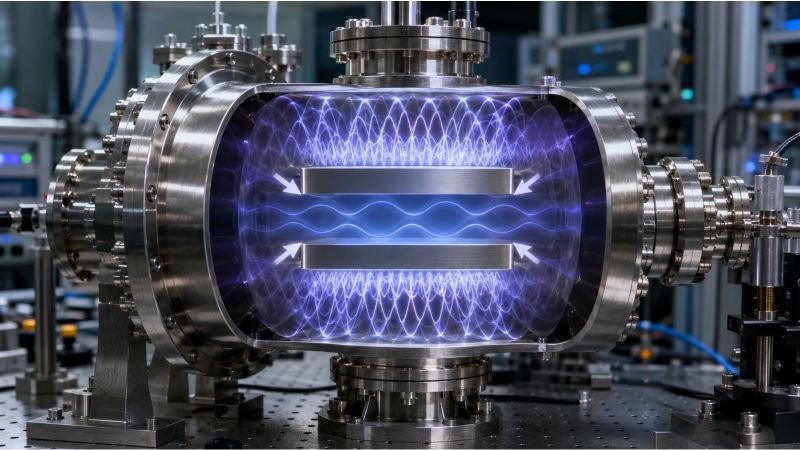
The Casimir effect is a measurable force between closely spaced, uncharged conducting surfaces caused by quantum fluctuations of the electromagnetic field. When two plates are separated by a nanometer-scale gap, only certain field modes can exist between them, while more modes remain outside. That imbalance creates a net pressure that pulls the surfaces together even without classical charge, voltage, or gravity as the direct cause.
For ideal parallel plates, the pressure scales approximately as P = -pi^2 hbar c / (240 a^4), where a is the plate separation. The inverse-fourth-power dependence makes the effect extremely sensitive to distance, surface roughness, material conductivity, temperature, and geometry. In real measurements, contamination, alignment error, and electrostatic patches must be controlled carefully because the force is small but rises sharply as the gap shrinks.
The concept matters because it shows that vacuum fluctuations can produce mechanical consequences in engineered nanoscale systems. In nanoscale fluctuation devices, the Casimir effect helps define which surface forces become relevant below a micrometer. Used in devices include MEMS actuators, nanomechanical test structures, precision force sensors, and cavity arrays that must account for quantum-scale surface attraction.
Example:
Two clean metal plates held tens of nanometers apart in a vacuum can experience an attractive pressure large enough to disturb a delicate microstructure.
Related Terms:
- Johnson-Nyquist Noise
- Metal-Insulator-Metal Junction
- Quantum Vacuum Fluctuation
NoSuchDevice is a free archive of machines that do not exist yet but already have a shadow in physics. I research and write every entry alone, with no ads. Take a look around the archive, or help keep it free.