






What Is Metal-insulator-metal junction?
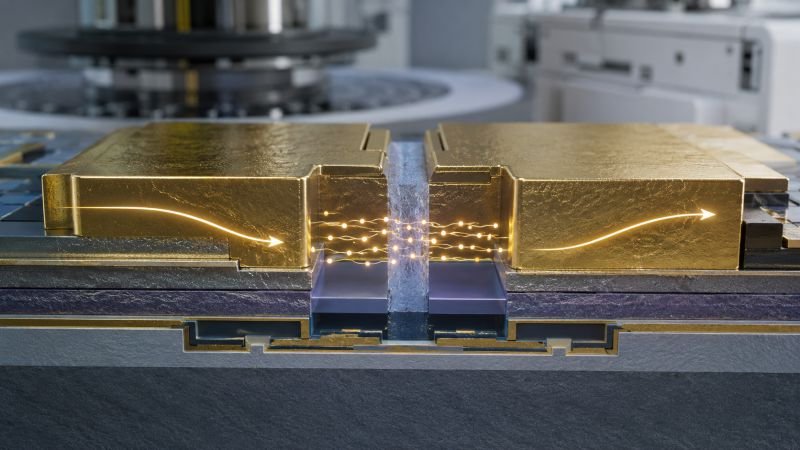
A metal-insulator-metal junction is a layered electronic structure in which two conductive metal electrodes are separated by an ultrathin insulating barrier. When the barrier is only a few nanometers thick, electrons can cross it by quantum tunneling rather than by having enough thermal energy to pass over it. The junction therefore behaves as a nonlinear electronic element controlled by barrier thickness, work function, and applied voltage.
A simplified tunneling dependence is I proportional to e^(-2 kappa d), where d is barrier thickness and kappa depends on barrier height. Because current falls exponentially with distance, tiny fabrication changes can strongly alter resistance and asymmetry. In real devices, oxide quality, interface roughness, electrode material, and contact geometry determine whether the junction can rectify very fast electromagnetic signals without excessive loss.
The structure matters because it can respond at frequencies beyond the switching limit of many classical semiconductor diodes. In terahertz rectification hardware, metal-insulator-metal junctions can convert high-frequency oscillating fields into direct current when coupled to suitable antennas. Used in devices include tunnel diodes, infrared detectors, rectenna feedpoints, memory cells, and nanoscale sensors that exploit barrier-controlled electron transport.
Example:
An aluminum oxide layer between two metal contacts can form a tunneling junction that rectifies terahertz signals from a nanoscale antenna.
Related Terms:
NoSuchDevice is a free archive of machines that do not exist yet but already have a shadow in physics. I research and write every entry alone, with no ads. Take a look around the archive, or help keep it free.