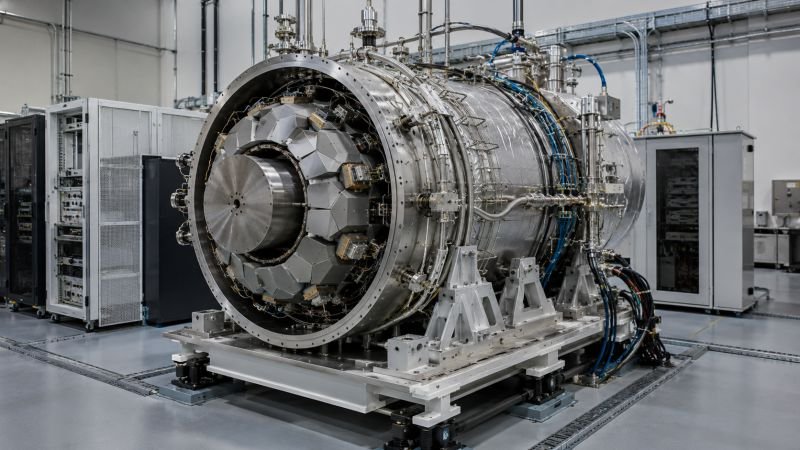





In 1997, a physicist named Steve Lamoreaux placed two metal plates inside a vacuum chamber, separated them by less than a micrometer, and measured the force between them. The plates were uncharged. The space between them was as empty as any space on Earth can be made. The force they felt had no business existing according to classical physics. But there it was – measured, repeatable, matching a prediction Hendrik Casimir had made in 1948 to within 5%. Empty space was pressing.
That experiment did not launch an energy revolution. What it did was confirm something more useful for a patient engineer: the quantum vacuum is not passive, it interacts with matter in ways that scale dramatically at nanometer distances, and those interactions are real enough to measure with force sensors. A quantum flux energy harvester is built on that confirmed reality – not on the Casimir force as a direct mechanism, but on the physical picture it validates. Ambient quantum-thermal energy fills every surface, every material, every manufactured object above absolute zero, and a sufficiently small device can reach into that reservoir and pull current out of it.
The short version: A quantum flux energy harvester converts ambient quantum-thermal noise into direct current through arrays of nanoscale antenna-rectifier junctions. Every conductor above absolute zero continuously emits electromagnetic fluctuations in the terahertz range. The device taps this spectrum using quantum tunneling junctions that classical semiconductors cannot operate at these frequencies. Projected power densities of 1-50 μW/cm² place it in thermoelectric territory – but without requiring any temperature gradient, movement, or light source.
Key Takeaways
- The Casimir effect – a real, measured force arising from quantum vacuum fluctuations – is the physical proof of principle, not the harvesting mechanism itself
- The device targets the 1-10 terahertz range, where quantum tunneling enables rectification faster than any classical semiconductor junction can manage
- Green sulfur bacteria already solved a version of this problem: the FMO protein complex routes photon energy at near-99% efficiency using quantum coherence at room temperature
- Two architectural approaches exist with fundamentally different engineering tradeoffs – Casimir cavity arrays and quantum-thermal rectenna grids – and conflating them is where most of the hype and most of the skepticism both go wrong
- At planetary deployment scale, quantum flux harvesting film turns every manufactured surface into a passive generator – not a supplement to the grid, but a new layer underneath it
Table of Contents
The Energy That Physics Cannot Switch Off
Classical energy harvesting runs on the same logic every time: find a gradient, convert it. A thermoelectric generator needs a hot side and a cold side. A piezoelectric film needs mechanical strain. A photovoltaic cell needs photons arriving from somewhere. The moment the gradient disappears, the harvesting stops. Night. Stillness. Thermal equilibrium. All of them have an off state.
A quantum flux harvester does not start with a gradient. It starts with the ground state of matter – the condition every object is in, all the time, simply by existing at a temperature above absolute zero.
What the Casimir Effect Actually Proves
When Casimir predicted in 1948 that two parallel uncharged metal plates held nanometers apart would attract each other, he was describing a consequence of quantum field theory. The electromagnetic modes that fit between closely-spaced plates are fewer than the modes outside them, and this asymmetry in vacuum fluctuations creates a net inward pressure. At 100-nanometer separation, the Casimir pressure is roughly 10 milliPascals – small in absolute terms, completely real, and scaling as the inverse fourth power of distance as the gap shrinks.
The Casimir effect is not the harvesting mechanism. It is the existence proof. A force arising from quantum vacuum fluctuations, measured in a laboratory, behaving exactly as theory predicts – that is the confirmation that quantum vacuum energy has mechanical consequences at nanometer scales, and that a device designed to interact with it is not operating in the territory of wishful thinking.
The Biological Argument That Changes the Terms

In green sulfur bacteria, a protein complex called the Fenna-Matthews-Olson complex – the FMO complex – transfers absorbed photon energy from antenna molecules to the reaction center with efficiency approaching 99%. Classical energy transfer at molecular scale through random thermal diffusion achieves perhaps 10-30% in comparable systems. The gap is quantum coherence: the excitation does not hop between sites like a particle. It propagates as a quantum wave exploring multiple transfer pathways simultaneously and arriving at the most efficient route.
Researchers confirmed this in 2007, and the result changed what the field believed was achievable at ambient temperature. Quantum effects in biological energy routing at room temperature, at near-perfect efficiency – that is three billion years of evolution finding what physics permits at molecular scale. A quantum flux harvester applies the same insight deliberately, for a different conversion task, using fabricated nanostructures in place of protein chemistry. The precedent is biological. The engineering is the unfinished part.
Two Architectures With the Same Name
There are two fundamentally different ways to build a quantum flux energy harvester. They share the name, they share the physics background, and they share almost nothing structurally. The confusion between them is where most of the hype and most of the legitimate skepticism about this device originate.
The Casimir Cavity Array
The Casimir cavity array attempts to harvest the vacuum pressure directly. Two parallel conducting plates are held 50-200 nanometers apart, with the separation modulated by a piezoelectric actuator. As the gap cycles, the Casimir force cycles with it. The system converts the mechanical work done against and with this force into electrical energy through the piezoelectric coupling.
Physically, the device looks like a multilayer sandwich: gold or aluminum conducting plates, a precisely-etched dielectric spacer layer, and a piezoelectric collection substrate beneath. The fabrication can be planar – a thin film stack – or corrugated to maximize total plate area per unit volume. The engineering challenge is severe. Nanometer-scale plate separations must be maintained across a useful device area under thermal expansion, vibration, and humidity variation. At room temperature, the Casimir force magnitudes over realistic fabricated areas produce power outputs in the picowatt range per element. Arrays of billions of elements are needed for any practical threshold. This architecture attracts perpetual-motion accusations – unfairly, since thermodynamics is not violated – but the accusations arise because the energy source is genuinely counterintuitive to anyone trained on classical physics.
The Quantum-Thermal Rectenna Grid
The quantum-thermal rectenna grid does not attempt to harvest vacuum energy at all. It targets something more prosaic and considerably more accessible: the spontaneous electromagnetic noise that every conductor at room temperature continuously emits across the terahertz frequency range.

A rectenna is an antenna coupled directly to a rectifier diode, converting received electromagnetic radiation to direct current without any intermediate conversion stage. Classical rectennas work at microwave frequencies, where semiconductor diodes switch fast enough to rectify the signal. At terahertz frequencies, classical junction capacitance makes semiconductor rectification impossible – the diode cannot follow the oscillation.
A quantum tunneling junction can. In a metal-insulator-metal (MIM) junction with an insulator layer 1-3 nanometers thick, electrons cross the barrier through quantum tunneling rather than classical thermal excitation. Tunneling response time is in the femtosecond range – fast enough to follow signals at 10 THz without difficulty. Each element of the device is a terahertz resonant antenna coupled at its feed point to a tunneling junction, with DC outputs collected across a thin conducting layer. This is the manufacturable architecture. The physics is already demonstrated in laboratory-scale devices. The challenges remaining are fabrication precision challenges, not fundamental physical barriers.
How a Quantum Flux Harvester Operates
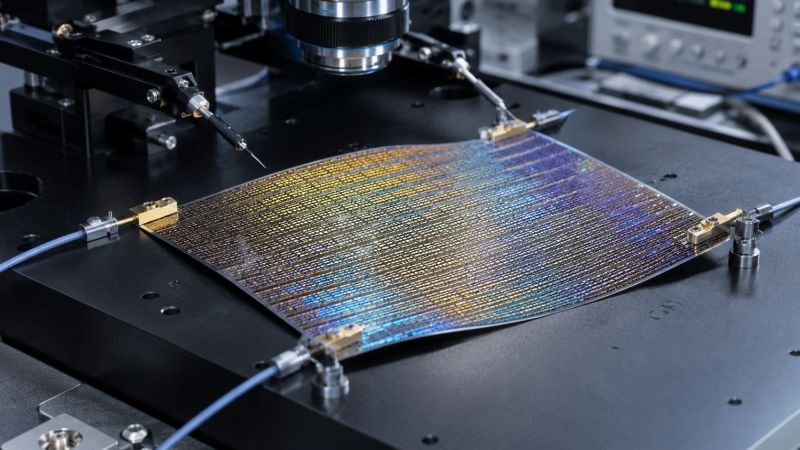
The device as deployed is a flat panel – a sheet of active material between 500 nanometers and 2 micrometers thick, produced on a flexible polymer substrate or a rigid silicon carrier depending on the application. From surface to substrate, the stack contains: a resonant antenna layer of metal traces patterned by electron-beam lithography, a tunneling junction layer where each antenna feedpoint meets a 1-3 nm aluminum oxide insulator between two aluminum contacts, a transparent conducting oxide current collection layer, and the substrate. The entire assembly has no moving parts, no chemical reaction, no preferred orientation toward any light or heat source.
Inside the Harvesting Layer
Each antenna element resonates in the 1-10 THz window. At these frequencies, resonant element dimensions fall in the 10-30 micrometer range – achievable with lithographic techniques already in use for other applications. Ambient terahertz radiation from the surrounding environment drives an oscillating voltage at each element. At the tunneling junction, electrons cross the insulating barrier in the direction of the instantaneous voltage, producing a net DC current because the junction’s current-voltage characteristics are asymmetric by design.
The spectral power available from the thermal field at temperature T follows the quantum-corrected Planck distribution:
S(f) = 2hf / (e^(hf/kT) – 1) + hf
where h = 6.63 × 10⁻³⁴ J·s and k = 1.38 × 10⁻²³ J/K. At f = 1 THz and T = 300 K: hf = 6.63 × 10⁻²² J, kT = 4.14 × 10⁻²¹ J, giving hf/kT ≈ 0.16. The classical thermal term dominates, but the quantum zero-point correction in the +hf term adds roughly 8% to the spectral power at this frequency. Across a 1 THz bandwidth with matched impedance, the available power per element is kTB = 1.38 × 10⁻²³ × 300 × 10¹² ≈ 4.1 μW. With 10⁶ elements per cm² operating at 1% junction coupling efficiency – a realistic figure for current MIM technology – the array output sits in the 1-50 μW/cm² range as a projected envelope.
The Thermal Noise Problem That Defines the Engineering Target
The same fluctuations that drive the harvesting signal also generate Johnson-Nyquist noise in the circuit itself. The noise power at room temperature across bandwidth B is P_noise = kTB – the same order as the signal. The device produces net positive output only when antenna-to-junction coupling efficiency exceeds the threshold at which signal gain outpaces the noise floor from the junction’s own resistance.
Current fabricated MIM junctions achieve coupling efficiencies of 1-3%, placing them near the operating threshold at room temperature. The engineering target – efficiency in the 5-15% range – has been demonstrated in specialized single-junction laboratory measurements. Reproducible arrays at manufacturable density remain unsolved. This is a fabrication tolerance problem, not a physics prohibition. The first-principles constraint is not violated. The manufacturing process does not yet reliably meet it.
Everything here is free. Readers are the reason it stays that way.
I make all of it alone, with no ads. If it is worth a coffee a month to you, that keeps the next one coming.
Keep it alive →What a Quantum Flux Harvester Does That Classical Devices Cannot
| Harvesting Mechanism | Power Density | External Requirement | Quantum Role |
|---|---|---|---|
| Piezoelectric film | 10-100 μW/cm² | Mechanical strain or vibration | None |
| Thermoelectric (ΔT = 1 K) | 1-10 μW/cm² | Temperature gradient | Partial (electron transport) |
| Thin-film photovoltaic | 10-100 mW/cm² in full sun | Light source, correct orientation | Core (photon absorption) |
| Quantum-thermal rectenna | 1-50 μW/cm² (projected) | Ambient temperature above ~50 K | Core mechanism |
The decisive column is the last one. For piezoelectric harvesters, quantum mechanics is irrelevant to the operating principle – it is a macroscopic mechanical effect, full stop. Thermoelectric devices use quantum electron transport internally, but the harvesting logic is entirely classical: a temperature difference drives current. Photovoltaics depend on quantum photon absorption, but photons must arrive from an external source that can be blocked, diffused, or simply absent for sixteen hours a day.
A quantum-thermal rectenna harvests energy present in every material, in every condition, continuously. A piezoelectric harvester on a building facade works only when the structure flexes. A thermoelectric patch on a roof works only when there is a temperature differential between surface and ambient air. A quantum flux harvesting film on the same surfaces works at midnight in a sealed basement. The power density is lower than a well-loaded piezoelectric device under active mechanical loading. That is the honest tradeoff, and it should be stated directly. The device is a harvester for conditions where no other harvester produces anything.
Where the Device Lives: From Implants to Building Skins
The deployment logic follows directly from the power density numbers. A quantum flux harvester is a continuous low-density source. The use cases where that is exactly what is needed form a specific and consequential category.

The Microwatt Domain: Sensors, Wearables, Implants
A cardiac rhythm monitor requires 10-100 μW of continuous power. A wireless environmental sensor node draws 50-500 μW. A cochlear implant needs 1-10 mW. Grid connection is physically inconvenient in each case, and battery replacement is either impractical or surgically inadvisable. A quantum flux harvester at 10 μW/cm² powers a cardiac monitor from a 2 cm² patch bonded directly to the device housing – permanently, with no battery, no recharging schedule, no replacement procedure.
Fabric integration follows the same arithmetic. Rectenna grid arrays across 100 cm² of garment panel deliver roughly 1 mW continuous at room temperature – enough for a fitness tracker, a body temperature sensor, or a personal air quality monitor with no charging behavior from the wearer. The garment is the generator.
Infrastructure Scale: The Right Question
A building facade of 500 m² covered in harvesting film at 10 μW/cm² delivers 500 W continuous. Against a commercial building consuming 50-500 kW, that is 0.1-1% of total load – a number that invites dismissal until the question changes. The argument for infrastructure integration is not energy replacement. It is sensor network power: providing continuous baseload for building automation, structural health monitoring, environmental sensing, and access control without running power cables to each node. A building covered in quantum harvesting film powers its own nervous system from its own skin, with no external supply chain for that subsystem.
From a Single Patch to a Planetary Coating
The first-generation quantum flux harvester is a laboratory device. A few cm² of rectenna array on a silicon substrate, producing measurable DC current under ambient conditions, demonstrating that MIM coupling efficiency above the noise threshold is achievable in a reproducible fabrication process. This generation proves the principle in a form that can be transferred to other laboratories and scaled up as lithographic precision improves. The energy conversion efficiency numbers at first generation are modest. They should be reported as modest.

The mature-generation device is a coating – not an object installed, but a property a surface acquires during manufacturing. Building panels, electronic housings, fabric substrates, structural composites: any flat surface produced with an integrated rectenna layer adds ambient power generation to its other properties without meaningful change to thickness, weight, or assembly complexity. At this stage, the device ceases to be an energy product and becomes a material property.
The civilizational-scale form is what emerges from that transition. When harvesting becomes a surface property, the deployment question disappears. Every manufactured surface generates microwatts of electrical power passively, because that is what surfaces do. The quantum mechanical principles enabling this are already part of the physical description of matter at nanometer scale. The engineering arc from first-generation laboratory device to ubiquitous surface coating follows a trajectory that nanofabrication manufacturing is already on, for different applications, at accelerating pace.
The system-level property that emerges at full deployment is not high energy density. It is energy ubiquity – power present in every manufactured object, without infrastructure, without logistics, without a supply chain for fuel or replaceable components. A sensor placed anywhere in the world on a quantum flux harvesting surface operates indefinitely without external energy input. The aggregate output across global built infrastructure is not a supplement to the electrical grid. It is a new passive layer underneath it.
The View From NoSuchDevice
I want to be careful about two things that usually get collapsed together in conversations about this device.
The first is the “limitless energy from the quantum vacuum” version of the story. That version is wrong, and wrong in a specific way. The quantum vacuum contains real energy – the Casimir effect is measured, the zero-point contribution to the thermal spectrum is calculable and confirmed – but extracting net work from the vacuum in the way that phrase implies would require violating thermodynamics, and thermodynamics has not lost a fight yet. The quantum-thermal rectenna is not that device. It converts thermal electromagnetic noise that is already flowing through every conductor, continuously, at any temperature above absolute zero. It is a conversion device. Saying so clearly does not diminish the concept. Failing to say so clearly produces exactly the kind of credibility collapse this field cannot afford.
The second thing worth stating directly is the opposite error: dismissing the device because 10 μW/cm² is a small number. Ten microwatts per square centimeter is small compared to a photovoltaic panel in direct sunlight. Against a surface with no harvesting layer at all – which is every surface currently in existence – it is the difference between a powered sensor and a dead one. The question is never whether this technology replaces solar. It does not and will not at current projected densities. The question is whether a passive ambient power source with no external energy input, no maintenance, no preferred orientation, and no geographic or temporal constraints changes what is possible for low-power electronics. The answer to that is yes, provided the MIM junction fabrication challenge is solved at production density.
I think this is a seed technology in the most useful sense: the mature form is not the device, it is the surface. When harvesting becomes a material property rather than an installed product, the deployment calculus changes completely. You do not deploy a surface that generates power. You use surfaces that generate power, because that is simply what surfaces are. Whether the engineering reaches that point depends entirely on nanofabrication progressing along a trajectory it is already on for other reasons. The physics is settled. The manufacturing is the open question.
You read the whole thing.
That is rarer than it should be, and it is the exact kind of attention I built this archive for. I make every piece alone, with no ads and no investor deciding what gets written. If you want the next machine taken apart like this one, you can help me make it.
A coffee a month is enough to keep it free for everyone.
Prefer crypto or a one time gift? Other ways to give →