





What Is Johnson-Nyquist noise?
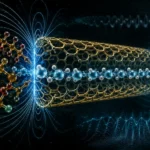
Johnson-Nyquist noise is the random voltage or current fluctuation produced by thermal motion of charge carriers in an electrical conductor. It appears even when no signal is intentionally applied, because electrons continuously exchange energy with the vibrating atomic structure of the material. The noise is not caused by poor construction; it is a fundamental consequence of temperature, resistance, and bandwidth.
For a resistor, the mean-square noise voltage is commonly written as v_n^2 = 4 k T R B, where k is Boltzmann’s constant, T is temperature, R is resistance, and B is measurement bandwidth. Higher temperature, larger resistance, or wider bandwidth increases the noise floor. In real circuits, this fluctuation limits weak-signal detection, defines amplifier sensitivity, and competes with useful electromagnetic signals in high-frequency electronics.
The concept matters because every sensor or rectifier must distinguish desired output from unavoidable thermal fluctuations. In ambient electromagnetic harvesting, Johnson-Nyquist noise sets the circuit background against which any extracted power must be measured. Used in devices include low-noise amplifiers, radio receivers, bolometers, precision resistors, and tunnel junction arrays designed around measurable noise limits.
Example:
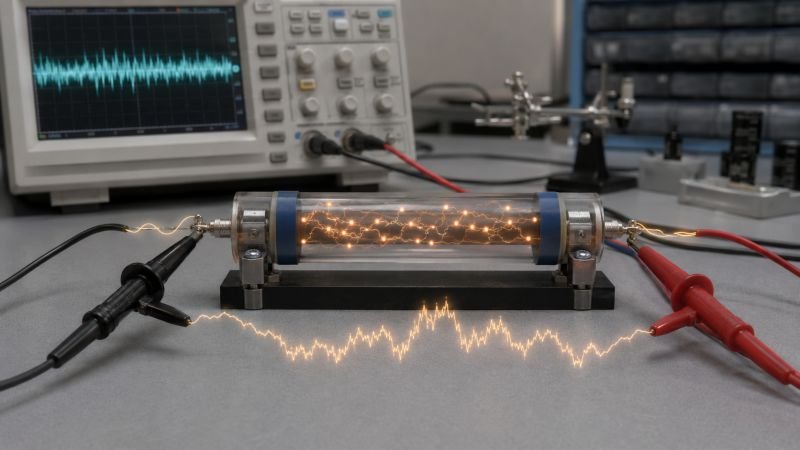
A resistor connected to a sensitive amplifier produces a small random voltage that grows when the circuit bandwidth is widened.
Related Terms:
- Rectenna
- Metal-Insulator-Metal Junction
- Thermal Noise
NoSuchDevice is a free archive of machines that do not exist yet but already have a shadow in physics. I research and write every entry alone, with no ads. Take a look around the archive, or help keep it free.