





What Is Condensation Polymer?
A condensation polymer is a macromolecule formed when monomers join through step-growth reactions that release a small molecule such as water, methanol, or hydrogen chloride. Common linkages include ester, amide, and carbonate groups. A useful relation is Xn = 1 / (1 – p), where Xn is degree of polymerization and p is the fraction of reacted functional groups.
In real materials, these polar linkages shape melting behavior, solvent response, moisture sensitivity, and chemical recyclability. Because the chain is built from functional group reactions, the same bond types can often be cleaved by hydrolysis, alcoholysis, or aminolysis under controlled conditions. Used in devices include beverage bottles, synthetic fiber lines, engineering bearings, and optical components made from polyesters, polyamides, or polycarbonates.
The class matters in polymer science because it connects synthesis, properties, and end-of-life processing more directly than many hydrocarbon plastics. This is especially visible in closed-loop polymer recovery, where reversible linkage chemistry can return monomers or near-monomer intermediates instead of mixed hydrocarbon fractions.
Practical performance depends on molecular weight distribution, crystallinity, additives, and contamination, all of which influence how completely a condensation polymer can be purified or depolymerized after use.
Example:
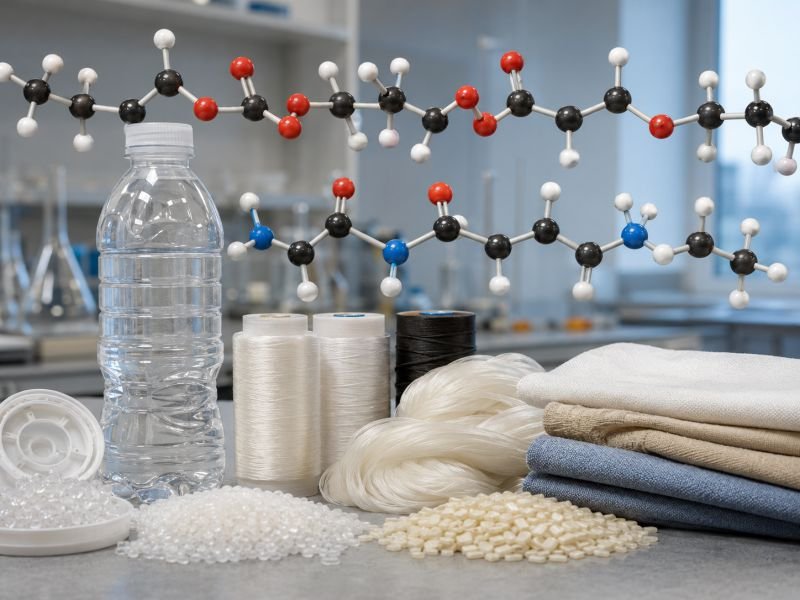
PET bottles are condensation polymer products because their ester-linked chains form from monomers that join while releasing small molecules during synthesis.
Related Terms:
- Depolymerization
- Addition Polymer
- Step-Growth Polymerization
NoSuchDevice is a free archive of machines that do not exist yet but already have a shadow in physics. I research and write every entry alone, with no ads. Take a look around the archive, or help keep it free.