





What Is Depolymerization?
Depolymerization is the chemical or thermal process of breaking a polymer chain into smaller molecules, oligomers, or original monomers. In chemical recycling, it reverses polymer formation by cleaving backbone or linking bonds under controlled conditions. A simple conversion relation is X = (n0 – n)/n0, where X tracks how much of the original chain population has been broken into lower-mass products.
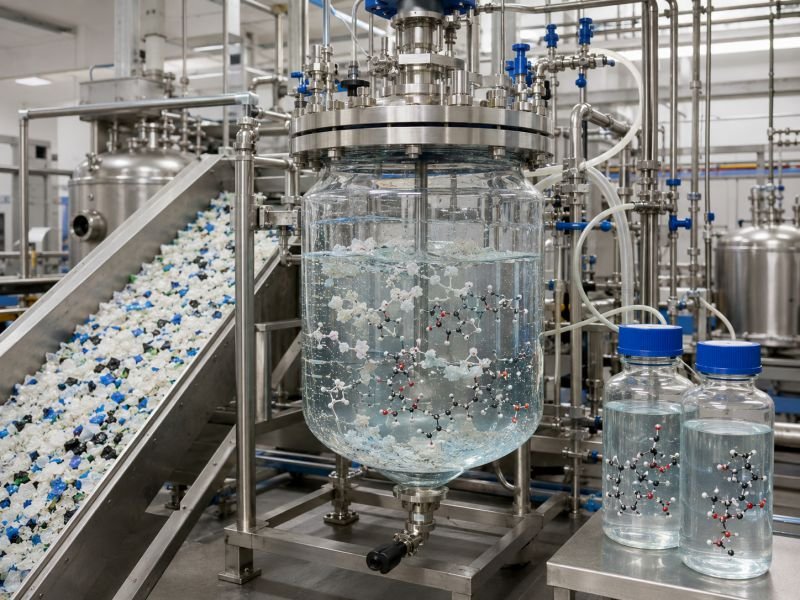
In real systems, the route depends on bond type, catalyst choice, solvent chemistry, temperature, and contamination level. Hydrolysis, glycolysis, and catalytic cracking each favor different products and operating windows. Used in devices include stirred chemical recycling reactors, depolymerization vessels, and feed purification units. One practical application appears in polyester recycling chemistry, where ester-linked chains can be split into reusable feedstock molecules.
The concept matters because polymer value is set not only by collection but by whether the chain can be taken apart selectively instead of burned or randomly cracked. Clean depolymerization can recover high-purity raw materials, lower demand for virgin petrochemical inputs, and reduce property loss across recycling loops.
Process performance is often tracked by monomer yield, selectivity, and energy input per kilogram of recovered product, because partial bond cleavage can create mixed outputs that need additional separation before reuse.
Example:
Alkaline hydrolysis of shredded PET can convert ester-linked plastic into terephthalate-rich solution and recovered glycol for reprocessing.
Related Terms:
- Condensation Polymer
- Addition Polymer
- Glycolysis
NoSuchDevice is a free archive of machines that do not exist yet but already have a shadow in physics. I research and write every entry alone, with no ads. Take a look around the archive, or help keep it free.