





What Is Conjugated Polymer?
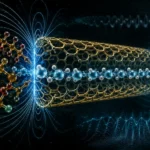
A conjugated polymer is a chain-like organic semiconductor with alternating single and double bonds that create a delocalized pi-electron system. That delocalization lowers the energy gap, allows the material to absorb visible light, and gives charges a pathway to move along and between polymer chains.
In solution-processed photovoltaic films, conjugated polymers usually act as donor materials that absorb sunlight and transport holes through the active layer. Their electronic levels and absorption range can be matched with a Non-Fullerene Acceptor by adjusting backbone units, side chains, and molecular packing.
A useful optical relation is E_g = 1240 / lambda_onset, linking bandgap in electronvolts to absorption onset in nanometers. Why it matters is that polymer design sets how much of the solar spectrum is absorbed, how much voltage the cell can produce, and how easily charges move through the blend.
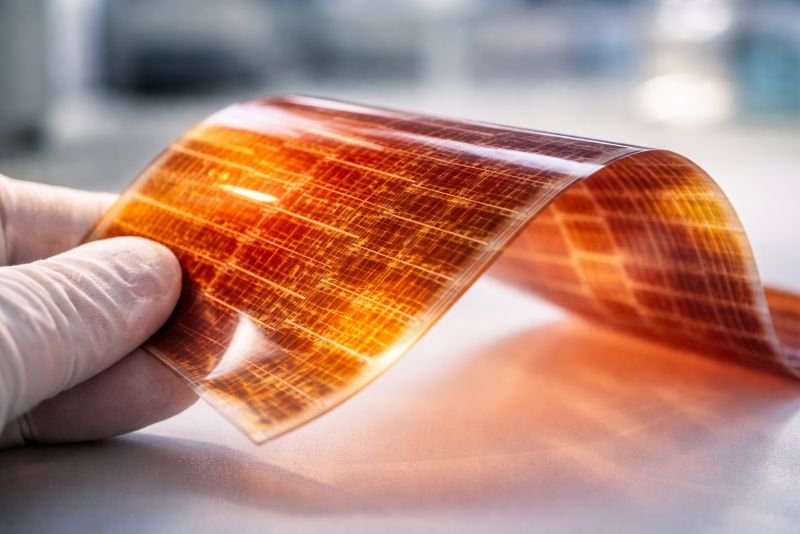
Used in devices include organic solar cells, flexible transistors, and OLED panels. Engineers monitor molecular weight, crystallinity, backbone planarity, and domain purity because these factors shape film morphology, carrier mobility, long-term mechanical flexibility, and printing behavior during large-area manufacturing and roll-to-roll coating.
Example:
A donor polymer with a lower optical gap can capture redder sunlight and raise the current output of a flexible organic solar cell.
Related Concepts:
NoSuchDevice is a free archive of machines that do not exist yet but already have a shadow in physics. I research and write every entry alone, with no ads. Take a look around the archive, or help keep it free.