





What Is Coulomb barrier?
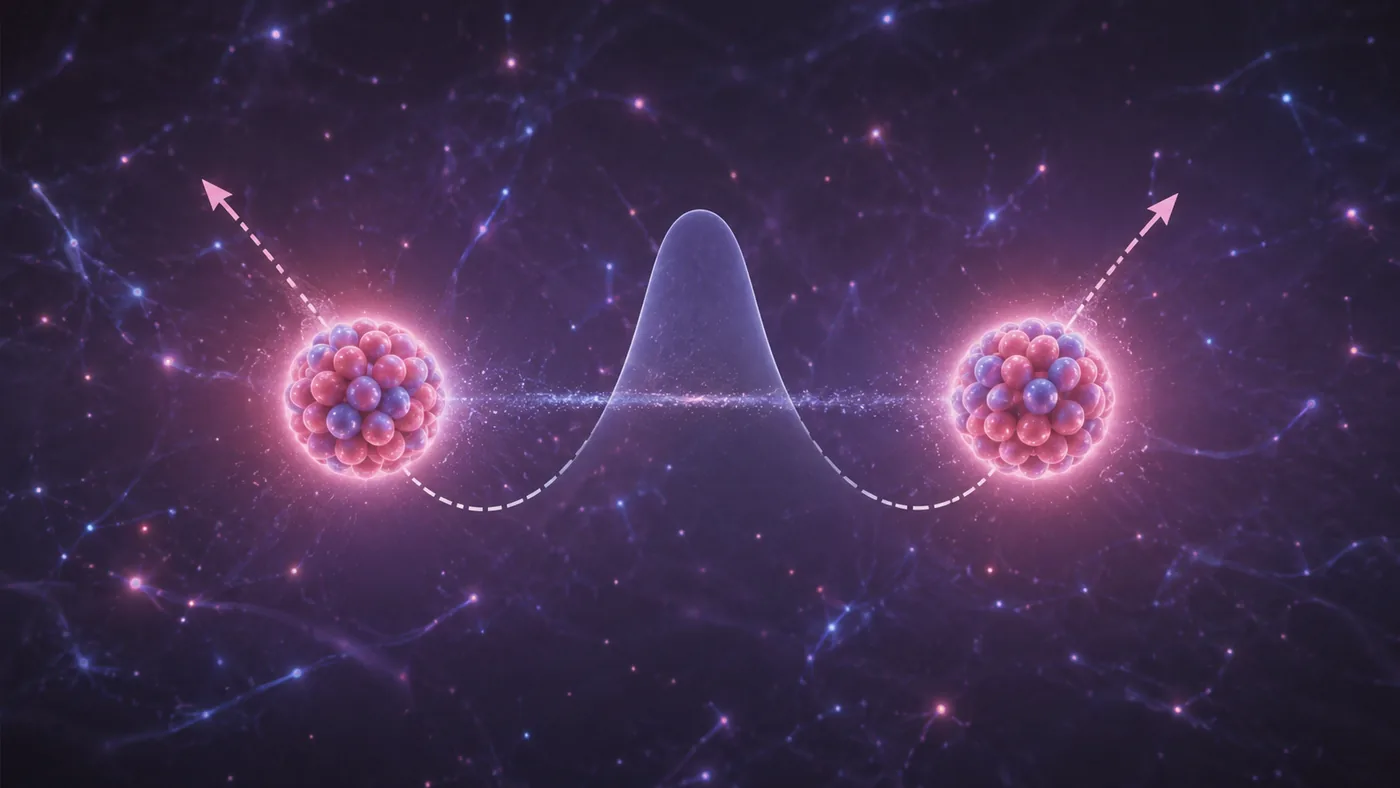
The Coulomb barrier is the electrostatic energy barrier that repels two positively charged atomic nuclei as they approach each other. Because both nuclei carry positive charge, they resist close contact before the strong nuclear force can bind them. A simple relation is U = k q1 q2 / r, where repulsive potential energy rises as separation decreases. Fusion requires nuclei to overcome or tunnel through this barrier.
In real nuclear systems, the barrier depends on nuclear charge, separation distance, and particle energy. Higher-temperature plasmas give nuclei more kinetic energy, while quantum tunneling allows a small fraction of collisions to succeed below the classical barrier height. In fusion plasma reaction physics, the Coulomb barrier explains why light nuclei are heated to extreme temperatures before useful reaction rates appear.
The concept matters because it sets the difficulty of fusion. Fuels with lower charge, such as hydrogen isotopes, face smaller barriers than heavier nuclei and therefore react at more achievable plasma conditions experimentally.
Used in devices include fusion reactors, particle accelerators, neutron generators, and inertial confinement systems that accelerate or compress nuclei toward fusion conditions.
Example:
In a deuterium-tritium plasma, only some ion collisions pass the Coulomb barrier closely enough for the strong nuclear force to produce fusion.
Related Terms:
NoSuchDevice is a free archive of machines that do not exist yet but already have a shadow in physics. I research and write every entry alone, with no ads. Take a look around the archive, or help keep it free.