




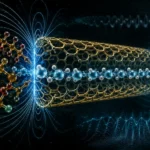


What Is Quantum Confinement?
Quantum confinement occurs when a semiconductor crystal becomes so small that electrons and holes are restricted to dimensions comparable to their quantum wavelength. That spatial restriction forces charge carriers into discrete energy states, so the material no longer behaves like bulk semiconductor matter with nearly continuous electronic bands.
In nanostructured photovoltaic design, this effect lets engineers tune absorption by changing particle size rather than chemical composition alone. A smaller nanocrystal usually raises the effective Bandgap, shifting absorption toward shorter wavelengths and changing which photons can generate useful charge.
A simplified relation is E_eff = E_bulk + k / d^2, where the added confinement energy rises as particle diameter d becomes smaller. Why it matters is that size becomes a real design variable, allowing one material system to cover more of the solar spectrum and reduce mismatch losses in advanced solar cells.
Used in devices include quantum dot solar cells, quantum dot LEDs, and semiconductor lasers. Researchers often detect confinement through absorption and emission shifts, because the optical color of a nanocrystal changes as its allowable energy states move farther apart.
Example:
Cadmium selenide nanocrystals with smaller diameters absorb bluer light than larger ones because confinement increases their effective bandgap.
Related Concepts:
NoSuchDevice is a free archive of machines that do not exist yet but already have a shadow in physics. I research and write every entry alone, with no ads. Take a look around the archive, or help keep it free.