





What Is de Broglie wavelength?
The de Broglie wavelength is the quantum wavelength associated with any moving particle. It expresses the wave-like aspect of matter, not just light. The basic relation is lambda = h / p, where lambda is wavelength, h is Planck’s constant, and p is momentum. Large everyday objects have wavelengths too tiny to notice, while electrons, atoms, and small molecules can have wavelengths comparable to nanoscale structures.
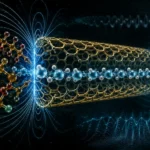
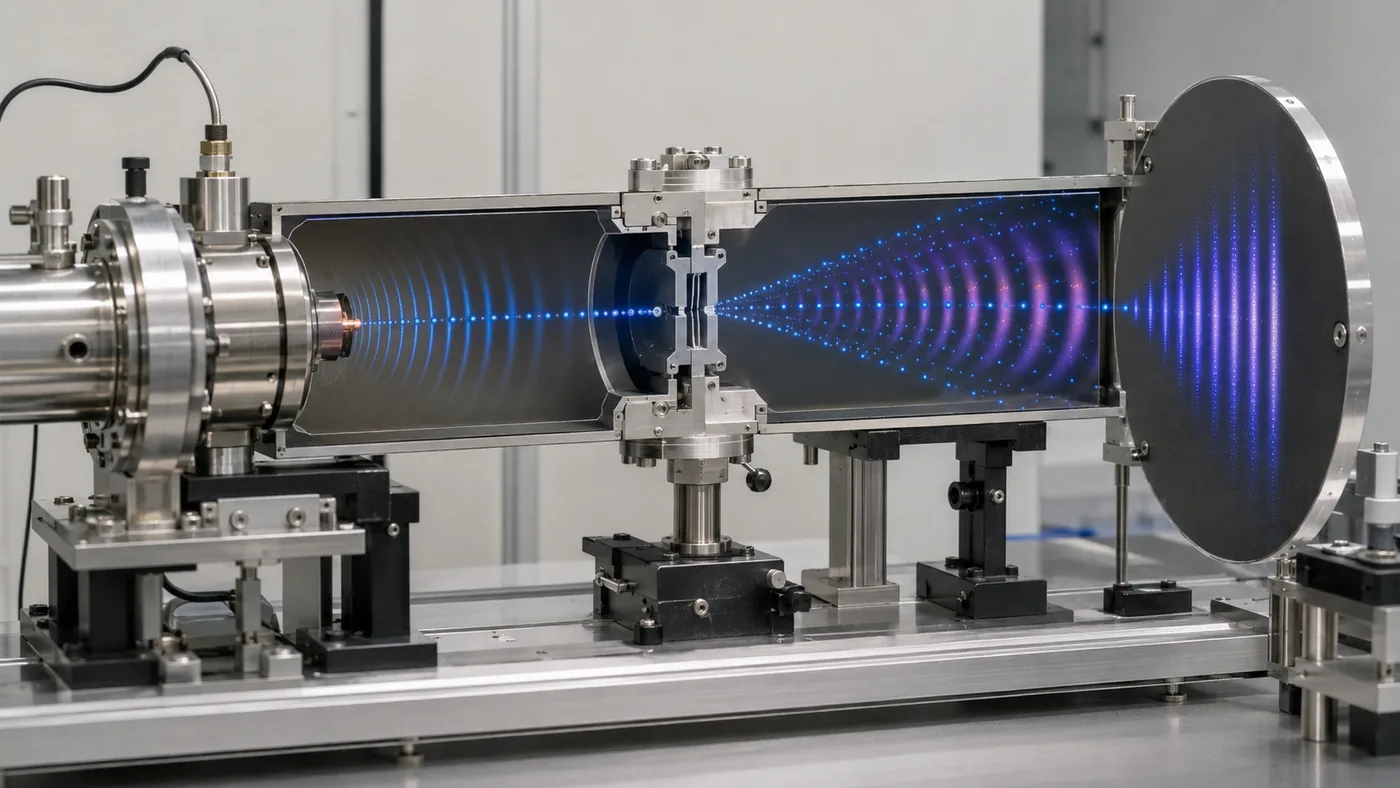
In real systems, the de Broglie wavelength becomes important when it approaches the size of a slit, pore, crystal spacing, or confinement region. Then particles can diffract, interfere, tunnel, or form quantized states instead of following simple classical paths. In quantum transport in confined channels, matching between wavelength and geometry can change how matter moves through narrow spaces.
The concept matters because it marks where classical mechanics gives way to quantum mechanics. Electron microscopes, semiconductor devices, neutron scattering, and cold-atom experiments all use matter waves to probe or control physical material structure at very small scales.
Used in devices include electron microscopes, quantum wells, atom interferometers, tunneling sensors, and nanoscale channels where particle wavelength affects transmission.
Example:
In an electron microscope, short de Broglie wavelengths allow electrons to resolve features much smaller than those visible with ordinary light.
Related Terms:
NoSuchDevice is a free archive of machines that do not exist yet but already have a shadow in physics. I research and write every entry alone, with no ads. Take a look around the archive, or help keep it free.